How to Choose a Forward Deployed Engineering Partner? A Buyer’s Checklist
Selecting a Forward Deployed Engineering Partner is less about finding an impressive team of AI engineers and more about establishing what they can deliver inside your environment, how they will prove it, and what your organization will own afterward.
A vendor may show a polished agent demo, a well-known platform partnership, or an impressive customer logo. None of those tells you whether its engineers can work with your access policies, connect to your systems of record, handle difficult exceptions, or leave a maintainable production system behind.
The practical way to choose a partner is to assess evidence, responsibility, and transferability before comparing price. This guide gives buyers a repeatable FDE vendor selection process: establish deal-breakers, test finalists on a bounded task, connect the test evidence to the statement of work (SOW), and compare the remaining proposals on the same basis.
Key Takeaways
- Evaluate proof, not titles or vendor claims. Ask to see a representative integration plan, negative-case tests, named delivery responsibilities, and handover artifacts—not just architecture slides.
- Separate mandatory controls from preferences. A strong technical proposal cannot offset an unresolved restriction on customer data, unsafe permissions, or ambiguous ownership of the production system.
- Test how the team handles an exception. A small, bounded proof exercise involving a failed API call, conflicting records, or an unauthorized request tells you more than a frictionless demo.
- Trace every important promise into a contract and an acceptance test. A capability is not a committed deliverable until the evidence, owner, scope boundary, and remedy are clear.
- Apply industry-specific diligence. Healthtech buyers need to verify ePHI boundaries, interoperability and clinical or administrative review responsibilities; fintech buyers should check data provenance, access entitlements, auditability and applicable third-party risk requirements.
 BESTARION
More on Forward Deployed Engineering
Practical guides to FDE roles, delivery decisions, security and production-ready AI.
- FDE fundamentalsWhat Is a Forward Deployed Engineer (FDE)? Roles, Skills and Use CasesUnderstand FDE responsibilities, skills and real-world use cases.
- Hiring decisionsWhen Should You Hire a Forward Deployed Engineer? Build vs Buy GuideDecide when embedded engineering makes sense and compare delivery options.
- Costs & planningWhat Does a Forward Deployed Engineer Cost? Pricing & Engagement ModelsCompare cost drivers, engagement models and project quotations.
- Vendor selectionHow to Choose a Forward Deployed Engineering Partner? A Buyer's ChecklistEvaluate delivery evidence, risk, accountability and handover.
- Security & ownershipComing soonHow to Control Forward Deployed Engineering Security? Data, IP Ownership & HandoverControl data access, IP rights and operational handover.
- Performance & ROIComing soonHow to Measure Forward Deployed Engineering ROI? KPIs That MatterConnect deployment KPIs to measurable business value.
- Fintech applicationsComing soonHow to Apply Forward Deployed Engineering in Fintech? AI Use Cases & Deployment GuideExplore KYC, risk and payment workflows from pilot to production.
- Healthtech applicationsComing soonHow to Apply Forward Deployed Engineering in Healthtech? From AI Pilots to Production?Understand EHR integration, clinical safeguards and AI rollout.
Coming soon cards remain non-clickable until published.
First, Know What Kind of FDE Partner You Are Buying
The label forward deployed engineering covers several commercial relationships. A model provider may supply engineers who specialize in its platform. An independent engineering firm may implement across multiple clouds and models. A staffing company may place an individual engineer under your direction. A managed delivery team may take responsibility for a defined workstream or outcome.
These approaches are not interchangeable. OpenAI, for example, explicitly says its FDEs work alongside professional-services partners rather than providing conventional professional services themselves (OpenAI FDE).
Before comparing providers, write down what you need to purchase: a named engineer, technical discovery, hands-on implementation, a managed delivery pod, production stabilization, or a continuing operating service. The answers determine which bidders belong on the shortlist.
People searching “hire forward deployed engineering company” may be seeking an outsourced delivery partner, whereas “hire an FDE” can also mean recruiting a full-time employee. An RFP should remove that ambiguity.
If you have not established whether you need embedded engineering at all, resolve that question before starting a provider competition. Otherwise, you risk assessing vendors for work that standard product configuration or your own team could complete.
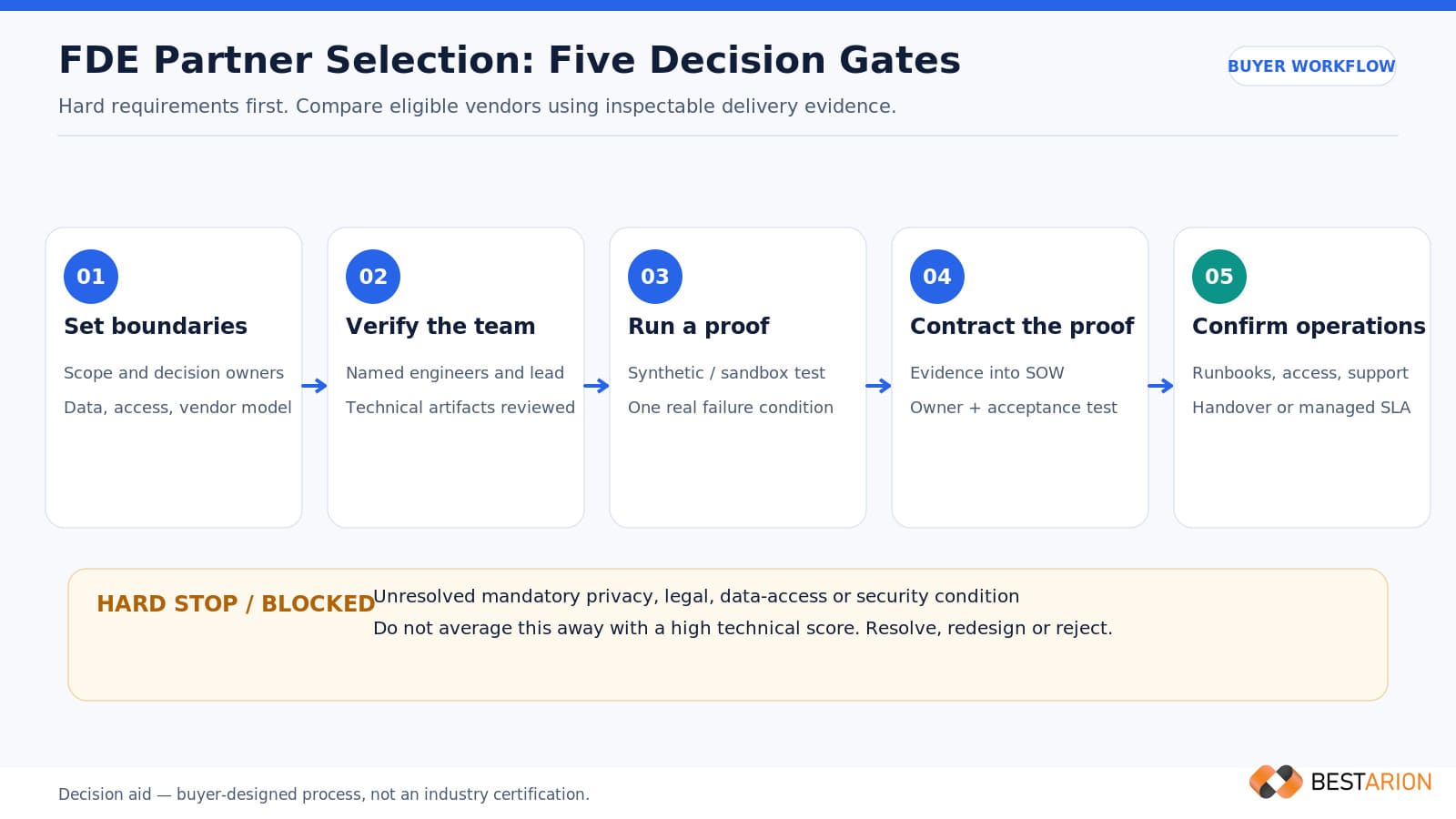
A Five-Gate FDE Vendor Selection Process
Use two different types of decision. Hard gates establish whether a vendor is eligible for the intended work. Comparative criteria help choose between vendors that have passed those gates. Do not conceal a failure of the first type inside a high average score.
Gate 1: Define the work and your non-negotiable boundaries
Write a one-page buyer brief: workflow and intended users, relevant systems, the biggest unresolved constraints, business owner, technical owner, data classification, acceptable deployment environment, initial success measures and intended post-launch owner.
Then specify non-negotiable requirements. Examples may include approved data residency, acceptable subcontractor arrangements, a customer-controlled identity process, required contractual protections for regulated data, or a defined clinical/human-approval boundary. These are project-specific gates, not universal compliance checkboxes.
If a requirement is not yet known, label it unresolved. Do not award points for an assumption.
Gate 2: Verify the actual delivery team and engineering approach
Ask who will work on the account, who leads architecture, who writes and reviews production code, and who can resolve integration issues. Confirm each role’s availability and substitution terms.
Request a short walkthrough of an anonymized integration artifact—such as an API contract, deployment diagram, test strategy, or redacted runbook—with a technical lead present. Ask the team to explain one constraint that changed its implementation approach.
A provider can be capable without sharing confidential customer code. What matters is whether it can show its method of engineering proof, not whether it provides unrestricted access to past clients’ systems.
Gate 3: Run a bounded evidence exercise
Give shortlisted vendors the same small, representative scenario. Use synthetic or properly de-identified data, approved sandbox access, and written rules that prevent the exercise from becoming a production deployment.
The exercise should include at least one difficult condition: an unauthorized user, a stale policy document, a failed upstream API, contradictory data, or an input that should trigger escalation instead of automated action.
Define expected artifacts before the task begins: architecture assumptions, a working thin slice or technically credible prototype, test evidence, a list of unresolved dependencies, and a recommendation to proceed, narrow scope, or stop.
A paid exercise can be appropriate because useful discovery consumes engineering time. Apply identical conditions to finalists, obtain legal approvals and decide in advance who owns the resulting work. Do not expect regulated organizations to expose live patient or financial records merely to evaluate a bidder.
Gate 4: Convert proof into obligations
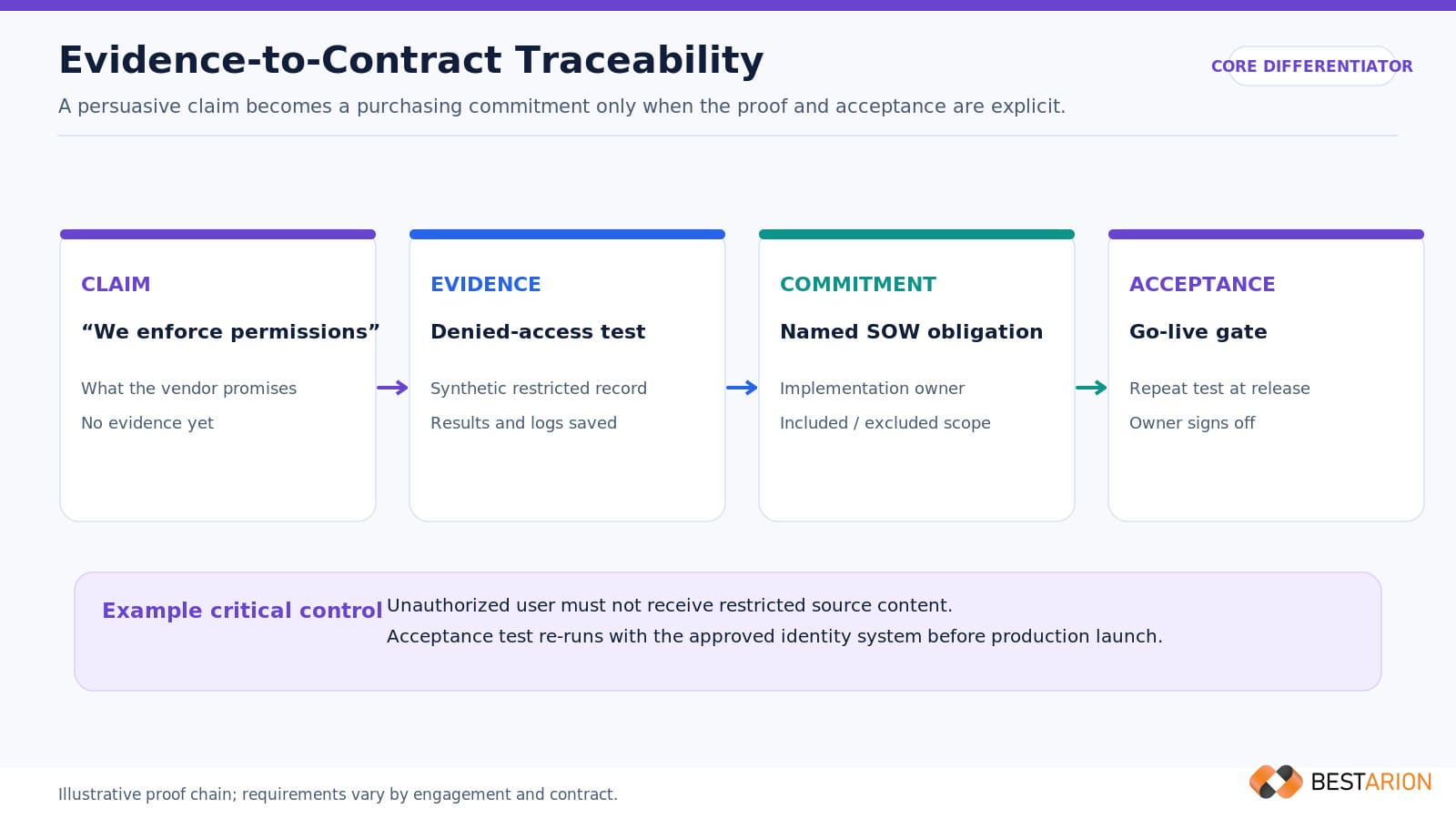
For every critical capability, record four things: vendor claim → observed evidence → contract commitment → acceptance test.
For example, a vendor’s claim that its agent honors user permissions should be supported by a denied-access test, assigned to an identified team, included in the SOW, and tested again before go-live. If any link in the chain is missing, the capability is not fully verified or committed.
This is the central distinction between vendor selection and collecting a list of persuasive answers.
Gate 5: Confirm operations and the exit path
Decide who controls repositories, environments, secrets, infrastructure, model configurations, evaluation datasets, logs, runbooks, incidents, license renewals and data deletion. Separate customer-owned components from vendor-managed assets and licensed platform components.
A useful handover test is whether the future operator can deploy a documented change, interpret a monitoring alert and run a recovery procedure with the FDE team’s support reduced to observation. If the vendor will operate the system long term, specify service levels and portability instead of pretending the customer will become fully independent.
Five-Gate FDE Partner Selection: qualification, technical evidence, bounded exercise, SOW traceability and operating ownership.
What Should an FDE Partner Prove? Six Evaluation Areas
A forward deployed engineering partner should be evaluated across dimensions that reflect the work actually being purchased.
| Evaluation area | Ask for evidence of | Warning sign |
|---|---|---|
| Technical implementation | Integration plan, representative code/review approach, API and failure handling | Only slides, demos or generic tool lists |
| Relevant domain capability | Explanation of real workflows, domain-review involvement and difficult exceptions | Industry logos without domain-specific engineering detail |
| Security and governance | Access architecture, data-flow map, testing, subcontractor controls and responsibility split | “We are compliant” without applicability and scope |
| Evaluation and reliability | Representative test cases, failure paths, versioned evaluations, monitoring proposal | Demonstration success treated as production proof |
| Delivery accountability | Named lead, dependencies, acceptance process, escalation and change control | No accountable decision-maker or undefined customer obligations |
| Maintainability and exit | Runbooks, repositories, support split, portability and handover exercise | The solution requires undocumented vendor knowledge |
A large bench, certifications and published case studies may provide supporting information. They do not replace proof of performance against your specific constraints.
How to judge domain experience without overvaluing industry logos
Ask a candidate to describe the control boundary that would change how it designs your system. In healthcare, that may be a review step before a note becomes part of an EHR. In finance, it may be a source-version conflict in approved legal guidance or a restricted account record.
This is more informative than asking whether the company has “healthcare experience” or “fintech experience” and accepting a logo slide as an answer.
What a good technical reference should demonstrate
Where permitted, seek a reference who can describe the implementation after handover: what went wrong, which team fixed it, what was excluded, and whether the system remains maintainable. Under NDA, ask for anonymized artifacts or a controlled technical reference conversation instead of demanding confidential records.
A Vendor Scorecard That Does Not Hide Critical Risk
Create a comparison only after applying hard eligibility gates. A useful scoring system can remain simple:
- 0 — Not evidenced: claim missing or cannot be assessed.
- 1 — Described: plausible answer, but little inspectable evidence.
- 2 — Demonstrated: relevant artifact or bounded test supports the claim.
- 3 — Contract-ready: verified approach is tied to named ownership, acceptance and support terms.
Score technical implementation, domain capability, validation, delivery accountability, handover and commercial transparency independently. You may add weights based on your procurement priorities, but these scores and weights are a practical editorial tool, not an industry-validated FDE certification or predictive statistical model.
An unresolved hard gate should have a status of BLOCKED, not a numeric penalty that a vendor can overcome by scoring well elsewhere.
| Criterion | Vendor A | Vendor B | Evidence reference / open question |
|---|---|---|---|
| Required data and security arrangements | Pass / Blocked / Pending | Pass / Blocked / Pending | Legal and security owner to verify |
| Technical implementation (0–3) | — | — | Integration exercise and API failure case |
| Domain workflow fit (0–3) | — | — | Operator review and exception explanation |
| Evaluation and monitoring (0–3) | — | — | Test artifacts and observability plan |
| Delivery accountability (0–3) | — | — | Named lead, dependencies and acceptance |
| Maintainability and handover (0–3) | — | — | Operator-led handover exercise |
| Comparable commercial proposal (0–3) | — | — | Normalized SOW and operating horizon |
Do not pick a winner from a scorecard with missing evidence. Record the missing item, the person responsible for resolving it and the decision date.
Evidence-to-Contract Traceability: see how claims become tests, obligations and acceptance criteria.
Healthtech Use Case: Evaluating a Partner for Prior Authorization Support
The following is a hypothetical procurement exercise, not a report of a particular hospital’s FDE engagement.
A healthtech company wants a system that gathers relevant documentation for prior authorization review, presents source-linked evidence and flags incomplete records for authorized staff. It does not want an AI model making unsupported clinical or coverage determinations.
The bounded test
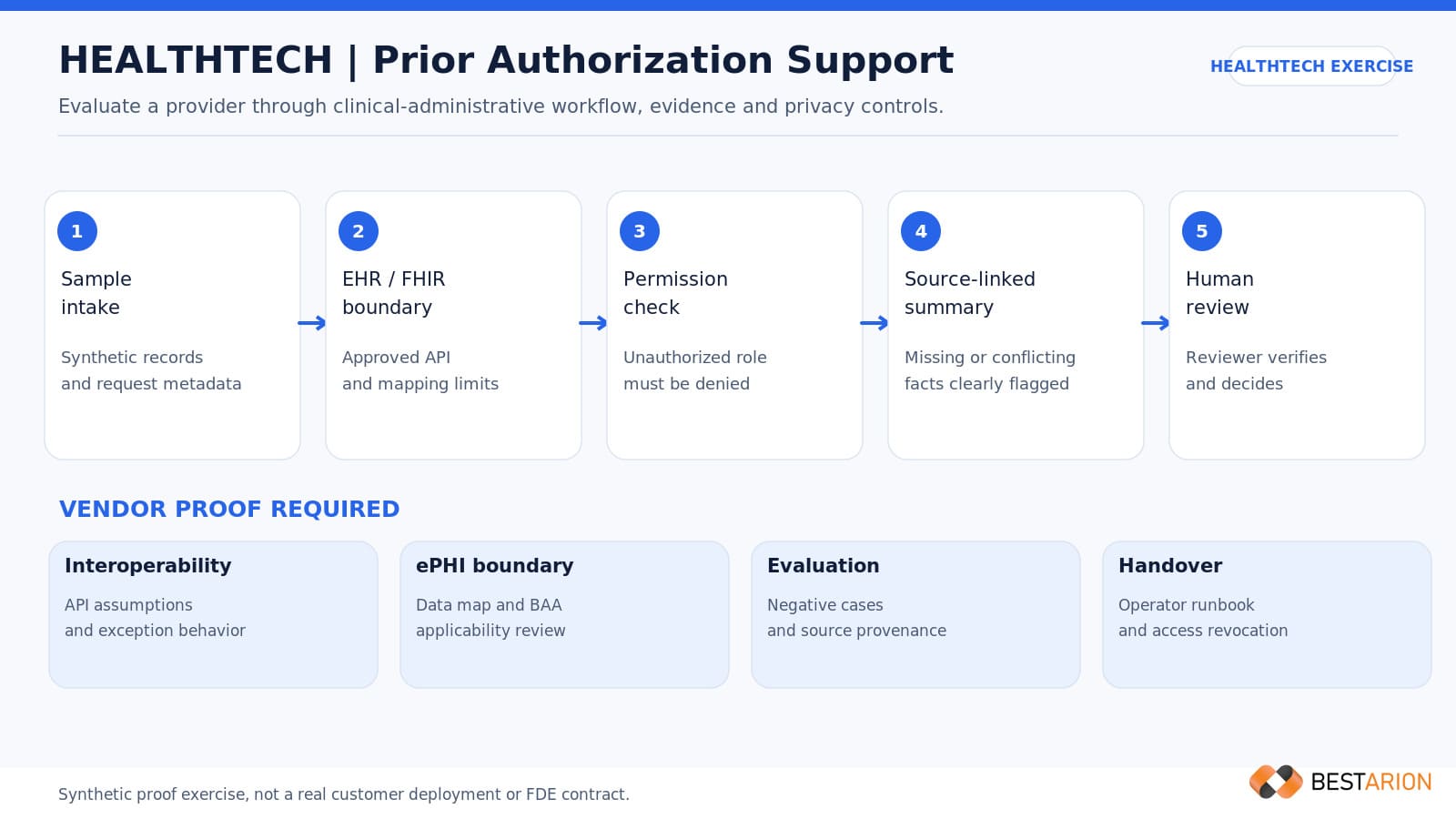
Give each vendor a synthetic record set containing incomplete information, conflicting document versions and a user role without access to some records. Ask it to demonstrate the proposed integration boundary, provenance of retrieved evidence and escalation path.
| Buyer question | Evidence to request | Acceptance boundary |
|---|---|---|
| Can the application connect to existing healthcare systems? | Documented interface assumptions and sample FHIR/API mapping where relevant | Unsupported interfaces are named as dependencies |
| Will unauthorized requests be blocked? | Access test with an intentionally restricted synthetic record | No restricted data returned to unauthorized role |
| Can reviewers verify the output? | Source-linked summary and version information | Unverifiable content is flagged, not presented as fact |
| How are missing records handled? | Exception path and staff review view | No silent approval or invented information |
| Can the healthtech team maintain it? | Runbook, monitoring examples and handover exercise | Named operator can perform agreed maintenance task |
The HIPAA analysis must be specific to the parties and data flows. HHS explains that cloud providers acting on behalf of a covered entity or business associate with access to ePHI may themselves be business associates and require appropriate agreements. Whether an FDE provider or subcontractor is a business associate depends on its actual functions and access, not on marketing language (HHS guidance). Certified EHR API requirements are separately addressed by ONC Health IT.
Healthtech Vendor Proof Exercise: workflow, control checkpoints and artifacts to verify.
Real-world context: HCA Healthcare, Google Cloud and Augmedix
HCA Healthcare and Google Cloud announced a collaboration in 2023 involving Augmedix to support clinical documentation. The published description says physician-reviewed notes were transferred to the EHR and that HCA’s clinical innovation team worked with its technology partners to refine the process (Google Cloud press release).
This is not evidence that HCA purchased an FDE service. It is a documented example of why healthcare buyers should examine clinician review, EHR interoperability, workflow fit and responsibilities across multiple organizations. The release does not provide an FDE scorecard, contract terms, or comparable vendor evaluation results.
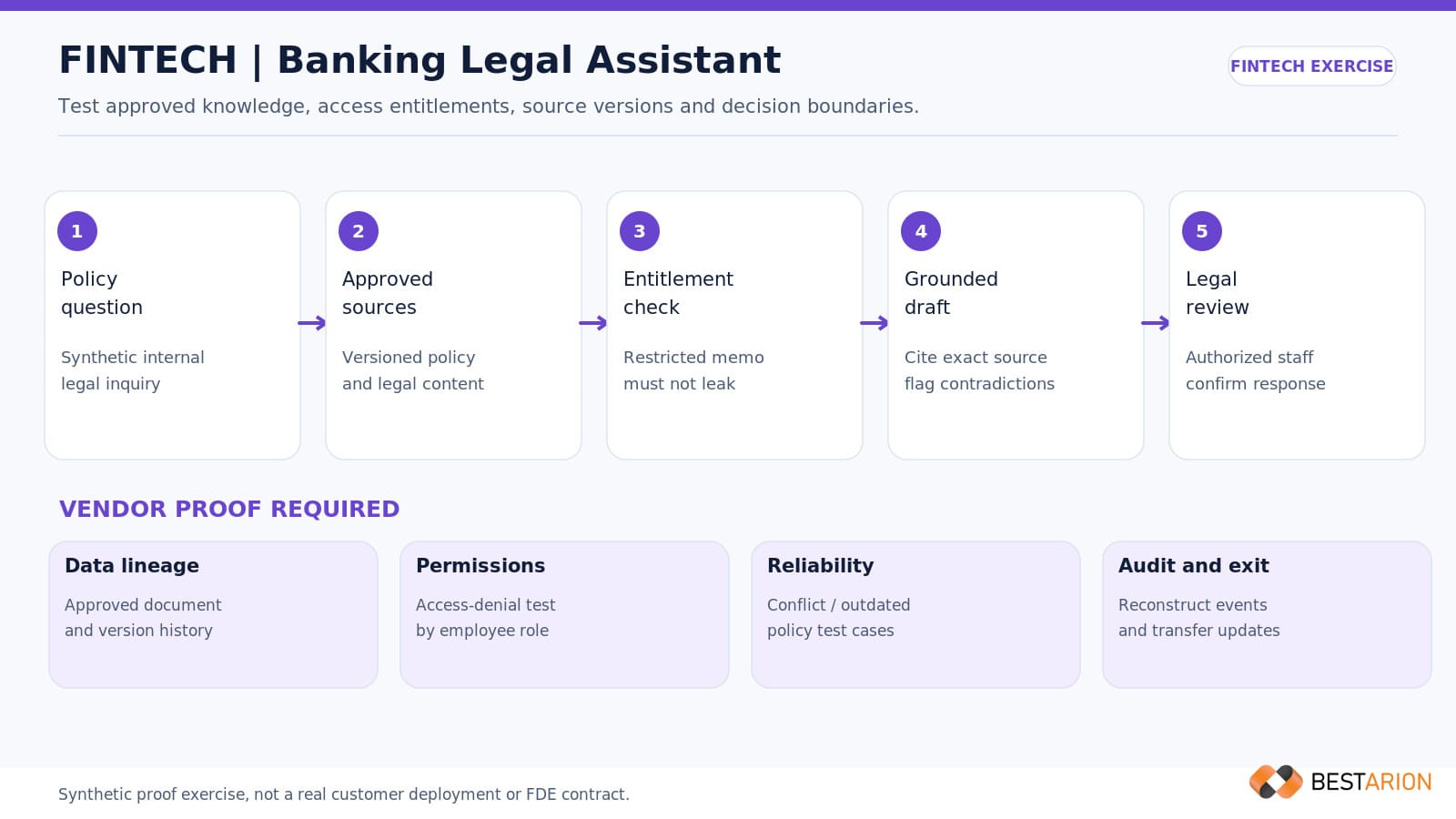
Fintech Use Case: Evaluating a Partner for an Internal Legal Knowledge Assistant
The following is a hypothetical procurement exercise, not a report of BBVA’s FDE selection process.
A bank wants an internal assistant that helps staff find approved legal and policy guidance. Different entities may have different rules; policies change; some questions require legal review. The assistant should retrieve relevant, authorized material and identify uncertainty rather than issue binding legal decisions.
The bounded test
Provide synthetic policy documents containing an outdated version, a jurisdiction-specific exception and one access-restricted memorandum. Ask the vendor to demonstrate version selection, source citations, access enforcement and escalation when documents conflict.
| Buyer question | Evidence to request | Acceptance boundary |
|---|---|---|
| Can answers be traced to approved guidance? | Citations, document versions, provenance log | Material claims point to authorized source versions |
| What happens when policies disagree? | Conflict test and escalation path | Assistant flags conflict rather than inventing a resolution |
| Can restricted records leak across user roles? | Permission-denial tests | No unauthorized retrieval or output |
| Is user action auditable? | Logging and access design | Defined events can be reconstructed by approved reviewers |
| Who owns updates when policy changes? | Content-owner RACI and freshness process | Named owner approves and publishes revised sources |
For US banking organizations, the federal banking agencies’ joint third-party risk guidance describes lifecycle considerations including planning, due diligence, contracting, monitoring and termination. Its applicability should be evaluated by the institution and its advisers (OCC, 2023).
Fintech Vendor Proof Exercise: approved knowledge, entitlements, grounded response, human review and audit.
Real-world context: BBVA and OpenAI
OpenAI’s June 2026 BBVA case study describes enterprise-wide banking AI, including legal, risk and operations workflows, and emphasizes collaboration among bank domain experts, security, legal, compliance and technology teams (BBVA case study).
This provides context for why a banking AI partner must demonstrate governance and operational adoption. It does not reveal a competitive FDE procurement, a partner evaluation score, or the terms of an FDE contract. Do not interpret those unknowns as verified facts.
Security, Ownership and Commercial Terms to Put in Writing
A technically impressive supplier can still be a poor fit if contract boundaries remain vague.
Security and data use. Identify which party processes each category of data, who approves access, whether subcontractors or model providers receive information, where logs and backups are held, and what happens when access is revoked. Ask for evidence that reflects the specific system, not generic marketing statements.
IP, reusable components and platform dependencies. List what the customer owns, what remains licensed from the vendor or third parties, and whether the solution can be exported. A customer-owned repository does not by itself eliminate external licenses or proprietary runtime dependencies.
Definition of done. Define production conditions, representative acceptance tests, known exclusions, data dependencies, defect remedies and who authorizes release. Avoid a contract in which the vendor can declare success solely because a demo works.
Commercial clarity. Compare provider fees plus customer-side work, security review, third-party systems, cloud/model usage, stabilization and operating costs over a common horizon. The cheapest day rate is not necessarily the lowest cost for an accepted implementation. For a detailed method, see the companion Forward Deployed Engineer Pricing guide.
Exit and continuity. Specify code/data return, access removal, deletion where required, documentation, transition assistance, service-level changes and operational ownership after the engagement. Requirements vary between a customer-owned build and a vendor-managed platform.
A Practical RFP Checklist: Questions to Send Every Finalist
Use the same questions and evidence expectations for every shortlisted provider. Request links to artifacts or controlled walkthroughs rather than relying only on verbal answers.
- Which exact named roles will perform discovery, engineering, security coordination, evaluation, deployment and handover?
- What are the top three dependencies or unknowns you see in our workflow, and how would you validate them?
- Can you demonstrate an access-denial case and a failed or contradictory upstream-data case?
- Which environments, repositories, secrets, logs, models, subprocessors and tools will you access or operate?
- What written tests and acceptance criteria will decide whether the solution can go live?
- Which artifacts, third-party licenses and runbooks will we receive, and what remains vendor-managed?
- Which costs and responsibilities are excluded from your fee, and what triggers a change request?
- Who will handle an incident and a routine change after launch, and what evidence proves handover readiness?
When Should You Reject, Pause or Narrow an FDE Proposal?
A useful FDE provider evaluation can conclude that no bidder should proceed yet.
Reject or block a provider that cannot satisfy a necessary legal, security, access or ownership condition for the proposed deployment, unless an approved alternative architecture resolves it.
Pause when the buyer has not confirmed data access, available business reviewers, authoritative sources or meaningful acceptance criteria. More engineer-days will not automatically fix those prerequisites.
Narrow the scope when an ambitious AI agent fails the negative-case exercise but a source-grounded assistant with human approval is viable. A vendor that can recommend a smaller, more defensible implementation may be making the better engineering decision.
The best FDE companies for a given project are not necessarily the largest or most prominent. They are the ones that can show credible evidence for the relevant work, accept appropriate contractual accountability and leave a supportable system behind.
Frequently Asked Questions
How do I choose a forward deployed engineering partner?
Define the deployment job and non-negotiable constraints, verify the actual delivery team, run a bounded test with representative failure conditions, require evidence-to-contract traceability, and confirm post-launch ownership. Compare commercial offers only after the critical gates are cleared.
What is the difference between an FDE partner and staff augmentation?
Staff augmentation primarily supplies capacity under customer direction. An FDE engagement may involve shared discovery, hands-on integration and specific deployment responsibilities, but the real difference depends on the contract and operating model—not the label.
What should an FDE vendor selection scorecard include?
Technical delivery evidence, domain fit, security and permissions, evaluation and monitoring, named accountability, maintainability and commercial transparency. Keep mandatory legal or security conditions as independent pass/block gates rather than averaging them into an overall score.
Should I pick a platform vendor’s FDE or an independent provider?
A platform FDE may be valuable when the deployment depends heavily on that platform’s technology and roadmap. An independent team may suit a multi-vendor architecture or customer-owned build. Ask which components are proprietary, who supports surrounding integrations, and what can be transferred.
Do I need to give potential partners production data during evaluation?
Usually not. Start with synthetic or appropriately de-identified samples and approved sandbox conditions. Any access to live regulated data must follow the organization’s legal, security, privacy and third-party risk processes.
What is the single most useful proof before signing?
A small test that reproduces a real integration constraint or failure mode, with inspectable results and named ownership. It should be accompanied by explicit acceptance criteria and a clear explanation of what the test does not prove.
Conclusion: Choose the Partner Whose Claims You Can Test
A credible FDE partner should make uncertainty easier to see, not hide it behind polished demonstrations. Buyers can reduce selection risk by verifying how the team works with their systems, how it handles exceptions, what it will contractually deliver, and who owns the result afterward.
Start with the scope and hard gates. Test the finalists on the same bounded problem. Then turn their evidence into an SOW with explicit acceptance and handover conditions.
References and Further Reading
- OpenAI — Forward Deployed Engineering
- NIST — Generative AI Risk Management Profile
- HHS — HIPAA and Cloud Computing
- ONC Health IT — API Conditions of Certification
- OCC/Federal Banking Agencies — Interagency Third-Party Risk Management Guidance (2023)
- Google Cloud — HCA Healthcare and Augmedix Collaboration (2023)
- OpenAI — BBVA Banking AI Case Study (2026)