When Should You Hire a Forward Deployed Engineer? Build vs Buy Guide
The right time for Forward Deployed Engineer hiring is when a valuable software or AI initiative needs hands-on engineering inside a specific business environment—and the people who can turn it into a reliable system are missing, overloaded, or too far from the workflow.
That does not automatically mean opening a permanent role. Sometimes you need an in-house engineer. Sometimes an external FDE team can help resolve an integration problem and transfer the capability back to your staff. And sometimes you need neither: a standard SaaS product, a scoped development project, or a short discovery sprint may do the job.
To decide when to hire a forward deployed engineer, separate two questions: Do we need forward deployed engineering? And how should we source and own that capability? This guide addresses both, without assuming an FDE is always the answer.
Key Takeaways
- Hire an FDE when implementation uncertainty is the main obstacle. A promising prototype, unclear workflow rules, difficult integrations, and no accountable deployment owner are stronger signals than project size alone.
- Do not hire one merely because the project uses AI. Standard configuration, well-specified builds, and gaps in ordinary development capacity often have simpler solutions.
- In-house vs external is an ownership decision, not only a cost comparison. Consider who must retain the architecture, source code, evaluations, operational knowledge, and long-term responsibilities.
- One FDE is not a substitute for a whole delivery team. If the work requires parallel data, application, security, evaluation, and operations capabilities, design a pod or hybrid team with a named lead.
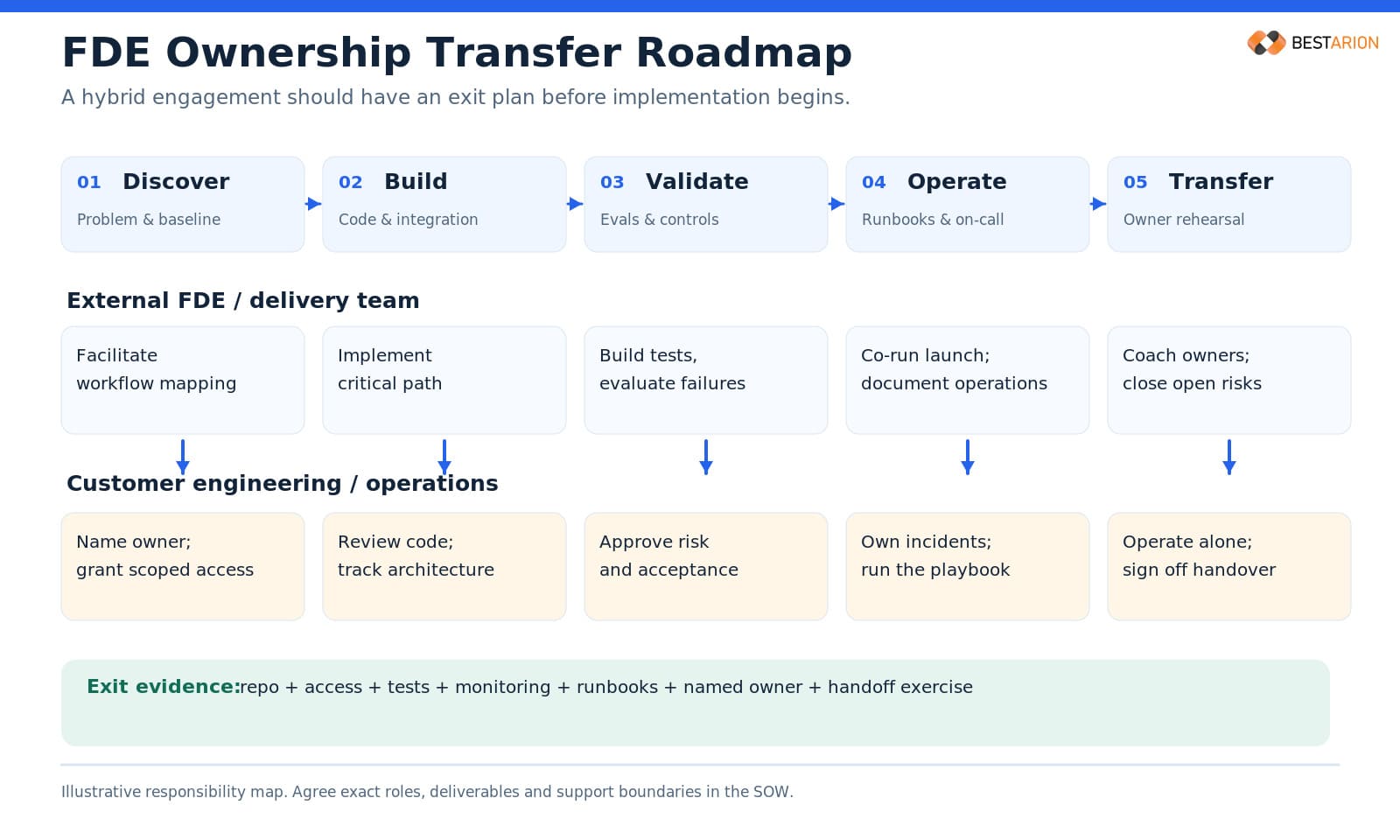
- The exit plan matters before kickoff. An external engagement should make it clear who will run, change, and secure the system after the embedded engineers leave.
When Should You Hire a Forward Deployed Engineer?
Consider a company that has built an internal AI assistant. In a demo, it retrieves the correct document and drafts a useful response. In production, it must respect each employee’s access rights, recognize outdated records, use several systems of record, and route sensitive actions to a human. No one owns the work across all those boundaries.
This is a plausible FDE problem. The obstacle is not an absence of code. It is the gap between a technical capability and a usable, supported workflow.
The strongest hiring signals tend to appear together.
Your prototype works, but nobody owns production integration
A demonstration can prove that an approach is possible without establishing that it is deployable. Someone still needs to handle authentication, data permissions, operational exceptions, monitoring, testing, and release procedures. An FDE is useful when a senior engineer must make those decisions alongside the customer’s technical and business teams.
First ask whether an existing engineering lead could own the deployment with additional specialist support. If so, adding a standalone FDE role may create overlap rather than solve it.
Requirements emerge only when engineers observe the workflow
Sometimes the business team can specify the outcome but not the implementation. The current process may depend on undocumented exceptions, conflicting records, and approval rules that operators apply from experience.
When learning what to build and building it must happen together, an embedded engineer can close the feedback loop. A conventional specification-driven project may be harder to manage until those unknowns are resolved.
Integration complexity outweighs the new feature itself
An AI model or software component may be straightforward. Connecting it to identity systems, old databases, customer portals, and audit logs may not be. Here, the integration boundary—not the model—is the real engineering problem.
FDEs can be valuable in that setting, but a well-equipped internal platform team or systems integrator can also be the right answer. The job title is secondary to the work and the delivery owner.
The project needs a technical owner who can challenge the initial request
Suppose a customer asks for an autonomous agent to approve cases. Discovery shows that policy requires human review and that the available records are incomplete. A strong FDE should be able to recommend a narrower, auditable assistant instead of implementing the original request literally.
That judgment is especially useful when the requirements cannot be safely fixed in advance.
There is a credible path from a bounded project to ongoing capability
A short embedded engagement can help establish the first production workflow while an internal team learns how to extend it. This only works if knowledge transfer is planned, not added at the end as a documentation task.
When You Do Not Need an FDE
Knowing when not to hire can prevent expensive mismatches.
A standard product already solves the workflow. If existing software meets the need with configuration and training, buying or extending that product can avoid custom code and maintenance work.
You have not chosen a meaningful problem. If the organization cannot identify a workflow owner, the desired outcome, or a way to assess success, start with targeted discovery. An embedded engineer cannot substitute for business accountability.
The scope is well defined and ordinary. A batch data transformation, a straightforward API change, or a conventional application feature may be more efficiently delivered by an existing team or a scoped engineering provider.
You need capacity, not discovery. If your architecture and requirements are sound and the backlog is the only constraint, consider staff augmentation or adding engineering capacity rather than creating a new embedded delivery function.
No one can grant appropriate access or make decisions. An FDE cannot responsibly deliver a production integration without a customer-side sponsor, access approvals, relevant domain experts, and clear authority to resolve blockers. Fix readiness before expanding delivery capacity.
The practical alternative is not always “hire an FDE later.” It may be to improve the product, simplify the workflow, fix the data, appoint an owner, or reduce the project scope.
Build vs Buy FDE Capability: In-House, External or Hybrid?
The phrase build vs buy FDE can be misleading. You are deciding how to obtain and retain the engineering capability, not simply whether to purchase a product. Moreover, a platform vendor’s FDE, a hired employee, a staff-augmentation contractor, and a managed delivery pod come with different rights and obligations.
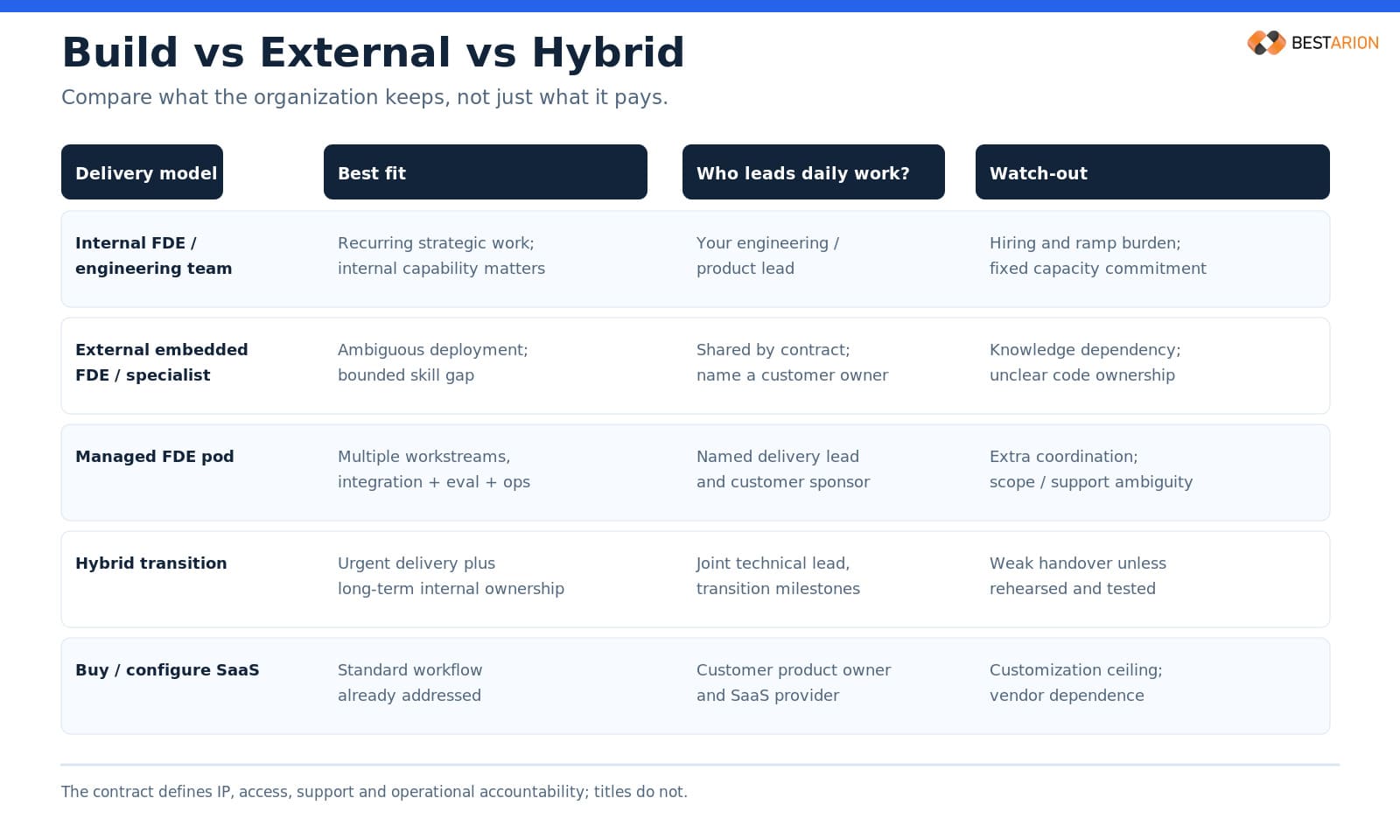
For most enterprise buyers, compare these choices.
| Model | Usually a good fit when | What the company must own | Principal trade-off |
|---|---|---|---|
| In-house FDE or engineering team | Similar deployments recur, expertise is strategic, and internal ownership is permanent | Hiring, roadmap, operations, skill development | Retains learning but commits to ongoing recruitment and management |
| External embedded FDE | A consequential deployment has unclear requirements or specialized integration work | Business outcome, access approvals, acceptance and future owner | Specialist depth, but dependency if knowledge stays outside |
| Managed FDE pod | Several engineering disciplines must deliver together | Product decisions, domain expertise, governance and vendor accountability | Coordinated delivery, but wider commercial and operational boundaries |
| Hybrid: external to internal | Delivery is urgent but long-term capability belongs inside | Joint design decisions and scheduled ownership transfer | Can combine delivery with learning; needs deliberate handover |
| Standard SaaS / scoped development | Workflow is routine or requirements are already stable | Product selection, integration boundaries and operations | Less custom discovery; may limit flexibility |
FDE vs in-house team: what actually changes?
An internal team can accumulate customer-specific context over time. It can also own sensitive architectural decisions, ongoing changes, and operational support. But that capability takes management attention and sustained work to develop.
An external team can bring experience in a particular integration or implementation pattern. That expertise is useful when the problem is urgent or bounded. It does not automatically provide faster delivery, and it does not remove the customer’s responsibility for risk decisions and long-term operations.
The question is therefore not whether external talent is technically better. It is whether the organization can retain the decisions and capabilities that will matter after the initial deployment.
What is different about a vendor’s FDE?
A platform provider may offer engineers who know its products exceptionally well and can collaborate with its Product or Research teams. This can be valuable for problems tied closely to that platform.
But vendor FDEs may have different service boundaries from a general engineering partner. For example, OpenAI says its FDEs work alongside professional services partners and do not themselves provide conventional professional services. The customer should confirm who builds surrounding integrations, who supports them, and what happens if the architecture needs to span several vendors.
Does “buy” mean outsource the outcome?
Not necessarily. A request to hire FDE specialists may refer to staff augmentation—where the customer directs the engineer—or a managed engagement where the provider supplies a delivery lead and accepts contracted obligations. The exact relationship must be written down.
To avoid confusion, describe who directs the work, who makes architecture decisions, who owns code and data, and who is accountable when the system fails.
One FDE or an Engineering Pod?
A single senior engineer can be effective when the problem is narrow, the customer already provides supporting engineering capabilities, and the FDE has a clear technical counterpart.
For example, one embedded engineer could resolve a difficult integration with an internal team that already owns infrastructure, testing, release processes, and operations.
An engineering pod may be more appropriate when the engagement needs several parallel capabilities: data pipelines, backend services, AI evaluation, frontend integration, security reviews, and operational enablement. No credible plan should make one engineer personally responsible for every specialty at enterprise scale.
| Ask this before deciding | One embedded FDE is more plausible | A pod or hybrid team is more plausible |
|---|---|---|
| How many dependent workstreams exist? | One critical integration or application path | Several dependent systems and workstreams |
| What support exists internally? | Engineering, security, QA and operations owners are available | Important delivery capabilities are missing |
| Who coordinates technical decisions? | Named internal lead can coordinate | Provider and customer need a formal joint delivery structure |
| What must happen after launch? | Internal team can operate it | Significant training, stabilization or transition is required |
Do not choose the staffing model before mapping these dependencies. Otherwise, “one FDE” can become an under-resourced project disguised as a role.
A Practical Forward Deployed Engineer Hiring Decision Framework
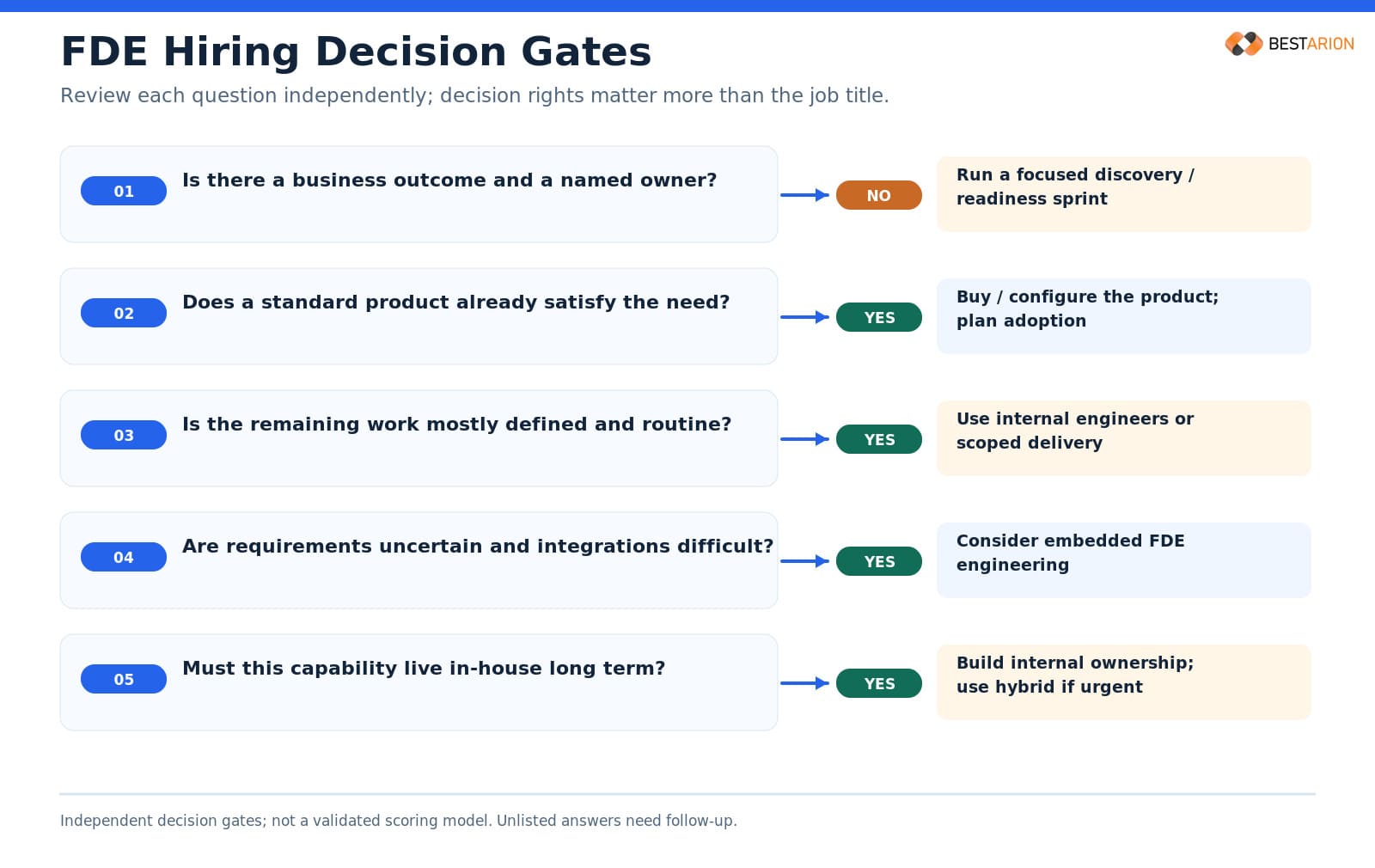
Rather than assigning an arbitrary score to your company, walk through five decision gates in order. Each asks for evidence that can change the sourcing decision.
Gate 1: Is there a real outcome and an accountable owner?
Write down the workflow, its current problem, the person who can make trade-offs, and the baseline against which improvement will be assessed. If these are absent, commission a short discovery exercise—not a full deployment.
Gate 2: Can you meet the need with a standard product?
Examine configuration, API and workflow capabilities before committing to custom engineering. Buying an existing product may be enough. Where restrictions, exceptions or interoperability requirements remain, define those gaps rather than claiming the entire workflow needs a custom build.
Gate 3: Is the work predictable or exploratory?
If scope, interfaces and acceptance criteria are stable, use normal delivery capacity. If core requirements can only be learned through building and working with operators, embedded engineering becomes more relevant.
Gate 4: Who has the technical capability and the decision rights?
List the actual people who can own architecture, system access, security approvals, evaluation, release, incidents and product decisions. If the skills exist but are unavailable, capacity may be the problem. If nobody can own the cross-system implementation, an FDE or managed pod may fill a real gap.
Gate 5: Who must own the capability after deployment?
If the company will operate and evolve the system continuously, internal ownership must be established early, whether the initial delivery is in-house or external. If the need is temporary and bounded, an external engagement can be appropriate—but agree on exit criteria.
These gates are a decision aid, not a validated scoring instrument. A single hard blocker, such as unresolved security permissions, may matter more than several favorable signals.
Example: Moving a Fintech AI Pilot into Production
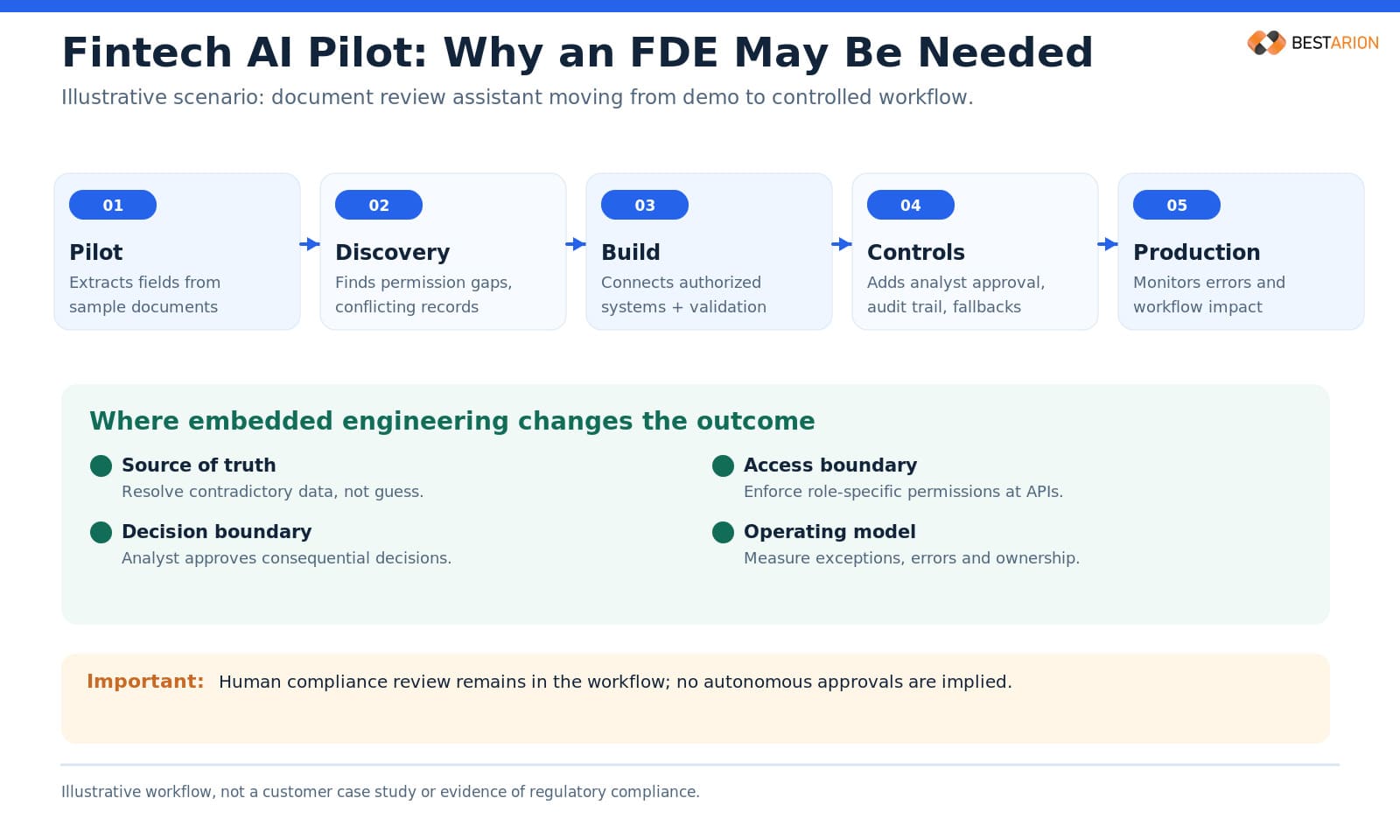
The following is a hypothetical scenario, not a published customer case study.
A fintech company has a prototype that extracts information from customer onboarding documents. Its engineering team can call the model and display results in a user interface. The prototype appears ready for wider use.
Then the team tests it against the actual onboarding process. Some records disagree across systems. Analyst permissions differ by customer and geography. Sensitive cases require manual approval. Errors need to be traceable to the source document.
The buyer’s first question might be “Should we hire a forward deployed engineer?” The more productive question is “Who can own the work between prototype and controlled production?”
An embedded FDE could collaborate with compliance analysts and internal engineers to define source-of-truth rules, enforce authorization through APIs, implement exception handling, establish evaluation scenarios, and prepare a production rollout. The FDE should not independently decide compliance policy.
One reasonable model: use an external FDE for the integration and evaluation bottleneck while the internal engineering lead retains architectural approval and operational ownership. Bring in a managed pod if security, data engineering and application development need substantial parallel work. If the existing team can perform all of this reliably, an external FDE may add little value.
The appropriate result is a controlled workflow that analysts can operate and support—not a claim that AI has replaced compliance judgment.
How to Avoid Dependency on an External FDE Team
An external engagement is incomplete if the system only works while the provider’s engineer is present.
Set a few non-negotiable boundaries before kickoff.
Code and artifacts. Decide where repositories, infrastructure configuration, evaluation datasets, tests, API contracts and architecture decisions will live. Clarify intellectual property and licenses contractually.
Security and access. Grant least-privilege access through approved processes. Define who provisions, reviews and revokes access, and who handles incidents.
Acceptance. Agree on technical and workflow criteria, including difficult scenarios and known limitations. A working demo is not sufficient evidence of readiness.
Operations. Name the person or team responsible for monitoring, on-call response, vendor dependencies, updates and recovery procedures. AWS’s operational-readiness guidance recommends runbooks, support plans and explicit review before production changes.
Transfer. Ask the future owner to deploy, troubleshoot and operate the system without the provider doing the work for them. A handover presentation is weaker evidence than a successful handover exercise.
The exact boundary depends on whether the provider remains responsible for managed operations. The objective is not always to eliminate a vendor relationship; it is to make the dependency deliberate, documented, and governable.
FDE Hiring Readiness Checklist
Before you hire FDE specialists in-house or engage an external team, answer these questions in writing:
- What workflow or customer outcome needs to change?
- Who is the executive sponsor and who is the day-to-day product or technical owner?
- Which parts are already solved by an existing product or team?
- What is genuinely unknown: workflow, integration, data, evaluation, or deployment?
- Which data and systems will the engineer need, and who can authorize access?
- What technical and operational acceptance criteria will govern launch?
- Which capabilities must remain within the organization afterward?
- Who maintains the system and handles incidents after go-live?
- What would make the engagement unnecessary or unsuccessful?
- Could a smaller discovery sprint resolve the key uncertainty first?
If your answers are incomplete, that is useful information. It may indicate that a readiness or discovery phase should precede an FDE hire.
Frequently Asked Questions
When should a startup hire a Forward Deployed Engineer?
A startup may benefit from an FDE when a consequential customer deployment needs complex, customer-specific integration and cannot be delivered by its existing product engineering team. If embedded implementation is becoming a repeatable core part of the product, an in-house FDE function may be worth considering. If the problem is short-lived, external help may be more proportionate.
Should I hire an in-house FDE or partner with an external FDE team?
Build internally when the capability is strategically important, recurring, and requires ongoing ownership. Consider an external FDE team when a bounded deployment needs expertise or engineering capacity that is not readily available. Hybrid delivery can work when you need both immediate progress and a long-term internal owner.
Is an external FDE cheaper than hiring full-time?
Not necessarily. Compare full lifecycle cost, not a monthly rate against salary alone. Account for recruiting and onboarding, internal management, vendor fees, security review, cloud and model usage, maintenance, transition work, and the cost of delay. The cheaper option depends on workload duration and the responsibilities included.
Can one FDE take an enterprise AI project to production?
Sometimes, if the work is focused and the customer already provides security, infrastructure, testing and operational support. Larger, interdependent deployments often require several people with distinct capabilities and a named delivery lead.
What should I ask before signing an FDE engagement?
Ask who owns architecture and code, how access is controlled, how changes to scope are handled, what acceptance criteria apply, who handles production incidents, and how ownership transfers when the engagement ends.
Final Recommendation
When to hire a forward deployed engineer is a question about unresolved engineering work and long-term accountability—not about whether FDEs are fashionable or whether a prototype uses AI.
Start by identifying the deployment constraint. If the missing ingredient is senior, embedded engineering judgment across customer workflows and systems, FDE may be the right approach. Then decide whether the capability should be internal, externally supplied, or developed through a hybrid engagement.
The strongest decision leaves the organization with a production system it can operate—and a clear understanding of who owns what comes next.
Sources and Further Reading
- OpenAI — Forward Deployed Engineering
- OpenAI — Forward Deployed Engineer Role
- Databricks — Forward Deployed Engineering: Delivering Business Outcomes with AI
- California Management Review — AI Reinvention Series: Build, Buy or Rent?
- NIST — AI Risk Management Framework Core
- AWS Well-Architected — Operational Readiness and Change Management