What Is a Forward Deployed Engineer (FDE)? Roles, Skills and Use Cases
A Forward Deployed Engineer (FDE) is an engineer who works directly with customers to build, integrate, and deploy software in their own technical environments. FDEs combine software engineering with a hands-on understanding of the customer’s business problems, often taking responsibility for getting complex solutions into production.
Consider a company that wants to use AI to review customer onboarding documents. The model can extract information from a sample document, and the initial demonstration looks promising. But once the team connects it to live systems, problems emerge. Some records are restricted, different databases contain conflicting information, and certain decisions require human approval.
Making that application useful takes more than a capable AI model. Someone needs to understand the workflow, resolve integration issues, build the application, and test it against real operating conditions.
That’s the kind of work a Forward Deployed Engineer is hired to do.
The role has attracted attention as companies such as Palantir, OpenAI, Anthropic, and Databricks expand their enterprise AI deployments. Yet FDE is neither an entirely new engineering discipline nor a universally defined job title. Understanding what the role involves, and where it overlaps with existing engineering and consulting practices, is important for anyone evaluating the model.
Key Takeaways
- A Forward Deployed Engineer bridges software engineering and customer-specific implementation. FDEs work closely with customer teams to turn technical capabilities into functioning applications and workflows.
- FDE responsibilities extend beyond writing code. Depending on the engagement, they can include problem discovery, architecture, integration, testing, production rollout, and feedback to product teams.
- FDEs are not interchangeable with every Software Engineer or Solutions Engineer. The most useful distinction is the work they own, their proximity to customer operations, and their responsibility for implementation outcomes.
- Enterprise AI is a major application of forward deployed engineering, but not its only one. The model also applies to data platforms, system integration, custom applications, and complex enterprise software.
- Not every project needs an FDE. The approach is most relevant when the solution involves uncertain requirements, complex integrations, and substantial engineering work in the customer’s environment.
What Is Forward Deployed Engineering?
Forward deployed engineering is an approach in which engineers work closely with the people and systems that will use the software they’re building.
Instead of developing a feature against a fixed specification and passing it to another team for implementation, an FDE may help determine what should be built in the first place.
That often means working through questions that a requirements document cannot answer on its own. Which data source is authoritative? Why do users handle certain exceptions manually? Can an existing application support the new workflow, or does the integration need to be redesigned?
The engineer’s job is to make those decisions in collaboration with the customer and turn them into working software.
The word embedded is often used to describe this approach. It refers to the close working relationship between the engineer and customer, rather than requiring every FDE to work physically on-site.
Where did the FDE role originate?
The role is closely associated with Palantir, which helped popularize the Forward Deployed Software Engineer (FDSE) model.
Palantir’s FDSEs work alongside customers to develop applications around complex operational problems, using the company’s software platforms. Unlike engineers focused primarily on product features for a broad customer base, FDSEs concentrate on the needs of particular deployments.
The underlying practice is older than the job title.
Implementation engineers, systems integrators, and technical consultants have worked inside customer environments for decades. The FDE model builds on some of those practices, often combining problem discovery and hands-on engineering within the same role.
In an October 2026 McKinsey discussion, several technology and consulting leaders acknowledged this overlap. Their perspectives suggest that the differences between FDEs and traditional technical consultants are becoming less clear-cut.
That matters because FDE is best understood by examining the work being performed, not by assuming the title represents a completely different type of engineering.
What Does a Forward Deployed Engineer Do?
An FDE may spend one day tracing an integration failure and the next discussing a workflow with business users. The role moves between technical implementation and customer collaboration because the two are closely connected.
The exact responsibilities depend on the organization, but five activities are particularly common.
1. Discover what the customer actually needs
A customer may know the outcome they want without knowing the best technical solution.
For example, a support team might request an AI agent to automate customer inquiries. An FDE would need to understand how those inquiries are handled today, which applications employees use, and when an issue needs to be escalated.
The investigation may reveal that the main difficulty isn’t generating responses. It could be inconsistent customer information or the inability to retrieve an accurate order status.
Finding that distinction early can prevent a team from building an impressive application that leaves the original problem unresolved.
2. Design around existing systems and constraints
FDEs turn what they’ve learned into an implementable technical design.
They need to account for the customer’s infrastructure, security requirements, data access, internal applications, and operational dependencies.
For AI projects, this may involve selecting an appropriate model, designing a retrieval architecture, defining tool permissions, or deciding which actions require human approval.
The best design is not always the most advanced one. Sometimes a deterministic workflow or an existing API solves the problem more reliably than introducing an AI agent.
3. Build and integrate the solution
An FDE is expected to contribute directly to the engineering work.
Depending on the project, this may include writing backend services, developing APIs, building interfaces, connecting data sources, implementing AI workflows, or resolving application failures.
An important part of this work happens at the boundaries between systems.
A model may produce accurate results in isolation but fail when it encounters inconsistent data, expired credentials, unusual user inputs, or restrictions imposed by enterprise infrastructure.
These issues rarely disappear through prompt changes alone. They require conventional software engineering and careful integration.
4. Test and deploy in real operating conditions
A successful demonstration does not establish production readiness.
FDEs work with customer teams to validate whether the application behaves correctly under realistic conditions, including difficult inputs and system failures.
Testing may cover functional accuracy, security, authorization, latency, reliability, and recovery procedures.
For AI systems, the team may also need to evaluate unsupported outputs, unsafe actions, and the effectiveness of human review.
Production deployment adds another set of responsibilities: monitoring, permissions, operational documentation, and confirming that employees can use the system in their normal workflows.
5. Improve the implementation and share what was learned
Once people begin using the software, new requirements and limitations usually emerge.
An FDE may investigate user feedback, resolve defects, refine application behavior, or improve performance.
For platform companies, lessons from customer deployments may also influence future product development.
For example, if multiple customers require the same integration capability, the vendor may decide to turn that functionality into a reusable product feature.
The engagement should also establish which team will maintain the resulting system. FDE involvement does not automatically include indefinite support.
How Does the FDE Delivery Process Work?
There is no single industry-standard FDE lifecycle. Still, the work commonly moves through a set of connected activities.
| Stage | FDE involvement | What the customer should be able to verify |
|---|---|---|
| Discovery | Understand workflows, systems, constraints, and desired outcomes | The problem and scope are clearly defined |
| Solution Design | Select architecture and identify technical dependencies | The proposed approach fits the existing environment |
| Implementation | Develop software and integrate the required systems | The application works against relevant test scenarios |
| Validation | Test reliability, security, quality, and operational requirements | Acceptance criteria have been evaluated |
| Production Rollout | Deploy, monitor, and support initial adoption | Authorized users can operate the solution |
| Improvement & Handover | Resolve issues, document the system, and transfer knowledge | Ownership and maintenance responsibilities are established |
These activities often overlap.
A failed test may reveal a design problem. A user observation may change the original requirements. A production issue may expose a dependency that was not visible during development.
The value of embedding engineers with customers is that these discoveries can be addressed through direct collaboration rather than being passed repeatedly between disconnected teams.
What Changes When an FDE Joins a Project?
The clearest way to understand the FDE role is to examine the engineering decisions that arise during a real implementation.
Consider a hypothetical fintech company building an AI application to help compliance analysts review customer onboarding documents.
The initial request appears straightforward:
“We want AI to extract information from onboarding documents and help analysts complete their reviews faster.”
The company already has a prototype that extracts names, addresses, and business information from sample files.
But production deployment introduces problems the prototype never encountered.
From initial requirements to production decisions
| Initial expectation | What the team discovers | Engineering decision |
|---|---|---|
| AI will read every submitted document | Different document types have inconsistent structures and quality | Add document classification, validation, and exception handling |
| Extracted information can be trusted | Customer records sometimes conflict across internal systems | Establish authoritative sources and surface discrepancies instead of silently choosing a value |
| AI can automate the review | Certain decisions require approval from authorized compliance staff | Separate automated preparation from human decision-making |
| The application can connect to internal data | Access permissions differ by role, system, and customer record | Enforce authorization at the integration layer |
| A working prototype is ready for deployment | The prototype has not been tested on difficult cases or production failures | Build representative evaluations, monitoring, and recovery procedures |
These are not simply additional features. Each discovery changes what a reliable solution should look like.
An FDE might recommend that the application prepare an evidence package for analysts rather than automatically approve or reject onboarding cases.
That decision reduces the scope of automation, but it may produce a system that is more appropriate for the organization’s workflow and control requirements.
What would count as a successful implementation?
The team would need to agree on measurable acceptance criteria before deployment.
For this example, those might include:
- Whether required information can be extracted accurately from representative documents.
- Whether users can trace extracted information to its source.
- Whether unauthorized data access is prevented.
- Whether exceptions are routed to the appropriate person.
- Whether the application reduces analyst effort without increasing unacceptable errors.
- Whether internal teams can monitor, operate, and maintain the system.
Actual thresholds would depend on the organization’s risk requirements and existing performance baseline.
The FDE’s contribution is not that they personally perform every task. It is their involvement in connecting the business requirements, engineering decisions, and production outcome.
This example is illustrative, not a documented customer deployment.
Forward Deployed Engineer vs. Software Engineer and Other Technical Roles
FDEs share many skills with Software Engineers, Solutions Engineers, Solutions Architects, and technical consultants.
The differences are better understood through typical responsibilities than through rigid job-title definitions.
| Role | Main focus | Typical work |
|---|---|---|
| Forward Deployed Engineer | Customer-specific implementation | Builds and integrates software while working directly with customer teams |
| Software Engineer | Software development and maintenance | Designs, develops, tests, and maintains software products or systems |
| Solutions Engineer | Technical customer solutions | Helps customers evaluate, design, configure, or implement technology |
| Solutions Architect | Technical architecture | Designs systems, integration patterns, and technical approaches |
| Technical Consultant | Customer technology problems | Assesses requirements and recommends or implements solutions |
An FDE is still an engineer. The role does not require an entirely different programming skill set.
What often changes is the working environment.
A product-focused Software Engineer may spend most of their time improving functionality used by many customers. An FDE may work deeply on one customer’s implementation, dealing with requirements and constraints that do not appear in the general product roadmap.
Similarly, a Solutions Engineer may focus on technical evaluations before a sale, while an FDE may be more involved in the subsequent implementation.
But these divisions are not universal. Some Solutions Engineers write production code, and many consulting teams deliver working software.
What Technical Skills Does an FDE Need?
Forward deployed engineering requires strong software engineering fundamentals and the ability to work through unfamiliar technical environments.
Software engineering and integration
Common skills include programming, API development, databases, debugging, cloud infrastructure, testing, and system integration.
The specific languages and frameworks depend on the project. Python, TypeScript, Java, and Go are examples found across modern enterprise engineering environments, but no single language defines the FDE role.
The ability to understand an unfamiliar system can matter as much as expertise in a particular framework.
Applied AI engineering
FDEs working on enterprise AI may need experience with LLM applications, RAG, agent workflows, model evaluation, and AI observability.
They also need to understand the limitations of these technologies.
For instance, an AI agent with access to enterprise tools introduces security and authorization questions that are different from those of a chatbot that only generates text.
An FDE needs enough engineering judgment to identify those risks and work with the appropriate specialists.
Business problem-solving and communication
Technical ability is necessary, but it is not sufficient.
FDEs must ask useful questions, understand how decisions are made, communicate trade-offs, and work with both technical and non-technical stakeholders.
This is particularly important when the customer can describe a problem but cannot provide complete software requirements.
An effective FDE should be comfortable challenging an initial technical request when the evidence suggests a different solution would work better.
How Leading Technology Companies Use FDEs
The FDE title appears across several major technology companies. Their published descriptions reveal a common customer-embedded approach, but they do not describe identical operating models.
Palantir: Engineering around customer operations
Palantir’s Forward Deployed Software Engineers develop customer-specific solutions using the company’s technology.
Its published roles emphasize hands-on engineering, complex data environments, direct customer collaboration, and project delivery from initial problem discovery through deployment.
Palantir also employs specialized forward-deployed roles, including AI and infrastructure engineers.
This illustrates how the approach can extend beyond a single software engineering job description.
Source: Palantir — Forward Deployed Software Engineer.
OpenAI: Bringing frontier AI into production
OpenAI’s FDE organization works with customers to turn advanced AI capabilities into functioning enterprise applications.
Its responsibilities include discovering workflows, designing systems, building applications, conducting evaluations, and supporting production adoption.
A distinctive part of OpenAI’s approach is the connection between customer deployments and its internal Product and Research teams.
OpenAI also explicitly separates its FDE role from conventional professional services, positioning FDEs alongside partners responsible for broader implementation work.
Source: OpenAI — Forward Deployed Engineering.
Anthropic: Building enterprise applications with Claude
Anthropic describes FDEs as engineers who work within customer systems to build production applications using Claude.
Its published responsibilities include developing AI integrations, agent components, and reusable deployment patterns.
The role combines customer-facing engineering with feedback to Anthropic’s Product and Engineering teams.
Source: Anthropic — Forward Deployed Engineer.
Databricks: Engineering-led data and AI delivery
In June 2026, Databricks announced its Forward Deployed Engineering organization.
Its approach combines the company’s data and AI platform, engineering-led delivery, implementation partners, and collaboration with internal R&D.
Databricks describes the model as a way to connect enterprise data infrastructure with production applications and measurable customer outcomes.
Source: Databricks — Forward Deployed Engineering: Delivering Business Outcomes with AI.
What these approaches have in common
Across these organizations, FDEs work closely with customers, perform hands-on engineering, and help translate technology into production applications.
An important difference is how closely the work is tied to a specific vendor’s platform.
A platform vendor’s FDE may focus on extending and deploying its own technology. An independent engineering provider may have a broader choice of products, architectures, and infrastructure.
Neither arrangement is automatically preferable.
Customers should understand which technology decisions are open, who owns the implementation, and what happens after the deployment is complete.
Common Forward Deployed Engineering Use Cases
FDEs are useful across several types of enterprise software projects. The strongest candidates usually combine important business requirements with technical uncertainty or complex integration needs.
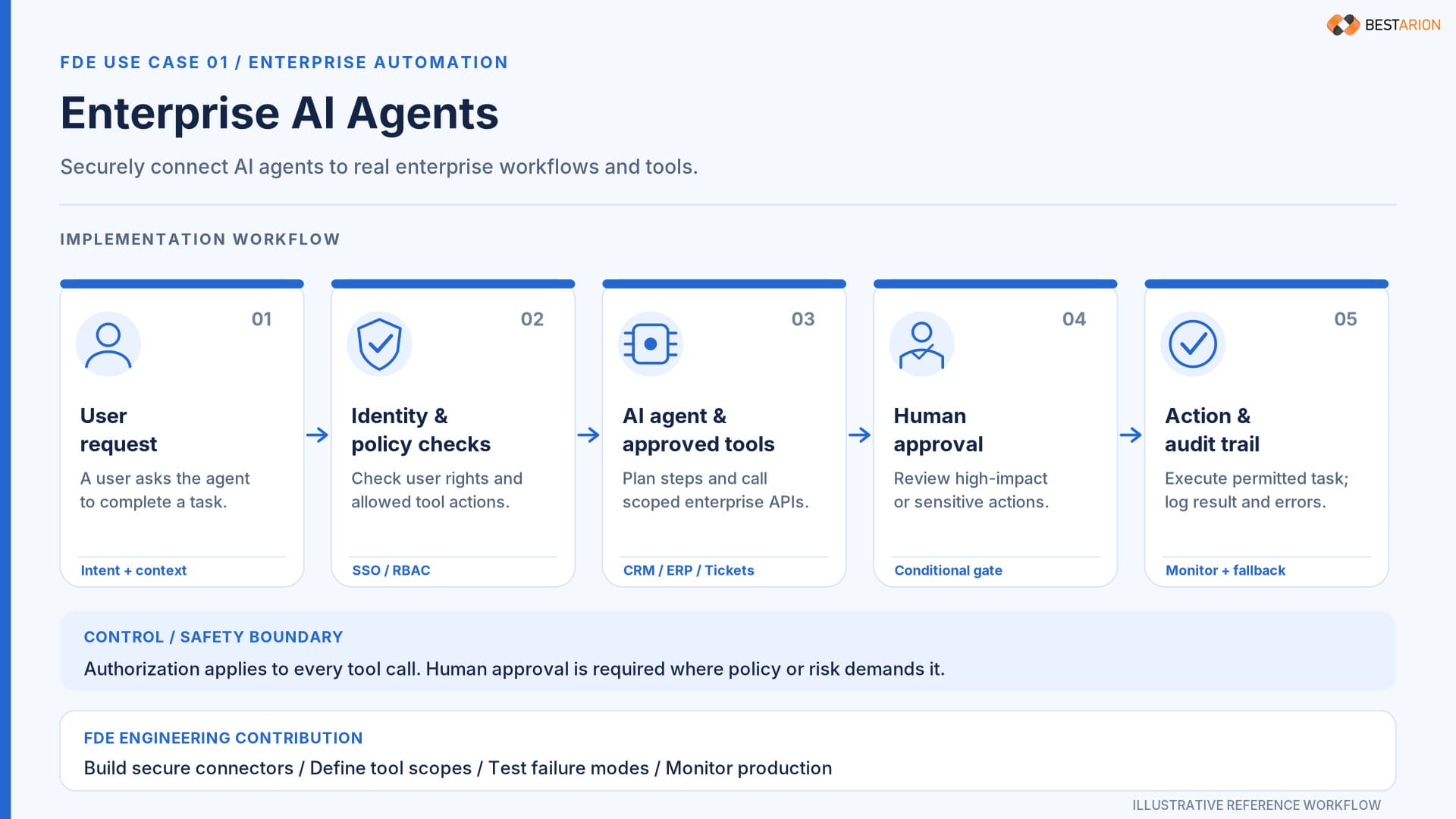
Enterprise AI agents
An organization may want AI agents to perform tasks across internal applications.
FDEs can help connect those agents to data, APIs, user permissions, and business rules.
The main challenge is often not generating a response but ensuring that the agent performs the correct action, handles failures, and respects the organization’s controls.
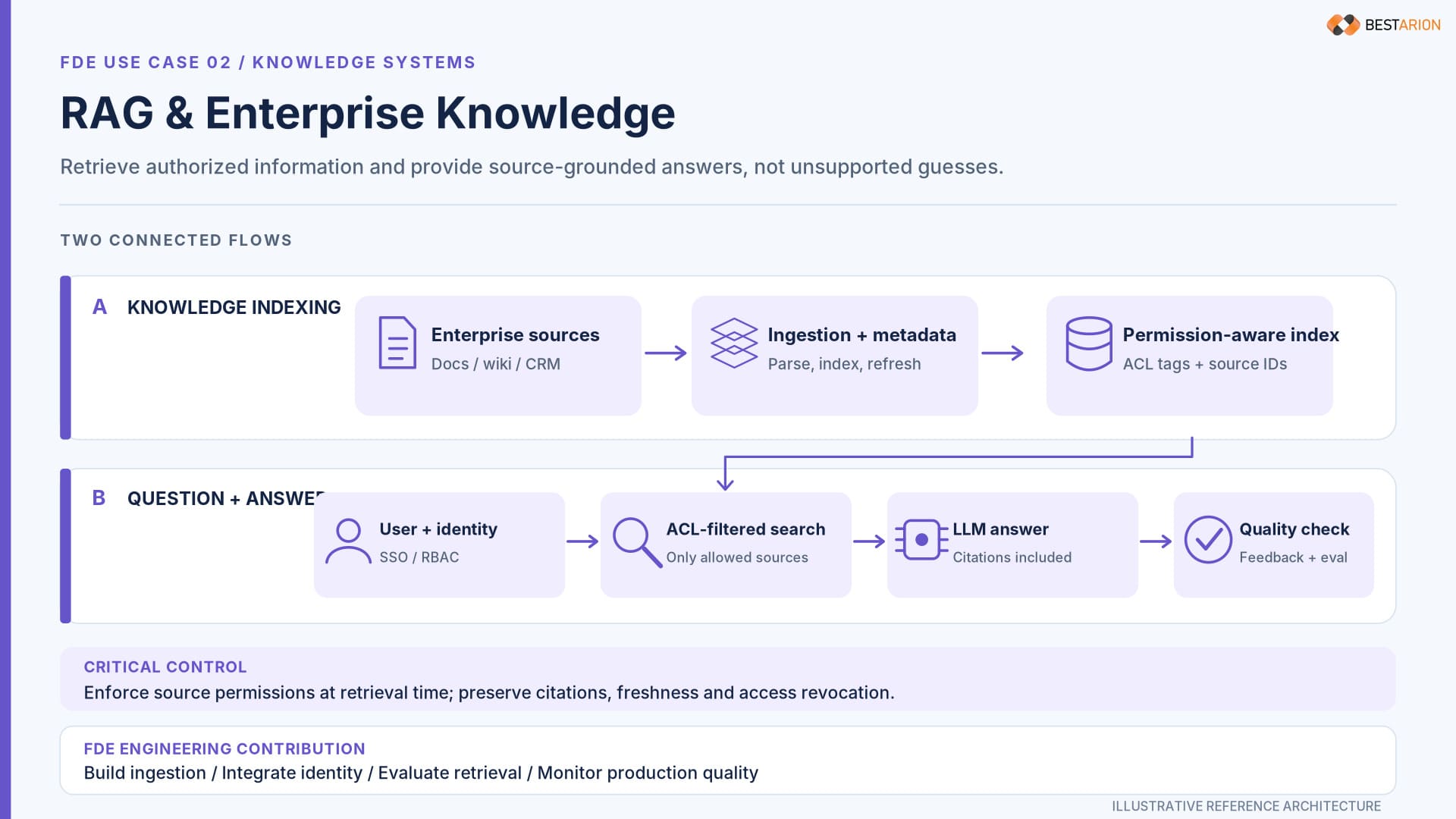
RAG and enterprise knowledge applications
An organization may need an AI application that retrieves information from internal documents and systems.
FDEs may work on data connectors, access controls, retrieval quality, and evaluation.
When information is incomplete or contradictory, the application needs a defined way to respond rather than generating an unsupported answer.
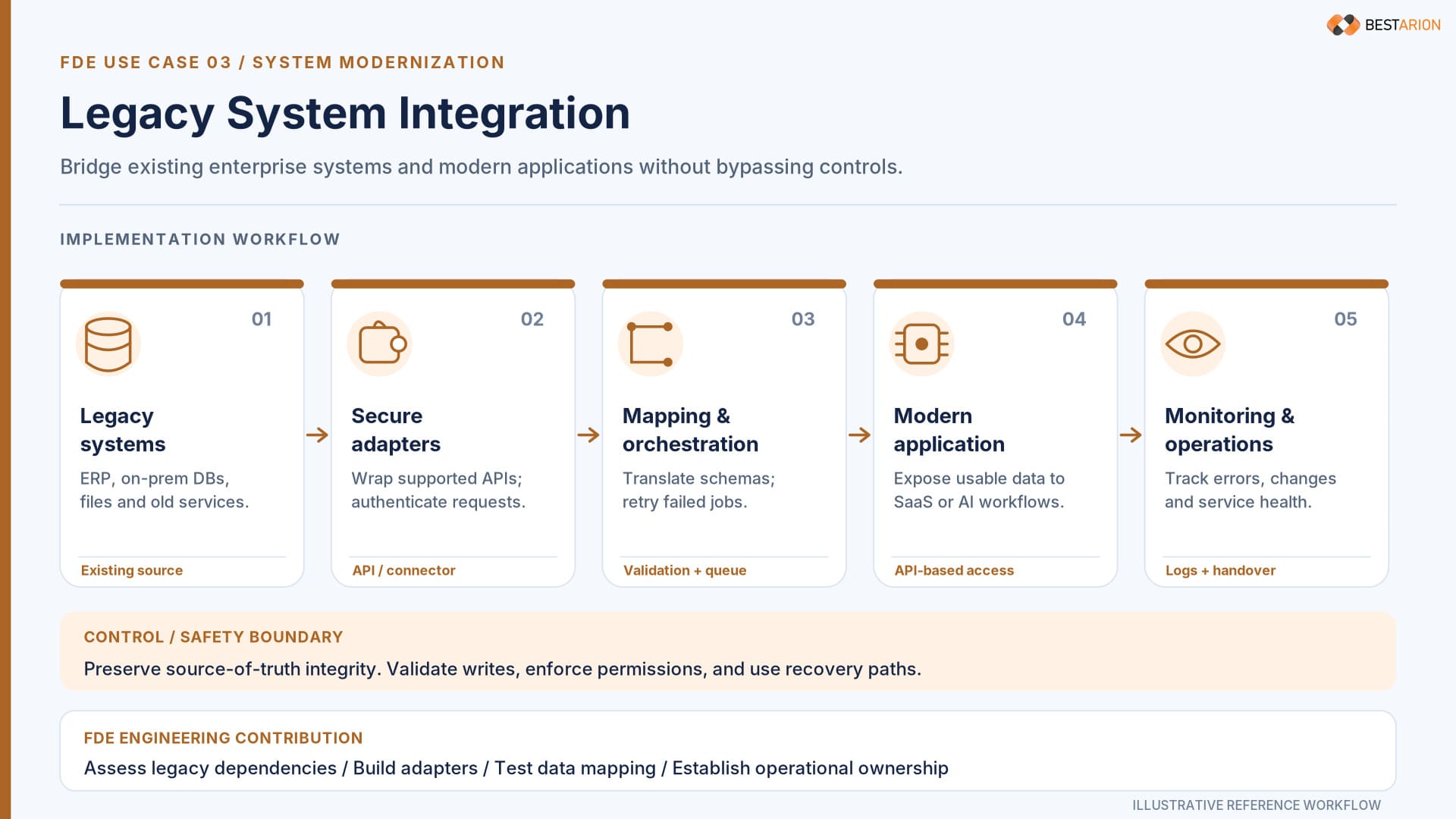
Legacy system integration
Many enterprise applications depend on systems that were not designed to support modern AI or cloud-based services.
An FDE may build integration components, APIs, or data pipelines that connect new functionality with existing infrastructure.
In some cases, the work reveals a need for broader modernization.
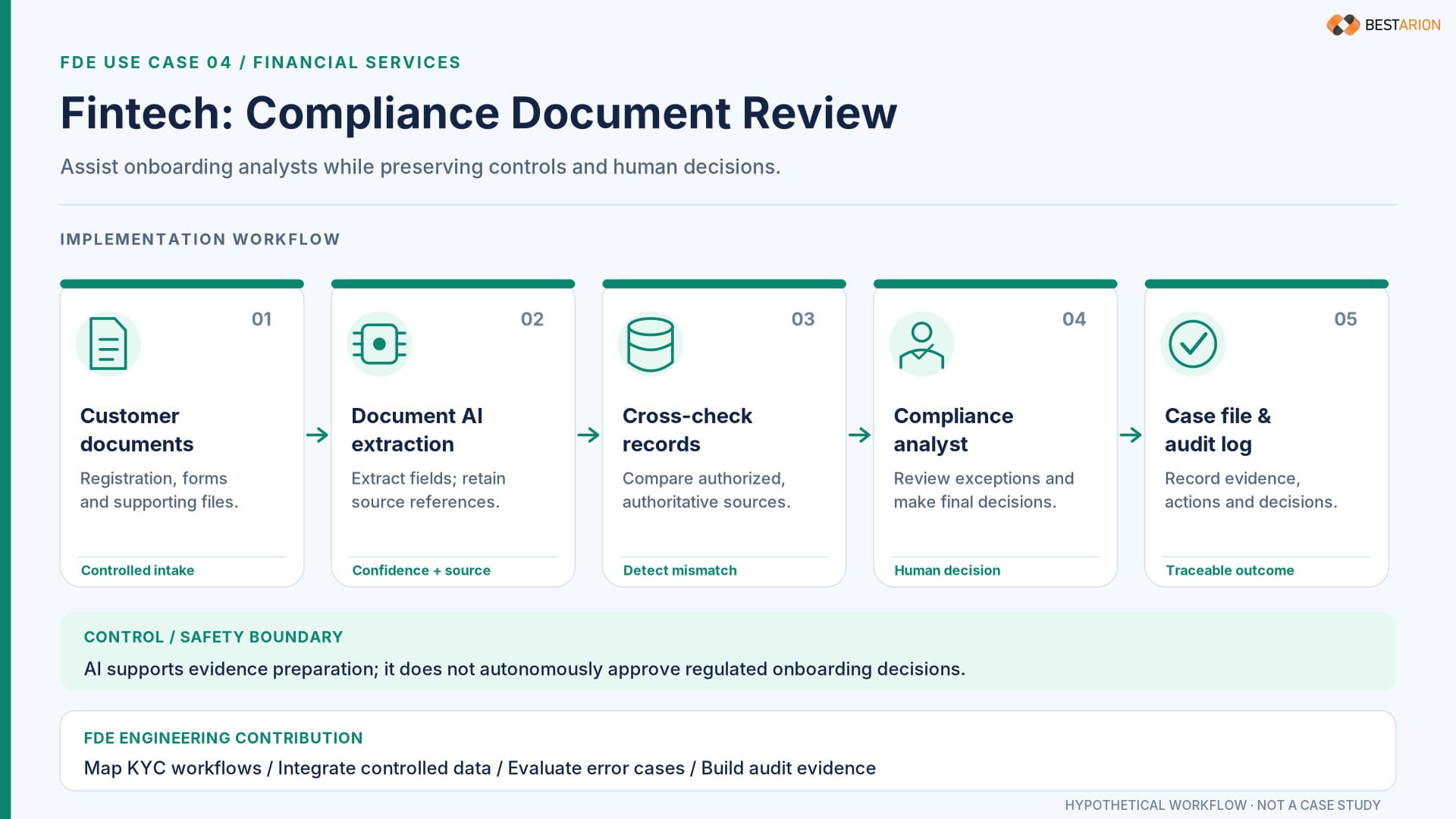
Financial services and fintech
Potential applications include document processing, compliance support, customer operations, and internal knowledge systems.
Projects may require particular attention to authorization, auditability, data handling, and human review.
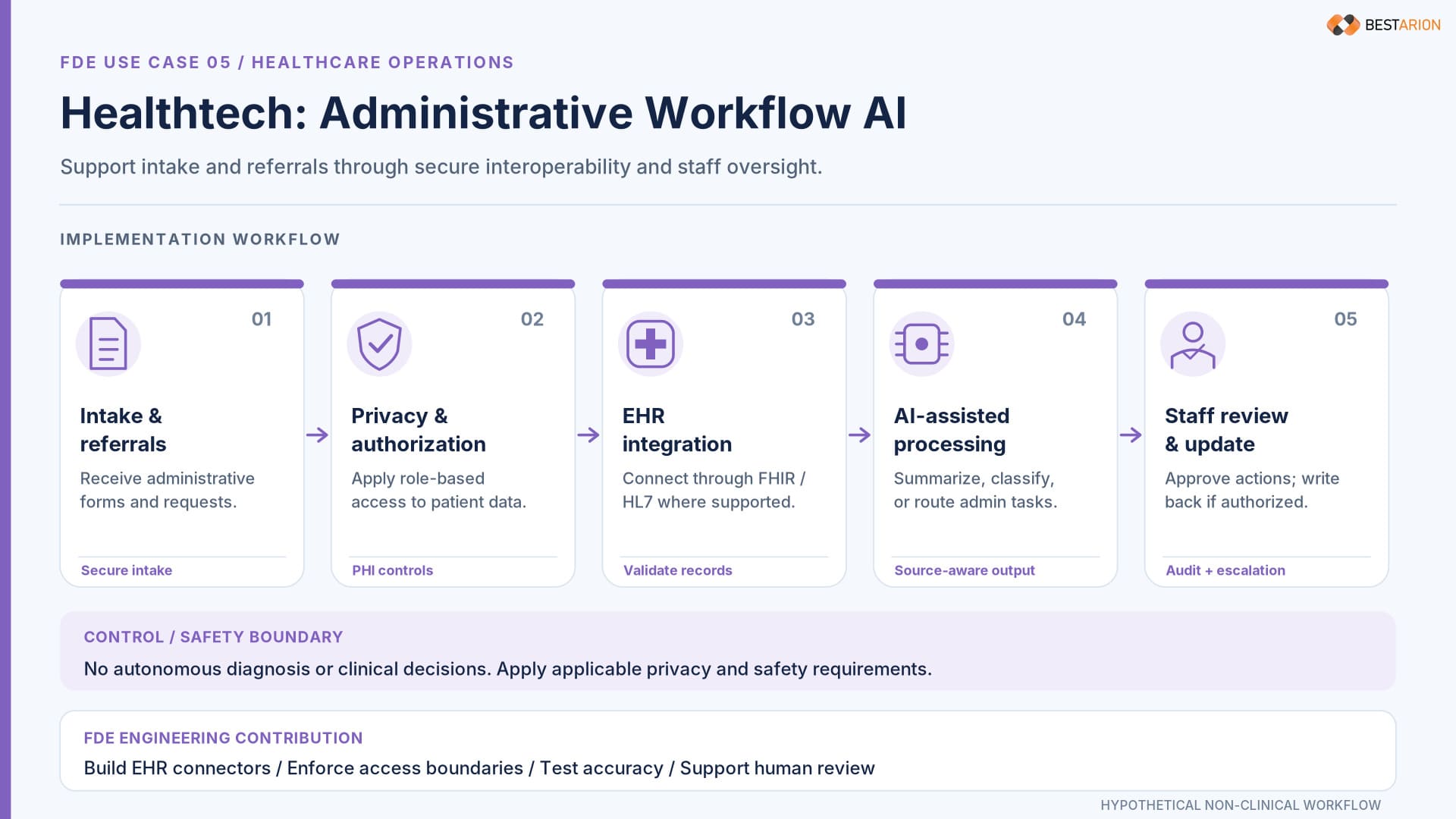
Healthcare and healthtech
FDEs may help integrate AI into administrative workflows, enterprise data platforms, and healthcare information systems.
These implementations can involve interoperability constraints, privacy requirements, and more demanding validation procedures.
For clinical applications, the required controls depend on the intended use and applicable regulatory obligations.
When Does a Business Need an FDE?
An FDE becomes worth considering when an organization has a valuable technical problem that cannot be solved through straightforward product configuration or routine development alone.
Three questions are useful when assessing whether the model fits.
1. Is the problem still partly undefined?
A team may understand the desired outcome but need engineering discovery to establish how the solution should work.
For example, the company may want to automate a workflow without knowing which parts can be automated safely.
When engineers need to work directly with stakeholders to define the solution, the FDE approach may be valuable.
2. Does implementation require significant integration work?
Applications that depend on multiple systems, complex permissions, legacy infrastructure, or customer-specific workflows may benefit from embedded engineering.
The relevant issue is the technical complexity of the implementation, not simply the size of the project.
3. Is there a gap between a working prototype and an operational system?
A company may already have demonstrated technical feasibility but lack the engineering capacity or expertise to address production reliability, governance, and integration.
FDEs can help resolve those implementation challenges alongside internal teams.
When an FDE may be unnecessary
An FDE may not be the right approach if a standard product already satisfies the requirement, the work is routine, or internal engineers can implement the solution without significant discovery or integration uncertainty.
If the primary requirement is additional development capacity against a well-defined backlog, conventional staff augmentation may be more appropriate.
And if the main problem is an unclear business strategy rather than an engineering challenge, starting with a technical deployment team may be premature.
The choice should follow the work that needs to be done.
What Should an FDE Engagement Leave Behind?
A production deployment is an important milestone, but it should not be the only thing a customer receives.
An application can work during an engagement and still become difficult to maintain after the external engineers leave.
For that reason, ownership and handover deserve attention from the beginning.
| Area | What should be clarified or delivered | Why it matters |
|---|---|---|
| Source code and configuration | Repository access, code ownership, build and deployment instructions | The customer can understand and maintain the implementation |
| Architecture and integrations | Architecture documentation, dependencies, API contracts | Future changes can be assessed without reconstructing the system |
| Testing and evaluation | Test coverage, evaluation scenarios, known limitations | The team can detect problems after updates |
| Monitoring and operations | Logs, monitoring setup, incident procedures, recovery guidance | Operational issues can be identified and handled |
| Security and access | Permission model, credential ownership, access revocation process | Security responsibilities remain clear |
| Maintenance | Named owners, support boundaries, unresolved issues | The system does not depend indefinitely on informal knowledge |
These are recommended considerations, not a universal set of deliverables guaranteed by every FDE provider.
The required handover will vary by engagement. A vendor-managed deployment, for instance, may give customers a different level of infrastructure access than a customer-owned application.
What matters is making that boundary explicit.
The customer should know what it owns, what the provider continues to operate, and what expertise will be required after the project.
How Do You Measure FDE Success?
An FDE engagement should be evaluated against the problem it was established to solve.
Engineering progress matters, but the completion of technical tasks does not necessarily mean the solution has improved business operations.
A useful evaluation considers three levels.
Technical performance: Does the system function reliably?
Relevant metrics may include task success rate, defect rate, latency, availability, and evaluation results.
Operational performance: Does the system improve the workflow?
Depending on the application, this could include processing time, manual effort, exception handling, rework, or throughput.
Sustainability: Can the organization continue using the system?
This involves user adoption, monitoring, maintenance readiness, documentation, and clear operational ownership.
These measures should be defined against an existing baseline where possible.
For the hypothetical fintech example, measuring how quickly an AI model processes a document would be useful, but insufficient.
The more consequential question is whether the overall compliance review process becomes more efficient while maintaining the required controls and accuracy.
A successful implementation must account for both.
Frequently Asked Questions
What does FDE stand for in software engineering?
FDE stands for Forward Deployed Engineer. It refers to an engineer who works closely with customers to develop and deploy software in their technical environment.
What is the difference between FDE and FDSE?
FDSE stands for Forward Deployed Software Engineer. The terms are closely related, although some organizations use FDE for a broader range of engineering specializations.
Is an FDE the same as a Software Engineer?
An FDE performs software engineering work, but the role is usually more directly connected to customer-specific implementations. Traditional Software Engineer roles can also include customer-facing delivery, so the distinction is not absolute.
Do Forward Deployed Engineers only work on AI?
No. FDEs also work on enterprise software, data engineering, infrastructure, and integration projects. AI is one important application of the model.
Do Forward Deployed Engineers work remotely or on-site?
Both arrangements are possible. Some roles require frequent customer visits, while others use remote collaboration. The level of customer involvement matters more than the physical location alone.
Is Forward Deployed Engineering a form of outsourcing?
Forward deployed engineering describes a way of working rather than a single commercial model. An FDE may be employed by a software vendor or supplied through an external engineering services provider. Outsourcing and staff augmentation arrangements can incorporate FDE-style practices.
Who maintains the software after an FDE engagement?
That depends on the agreement. Maintenance may remain with the vendor, transfer to the customer’s engineering team, or be handled by another delivery partner. Responsibilities should be defined before deployment and handover.
Final Thoughts
Forward deployed engineering brings engineers closer to the problems their software is supposed to solve.
That can be valuable when requirements are unclear, integrations are difficult, and getting a system into production involves much more than writing application code.
But the job title alone tells a customer relatively little. A useful evaluation looks at what the engineer will build, the decisions they are responsible for, how success will be measured, and who will operate the resulting system.
For companies developing enterprise AI applications, those questions often matter more than the choice of model or framework.
References
- McKinsey — What Is a Forward-Deployed Engineer? (October 16, 2026)
- Palantir — Forward Deployed Software Engineer
- OpenAI — Forward Deployed Engineering
- OpenAI — Forward Deployed Engineer Role
- Anthropic — Forward Deployed Engineer Role
- Databricks — Forward Deployed Engineering: Delivering Business Outcomes with AI (June 11, 2026)
- Atlassian — Forward Deployed Engineering Playbook (October 4, 2026)