What Does a Forward Deployed Engineer Cost? Pricing & Engagement Models
What does a forward deployed engineer cost? The answer depends on what you are buying. A single embedded engineer billed monthly, a managed FDE pod, and a fixed-scope AI implementation can have entirely different fee structures and different responsibilities after the software goes live.
Published offers illustrate the spread, but not a universal market rate. ILMTEC describes approximately $8,000–$30,000 per engineer per month for its forward-deployed engineering model. Andersen advertises approximately $40–$90 per hour for offshore engagements. A separate provider, Forward Deployed Engineers Agency, publishes $25,000–$50,000 for a defined six-week production AI workflow build.
These figures come from vendors describing their own services; they are not an independently verified market average, interchangeable quotes, or a forecast for your project.
Sources: ILMTEC, Andersen, FDE Agency.
Forward deployed engineering cost therefore has two layers: the contracted engineering or implementation fee, and the surrounding work required to make the system safe to operate.
For buyers, a better starting point is to identify the delivery unit, what the fee includes, which costs remain with the customer, and who owns the system after handover.
This guide provides a practical way to compare those elements, including examples for healthtech and fintech teams.
Key Takeaways
- There is no standardized Forward Deployed Engineer pricing rate. Publicly listed rates use different units and cover different responsibilities. Compare like-for-like scope, not a monthly retainer against a fixed project total.
- Total engagement cost is larger than the FDE invoice. Integration access, internal stakeholders, cloud and model usage, testing, security reviews, rollout, and ongoing operations may be billed separately or supplied by the customer.
- Choose the contract model according to scope uncertainty. Time and materials or capped discovery can help define unknown work; fixed-scope agreements suit testable deliverables; outcome-linked terms require a credible baseline and attribution method.
- A solo FDE and a managed pod are not substitutes. A pod may cover multiple engineering disciplines, but only the contract establishes delivery management, acceptance obligations, and support.
- Healthtech and fintech require industry-specific cost assumptions. EHR interoperability and ePHI safeguards differ from financial data lineage, transaction controls, and risk-review workflows.
 BESTARION
More on Forward Deployed Engineering
Practical guides to FDE roles, delivery decisions, security and production-ready AI.
- FDE fundamentalsWhat Is a Forward Deployed Engineer (FDE)? Roles, Skills and Use CasesUnderstand FDE responsibilities, skills and real-world use cases.
- Hiring decisionsWhen Should You Hire a Forward Deployed Engineer? Build vs Buy GuideDecide when embedded engineering makes sense and compare delivery options.
- Costs & planningWhat Does a Forward Deployed Engineer Cost? Pricing & Engagement ModelsCompare cost drivers, engagement models and project quotations.
- Vendor selectionHow to Choose a Forward Deployed Engineering Partner? A Buyer's ChecklistEvaluate delivery evidence, risk, accountability and handover.
- Security & ownershipComing soonHow to Control Forward Deployed Engineering Security? Data, IP Ownership & HandoverControl data access, IP rights and operational handover.
- Performance & ROIComing soonHow to Measure Forward Deployed Engineering ROI? KPIs That MatterConnect deployment KPIs to measurable business value.
- Fintech applicationsComing soonHow to Apply Forward Deployed Engineering in Fintech? AI Use Cases & Deployment GuideExplore KYC, risk and payment workflows from pilot to production.
- Healthtech applicationsComing soonHow to Apply Forward Deployed Engineering in Healthtech? From AI Pilots to Production?Understand EHR integration, clinical safeguards and AI rollout.
Coming soon cards remain non-clickable until published.
How Much Does Forward Deployed Engineering Cost?
An FDE hourly rate tells you the price of a unit of labor. A monthly retainer tells you what recurring access or capacity may cost. A project fee tells you what a vendor agrees to deliver for an agreed scope.
None of these, on its own, defines the cost of operating a working system.
Published FDE pricing examples: what the numbers actually mean
| Public source (accessed October 2026) | Published figure | Commercial unit | Critical limitation |
|---|---|---|---|
| Andersen FDE service | Approximately $40–$90/hour | Offshore engineering hourly rate | Not a full-project price; scope, utilization, supporting roles, and non-labor costs require confirmation. |
| ILMTEC cost guide | Approximately $8,000–$30,000/engineer/month | Vendor-described embedded engineer retainer | Provider’s published indicative range, not verified industry-wide average. |
| Forward Deployed Engineers Agency service list | $25,000–$50,000 | Defined six-week production AI workflow build | Package-specific scope and assumptions; not comparable to an individual monthly rate. |
| HireAFDE | Quote required | Fractional, contract, project or permanent matching | Terms vary; a public pricing page does not always disclose an amount. |
These are provider-published offers, not a survey sample from which to derive a median. They are also not necessarily current offers by the time a contract is signed.
Ask for a dated, project-specific proposal and check whether taxes, travel, hosting, platform licenses, model inference, security review, and post-launch operations are included.
What Drives the Cost of an FDE Engagement?
The biggest cost driver is rarely the job title. It is the amount of uncertainty and engineering work between the current environment and a supportable production workflow.
1. Discovery and scope uncertainty
A team that already has documented requirements, approved data access and acceptance tests can ask for a more specific quote.
A team that needs to discover the workflow, identify authoritative data sources and resolve business rules is buying more exploratory work. That can justify a short paid diagnostic before a larger commitment.
2. Systems integration and data readiness
An AI interface may be quick to demonstrate. Connecting it to a legacy EHR, identity provider, claims platform or financial system of record can dominate the real effort.
Ask the provider to list every dependency, API permission, data transformation and exception path assumed in the estimate.
3. Engineering team composition
A single senior engineer may cover a narrow integration when the customer already provides platform engineering, security, quality assurance and deployment support.
A managed pod can add backend, data, AI evaluation, frontend or DevOps capacity but verify precisely which roles and management responsibilities are included.
4. Evaluation, security and operational readiness
Production work includes representative tests, negative cases, access controls, monitoring, recovery procedures and a release decision.
These activities do not disappear under a fixed fee; they are either priced, explicitly excluded, or left to the customer’s team.
The NIST Generative AI Profile provides a reference for risk-aware evaluation without prescribing an FDE rate.
5. Delivery location and operating hours
Travel, time-zone overlap, on-site workshops, regulated-data environments and incident coverage can affect price.
“Embedded” does not automatically mean full-time on-site availability or 24/7 support.
6. Ownership and the post-launch horizon
A quote that ends at a demo has a different cost boundary from one that includes deployment, training, source-code handover, operational runbooks and stabilization.
A cheaper upfront proposal can create a higher ongoing cost if the buyer must rebuild missing documentation or purchase extended vendor support.
Forward Deployed Engineer Pricing Models Compared
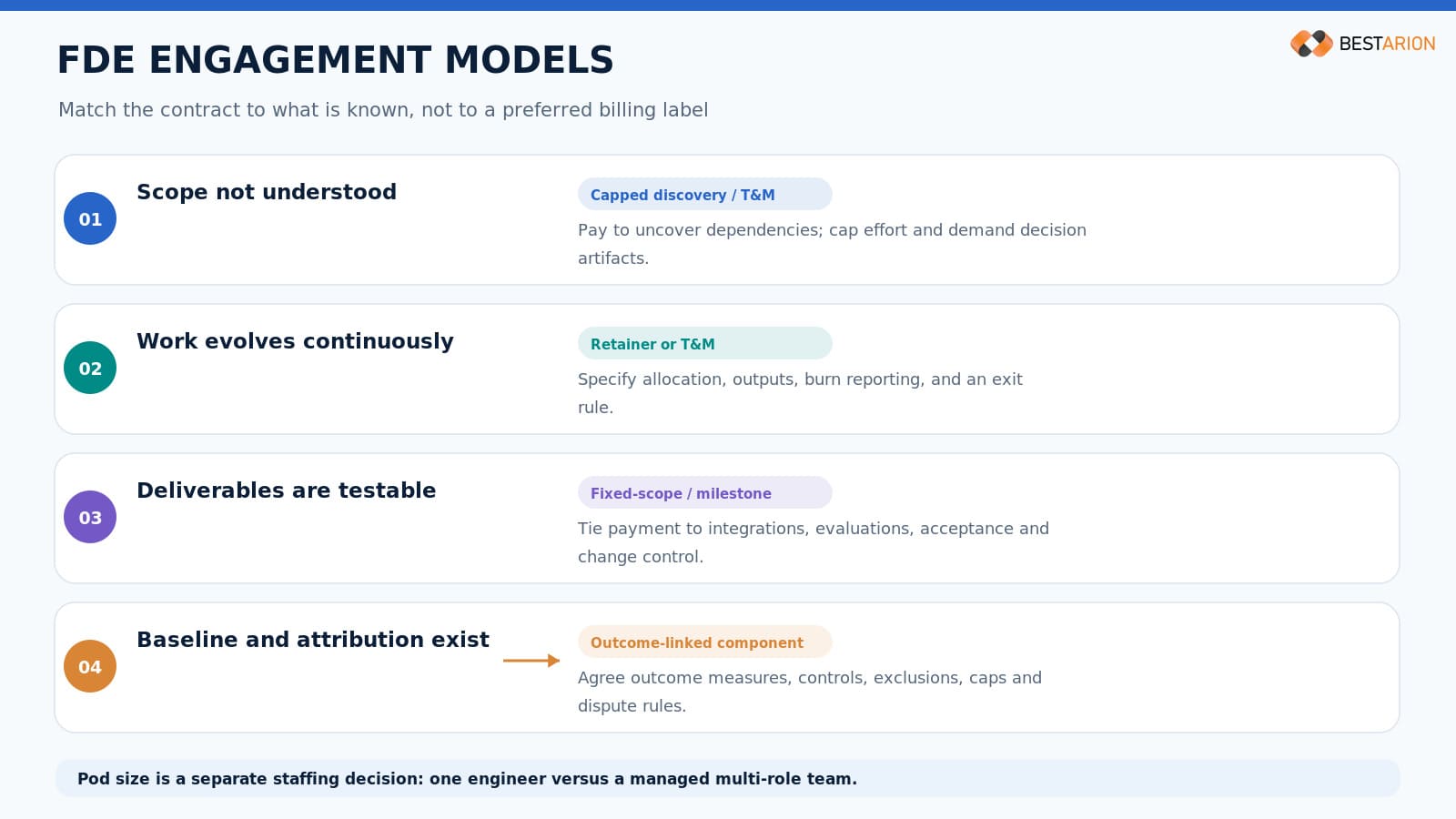
The commercial model determines how charges are calculated. The statement of work determines what the provider actually owes.
The two must be reviewed together.
| Engagement model | What you pay for | Appropriate when | Key exposure | Contract protection to request |
|---|---|---|---|---|
| Time & Materials (T&M) | Agreed labor rates × approved effort | Requirements or integration paths are evolving | Final cost can expand | Weekly burn report, authorized staffing, capped phase or stop/go review |
| Capped T&M discovery | Actual approved effort up to an agreed ceiling | You need evidence before committing to a build | Discovery may not produce production software | Named decisions and deliverables at the cap |
| Monthly retainer / fractional FDE | Recurring access or agreed capacity | Ongoing, variable demand for embedded expertise | Underused capacity; ambiguous response times | Allocation, carryover, response and termination terms |
| Fixed-scope / milestone fee | Defined deliverables and acceptance milestones | Interfaces, scope and tests are sufficiently specified | Change requests and exclusions | Acceptance tests, dependencies, change control and remedies |
| Managed pod / dedicated team | Team composition for a period or outcome | Several workstreams need parallel delivery | Staffing substitutions and opaque management charges | Role allocation, leadership, reporting and knowledge-transfer terms |
| Outcome-linked fee | Base fee plus or tied to an agreed business measure | Reliable baseline and shared measurement exist | Attribution disputes; unintended incentives | Metric definition, control group or baseline, exclusions, caps and dispute process |
A forward deployed engineer pricing model does not guarantee outcomes by itself.
For example, a monthly retainer can contain strong deliverable commitments, while a fixed-price agreement can exclude the integrations essential to production.
When is outcome-based pricing appropriate?
Only when the parties can agree on the measured workflow, baseline period, evaluation method, data quality, external influences and responsibilities.
If a healthtech vendor claims to reduce prior-authorization review time, the buyer should define which cases count, which require human review, how changes in case mix are handled and what happens when system downtime changes the metric.
Otherwise the “outcome” is too disputed to price reliably.
How to Calculate Total FDE Engagement Cost
Before comparing vendors, choose a common time horizon such as the delivery period plus 12 months of operation.
Then estimate the cost of the same deliverable and ownership boundary for every option.
Include each cost only once. If security testing is included in the vendor fee, do not add it again.
Do not confuse an allowance or contingency with a committed payment. Record uncertainty separately.
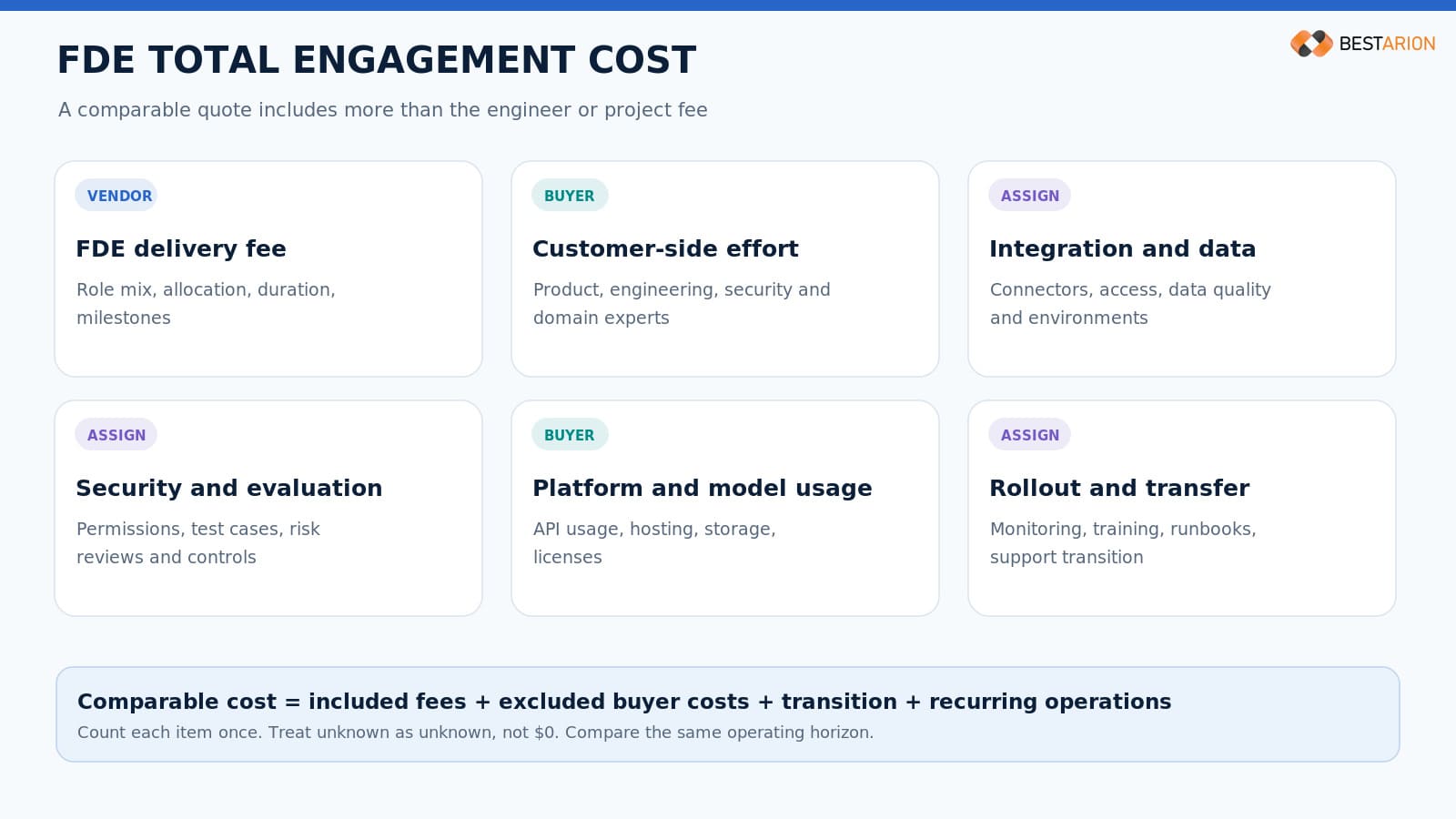
| Cost line | What to capture | Who can estimate or confirm? |
|---|---|---|
| FDE delivery | Role mix, rate, allocation, duration, milestone fees | Provider SOW |
| Customer-side effort | Internal engineering, product, domain experts and security approvals | Customer project owner |
| Platform and AI usage | Cloud infrastructure, model API, vendor license, data storage | Provider + customer finance/IT |
| Integration and data access | Connectors, permissions, data quality corrections, sandbox environments | Technical teams and system owners |
| Risk and validation | Threat modeling, testing, evaluation datasets, audit evidence | Security, compliance and QA |
| Go-live and handover | Training, runbooks, observability, stabilization, exit assistance | Joint owners |
| Post-launch operations | Monitoring, support, model updates, recurring licenses | Future operations owner |
Cost Boundary Map: The diagram shows which line items belong in the provider’s contract and which remain customer-side. It does not depict a universal percentage breakdown.
A quote-normalization example without invented market prices
Vendor A offers a lower monthly engineering rate but excludes integration testing, customer training and on-call stabilization.
Vendor B offers a fixed project price including those deliverables, but excludes cloud and model consumption.
Do not compare A’s monthly rate against B’s entire fee.
Request the same scope, assumptions, acceptance tests, 12-month run-cost forecast and exclusions from both providers. Then calculate the comparable cost and track residual delivery risk.
If a cost cannot yet be estimated, label it unknown rather than entering zero.
Healthtech Example: Pricing an AI Intake and EHR Integration Workflow
Hypothetical procurement scenario. No client name, project fee or implementation timeline is implied.
A healthcare software provider wants an AI-assisted administrative intake process.
Patients submit documents and insurance information; staff need a structured intake summary and must review missing or contradictory records before taking action.
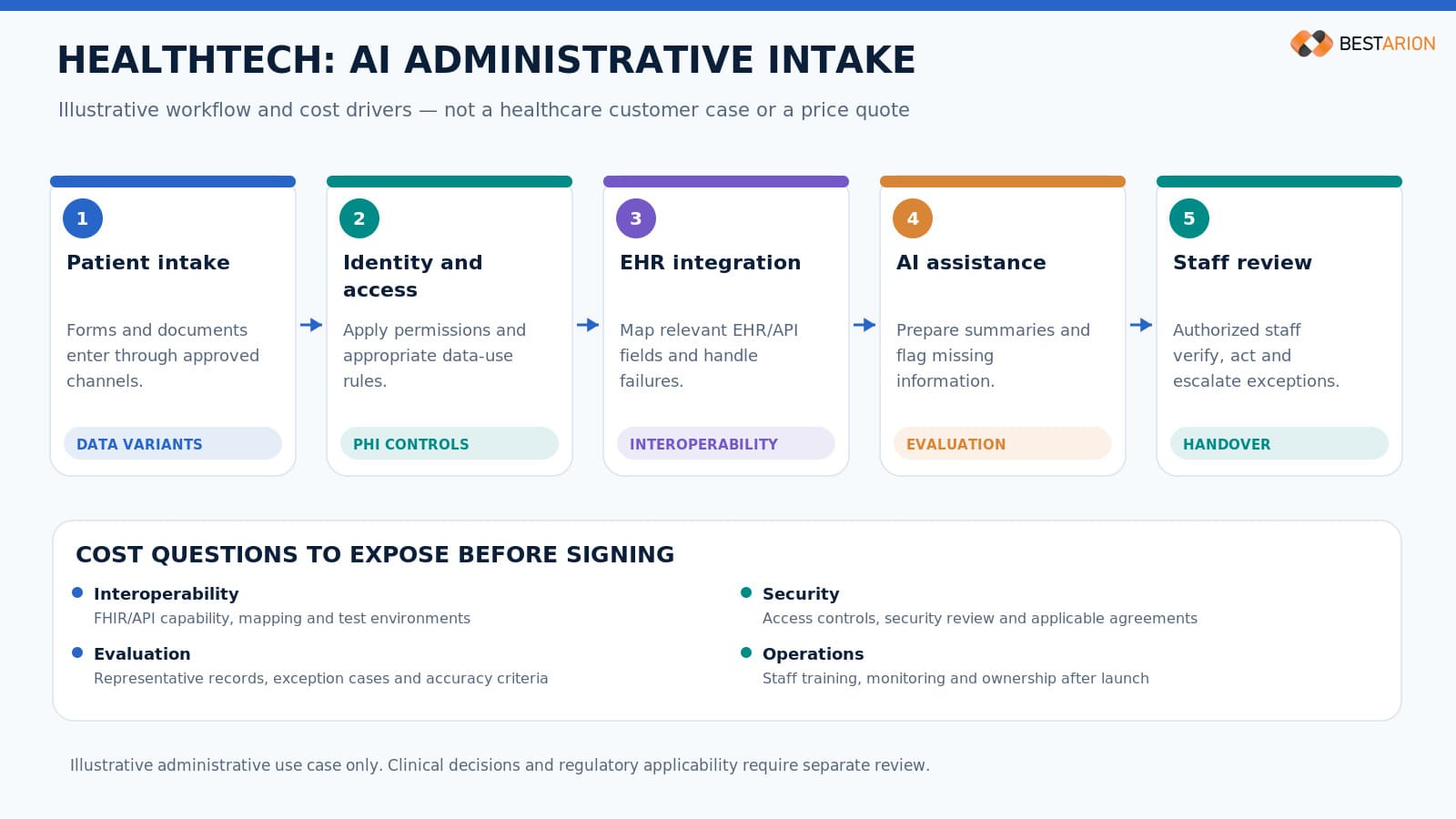
The prototype is not the largest unknown. The cost sits in the links to the EHR, identity and access permissions, document variability, staff review workflow, evaluation and ongoing operations.
| Workstream | FDE contribution to scope | Budget item that must be specified |
|---|---|---|
| Workflow discovery | Map intake variants and review exceptions | Stakeholder workshops and sample-case access |
| EHR integration | Validate API availability, FHIR mappings and failure handling | Connector scope, environments and vendor coordination |
| PHI safeguards | Implement approved data handling, roles, logging and access boundaries | Security review, agreements and audit requirements |
| AI evaluation | Test document extraction, incomplete records and human escalation | Test corpus, quality criteria and reviewer time |
| Production and handover | Monitoring, training, runbooks and internal ownership | Stabilization period and support responsibility |
For organizations subject to HIPAA, the HHS Security Rule summary describes safeguards for electronic protected health information; the applicability of a business associate agreement and allocation of duties must be assessed in the actual arrangement.
EHR API obligations and standards are separately addressed by HealthIT.gov.
Neither authority provides an FDE price list.
Likely pricing approach: pay for a bounded discovery/integration assessment first if EHR access and data conditions are uncertain; specify a fixed scope for build and acceptance once those constraints are understood; reserve explicit post-launch operational coverage.
This is a procurement example, not a guarantee that any particular model will be cheapest.
Healthtech AI Intake — Workflow & Cost Drivers: shows the operational steps and why each creates a distinct estimation question.
Documented healthcare deployment: CVS Health’s explainable research agent
Databricks describes how CVS Health worked on a Genie-powered research agent that explains business and retail forecast outcomes using governed data.
The public account highlights semantic definitions, explainability and the operational work needed to make answers trustworthy.
Source: Databricks — Building an Explainable AI Research Agent with Genie.
What it teaches a pricing buyer: data governance, semantic-layer design, explainability and user evaluation may be essential workstreams beyond model access.
What the source does not establish: that the engagement was sold as an FDE contract, the services fee, staffing rate or total project cost.
It must not be used as evidence of FDE market pricing.
Fintech Example: Pricing an AI Onboarding Document Review Workflow
Hypothetical procurement scenario. No client name, project fee or implementation timeline is implied.
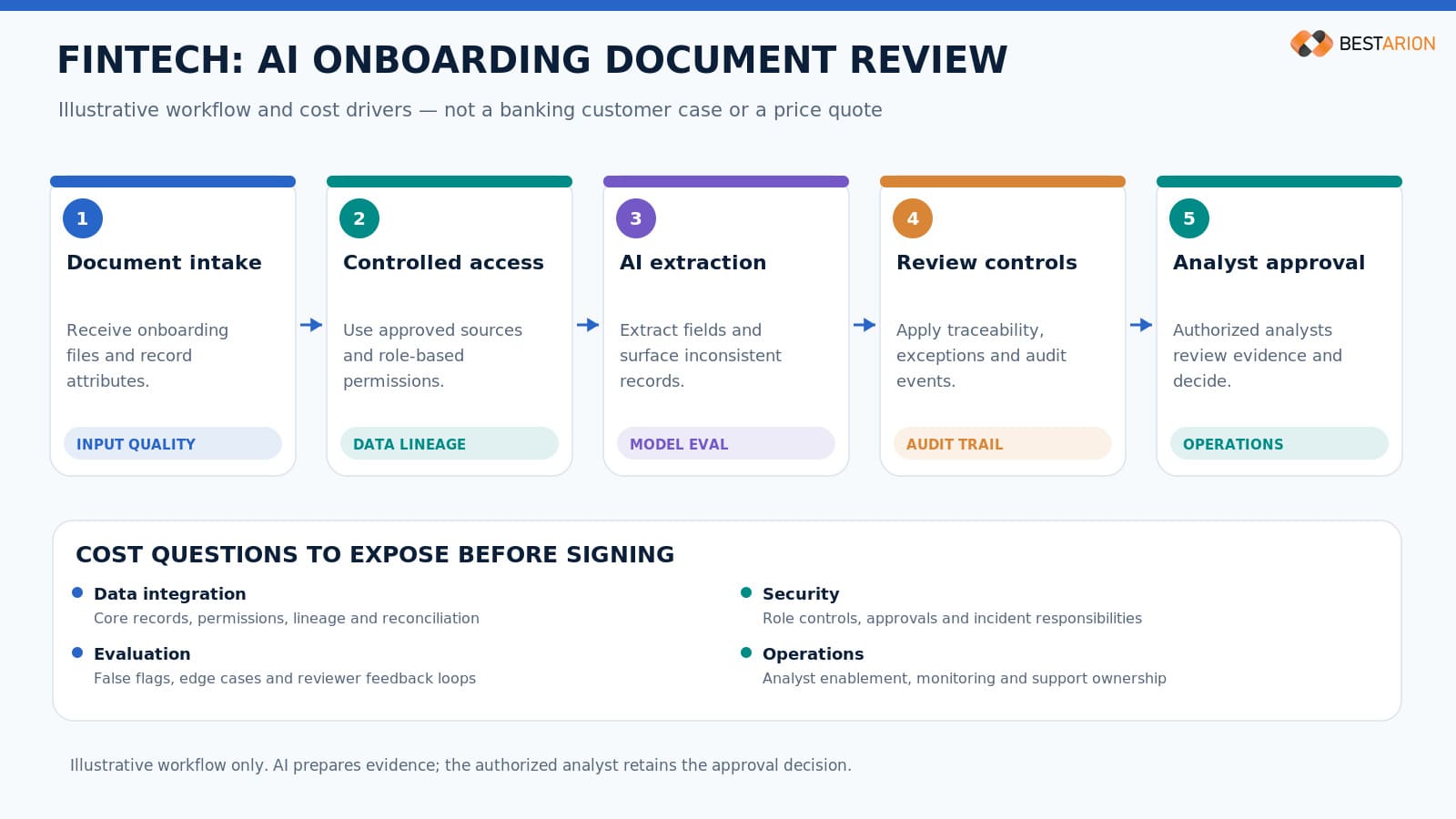
A fintech firm wants to assist analysts reviewing onboarding documents.
Its AI application extracts fields, compares records with approved sources, flags mismatches, and prepares evidence for human review rather than autonomously approving customers.
| Workstream | FDE contribution to scope | Budget item that must be specified |
|---|---|---|
| Workflow discovery | Map KYC review tasks, exceptions and sign-off | Compliance stakeholder participation |
| Data and system integration | Connect onboarding, document and system-of-record services | API access, lineage, reconciliation and change handling |
| Security and controls | Permissions, traceable actions and audit evidence | Security testing and approval ownership |
| Evaluation | Check extraction, false flags and exception routing | Representative sample, error analysis, threshold decisions |
| Production and handover | Controlled rollout, monitoring, analyst training and support | Ownership transfer and ongoing maintenance |
Likely pricing approach: contract for discovery where data quality and controls are unclear, then price a narrowly defined workflow and specified evaluation.
An outcome-linked component should wait until analyst-review metrics can be measured reliably and separated from changes in case mix or staffing.
Fintech Onboarding — Workflow & Cost Drivers: maps document intake through analyst approval and the costs of secure integration, evidence capture and exception handling.
Documented fintech deployment: BBVA’s AI credit-analysis workflows
OpenAI’s BBVA case study describes enterprise AI adoption at a global bank, including tools supporting credit analysis and work involving risk, technology, legal and compliance teams.
It is evidence that business workflow integration and governance matter in financial AI deployments.
What it teaches a pricing buyer: do not scope the AI assistant while omitting approved sources, staff adoption, governance and evaluation.
What the source does not establish: BBVA’s FDE contract price, an hourly rate, or that each use case was independently purchased as an FDE engagement.
Those details are not assumed.
How to Evaluate an FDE Quote Before Signing
Ask every provider to respond to the same scope and attach evidence for six questions:
- What exactly is the unit being purchased? Named engineer hours, engineer-months, fractional availability, fixed deliverable, pod capacity or outcome? Specify working hours, location and travel.
- What counts as accepted work? Require objective conditions for integrations, representative evaluations, security checks and production readiness. A demo alone is not sufficient.
- What is excluded? Cloud bills, API tokens, EHR/financial-system access fees, customer engineering time, licenses, security reviews, data cleanup, travel and post-launch support must be explicitly assigned.
- How are changes priced? Agree when a new data source, additional jurisdiction, expanded user population or altered approval workflow becomes a change order.
- Who owns the implementation? Document source code, model configuration, test assets, third-party licenses, repositories, support and exit assistance.
- What does operation cost afterward? Request a recurring-cost estimate and a named owner for monitoring, escalation, patches and model or data changes.
A procurement scorecard should have an unknown state, not just pass or fail.
An answer without supporting scope details should be treated as unresolved rather than optimistically assumed included.
Common Pricing Mistakes
Comparing different billing units. A freelancer’s hourly rate is not the same product as an enterprise pod with a delivery lead, security review and operational handover.
Treating salary as the cost of a service. Permanent staffing includes benefits and internal management; an external proposal may bundle several capabilities and contractual risk. Compare an equivalent service boundary and time horizon.
Buying a fixed price before dependencies are understood. Ambiguous APIs, data permissions and acceptance criteria tend to resurface as exclusions or change requests.
Assuming “outcome-based” removes delivery risk. Outcomes depend on agreed measurement, user behavior and external processes. Poorly defined metrics can create more disputes, not fewer.
Ignoring the exit. The apparent FDE engagement pricing may omit the work required to make the application supportable without the provider.
Frequently Asked Questions
What is the average cost of a Forward Deployed Engineer?
There is no defensible single average across individual contractors, embedded retainers, vendor-sponsored FDE programs and managed projects.
Public figures can help frame questions, but buyers should request quotes for a defined team, scope, delivery boundary and duration.
What is a typical FDE hourly rate?
Rates vary by region, seniority, technical focus and terms.
Andersen publicly cites approximately $40–$90/hour for offshore FDE arrangements, but that provider-published rate is not an independently established market benchmark and may not include a full managed deployment.
Is FDE pricing monthly or project-based?
Both, and more.
FDE engagement pricing can be hourly, capped T&M, monthly retainer, milestone or fixed-scope project fees, a managed pod or a carefully defined outcome-linked arrangement.
What is included in FDE services cost?
Only what the statement of work promises.
Discovery, engineering, integration, testing, rollout, knowledge transfer and support should each be marked included, excluded or customer-provided.
Cloud, model and third-party platform charges frequently require separate confirmation.
Does hiring an embedded AI engineer cost less than building an internal team?
To assess embedded AI engineer cost, compare engagement length, workload, internal support, vendor scope and post-launch responsibilities.
A time-limited specialist engagement can avoid permanent hiring, while recurring embedded work can become expensive if internal capability never develops.
Compare the same 12-month operating boundary before deciding.
Is a fixed-price FDE project safer than time and materials?
It can improve cost predictability once the scope and acceptance criteria are stable.
For work with unknown dependencies, a capped discovery phase followed by a defined build may be more transparent than forcing uncertainty into an early fixed bid.
Conclusion: Buy an Operating Result, but Price Every Boundary
The useful question is not simply “How much does a forward deployed engineer cost?”
It is what must be discovered, integrated, validated and transferred before the customer can run the system and which party pays for each part.
Ask for a consistent scope, transparent exclusions, a common operating horizon and credible acceptance criteria. Then choose the engagement model that matches the uncertainty, delivery responsibility and ownership you actually need.
Planning an FDE engagement? Prepare a one-page scope describing the workflow, systems, known constraints, expected acceptance tests and long-term owner.
Use it to request comparable, itemized proposals rather than a generic day rate.
Sources and Further Reading
- ILMTEC — Forward-Deployed Engineering as a Service: Cost & Model (2026)
- Andersen — Forward Deployed Engineer Services
- Forward Deployed Engineers Agency — Public Service Packages
- OpenAI — Forward Deployed Engineering
- NIST — Generative AI Risk Management Profile
- HHS — HIPAA Security Rule Summary
- HealthIT.gov — API Condition of Certification
- Databricks — CVS Health Explainable AI Research Agent
- OpenAI — BBVA Banking AI Case Study