Offshore outsourcing is the practice of hiring an external provider in another country to deliver work that would otherwise be handled in-house or domestically. The important part is that “offshore” only describes location. It does not, by itself, tell you whether the work is staff augmentation, a managed service, a project engagement, a dedicated team, […]
How to Choose Right Outsourcing Model: Across Location, Pricing, Engagement, and Service Delivery Fit
Outsourcing does not fail only because a vendor is weak. It often fails because the buyer chooses the wrong model for the work. Choosing right outsourcing models is the one that matches your scope clarity, internal management capacity, cost structure, delivery risk, collaboration needs, and accountability expectations. A company can choose offshore delivery, time and […]
Outsourcing Models Explained: Location, Pricing, Engagement, and Service Delivery
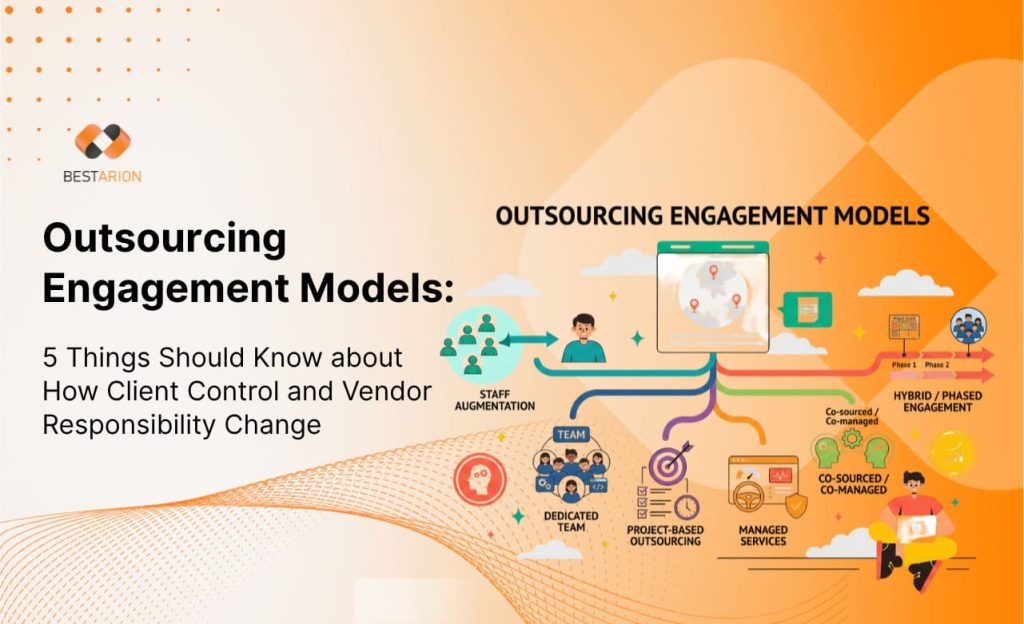
Outsourcing models are easy to misunderstand because most buyer conversations mix four separate decisions into one label. A provider can be offshore, priced on time and materials, structured as a dedicated team, and delivered through a co-managed operating rhythm. This guide separates the four lenses so you can compare providers without confusing cost, control, and […]
Outsourcing Location Models Explained: What Offshore, Nearshore, and Onshore Actually Change
Outsourcing location models describe where outsourced work is delivered relative to the buyer. They do not, by themselves, decide pricing, ownership, service accountability, or whether the provider manages outcomes. That distinction matters because “offshore,” “nearshore,” and “onshore” are often used as shortcuts for cost, collaboration, speed, control, and risk. In reality, location is only one […]
Outsourcing vs In-House: Cost, Control, Speed, Risk, and When Each Model Fits Best
Outsourcing vs in-house are not competing because one model is always better. They solve different business problems. Choose in-house when direct control, long-term capability, and business-specific knowledge matter most. Choose outsourcing when speed, flexibility, or specialist expertise matters more than building permanent internal capacity. This guide compares outsourcing and in-house across the criteria that matter […]
What Is Outsourcing, What Are the Benefits and Risks, and When Should You Use It?
Most companies do not start by asking, “What is outsourcing?” in a theoretical way. They ask because something inside the business is already under pressure: the internal team is overloaded execution is slowing down hiring is too slow or too expensive specialized work is piling up leaders are unsure what should stay in-house and what […]
When Software Development Outsourcing Works, When It Fails, and How to Choose the Right Delivery Model
Software development IT outsourcing is rarely a simple staffing decision. For most companies, the harder question is whether the work should be outsourced as a fixed-scope project, handled by a dedicated team, or supported through IT staff augmentation. That choice shapes cost, ownership, delivery speed, and long-term control. When the model fits the work, outsourcing […]
What Is Small Business IT Outsourcing, Which IT Functions Should You Outsource First, and What Should You Keep In-House?
Small businesses usually do not ask, “Should we outsource IT?” in the abstract. They ask much more practical questions: Who should handle support tickets when no one internally has time? Who should manage backups, patching, and cloud admin before something breaks? Which security tasks are too risky to leave ad hoc? What should stay internal […]
Follow-the-Sun Model Explained: Benefits and Risks, Workload Fit, Handoff Protocol, Overlap Hours, Escalation Design, Governance Cadence, and Staffing Model
Follow-the-sun sounds simple: work moves west as the day ends, so progress continues while your first team sleeps. In practice, it only works when you treat it as an execution system built on evidence-grade handoffs, explicit ownership transfer, and escalation rules that survive shift boundaries. Key takeaways What it is: Follow-the-sun is a handoff-driven execution […]
Outsourcing Costs Explained: TCO Breakdown, Engagement Model Comparison, and Hidden Cost Controls
Outsourcing costs can look simple at first: compare vendor rates, pick a model, and forecast spend. In practice, cost overruns rarely come from the rate card alone. They come from what the rate card doesn’t capture: transition friction, governance load, rework, stalled decisions, and SLA or incident impact. This guide explains outsourcing costs hidden the […]