AI in Outsourcing Pricing Models: How Automation, Tool Costs, Quality Control, and Productivity Gains Change Pricing Decisions
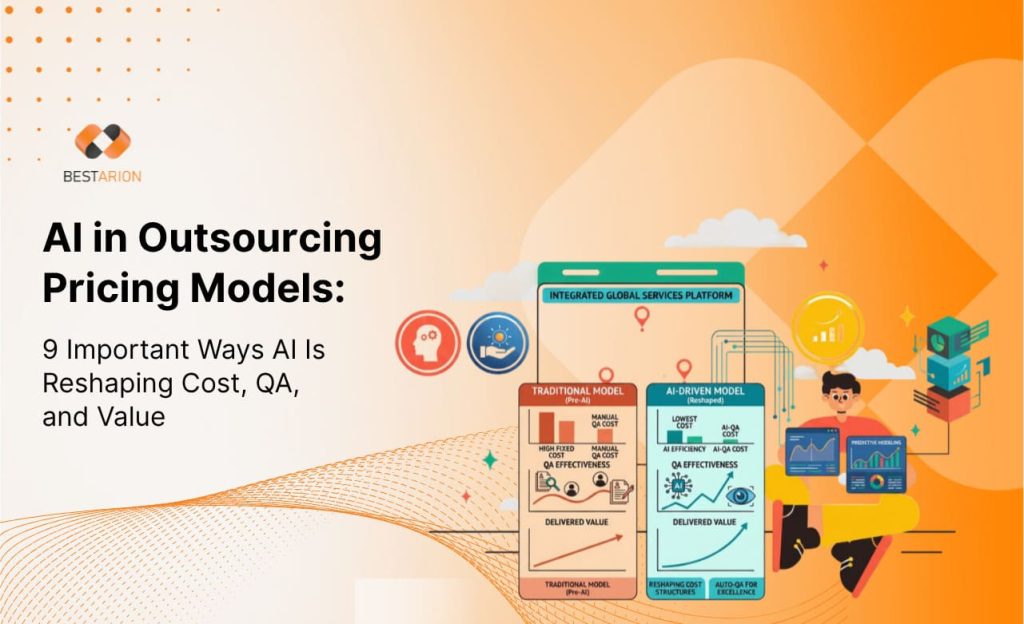
AI in outsourcing pricing models is not about making every contract suddenly outcome-based or “AI-powered.” The real shift is more practical: AI can reduce manual effort in some workflows, introduce new usage-based cost layers, change how quality-control work is handled, and make productivity gains harder to price with old labor-only assumptions.
Where AI changes outsourcing pricing first
- Labor-only pricing can hide AI productivity gains, especially when the provider uses automation but the buyer still pays only by hours or FTE.
- AI tool usage can create new variable costs, including tokens, API calls, cloud infrastructure, model monitoring, and human review.
- Output-based or outcome-based pricing can look attractive, but it becomes risky when the buyer cannot define baselines, quality thresholds, attribution, and exception handling.
- Fixed-price deals can create margin disputes if the provider gains AI efficiency but the contract does not explain whether savings are shared or retained.
- Buyers may overpay for “AI-enabled” work if the contract does not separate actual delivery value from software access, experimentation, or vague automation claims.
Key Takeaways
- AI does not replace outsourcing pricing models; it changes the cost drivers, risk allocation, and control requirements inside fixed price, time and materials, FTE, transaction-based, output-based, outcome-based, and hybrid structures.
- Pricing should separate human effort, AI tooling, cloud/compute, data preparation, governance, human review, and exception handling instead of bundling everything into one “AI fee.”
- Consumption and value-based pricing are becoming more relevant as AI introduces digital work that is not directly tied to headcount or seat count, but buyers still need auditable baselines and quality controls [7], [8], [10], [11].
- Outcome-based pricing is strongest when the result is measurable, repeatable, attributable, and protected by SLA, governance, security, and change-control terms [10], [12].
- For most outsourcing programs, the safest approach is a hybrid pricing structure: fixed discovery or setup, transparent T&M or FTE capacity, controlled AI usage pass-throughs, and performance incentives only where outcomes can be measured.
What AI in outsourcing pricing models actually means
AI in outsourcing pricing models means the use of artificial intelligence, automation, analytics, or AI-assisted delivery to change how work effort, cost, value, quality, and risk are priced between a buyer and a provider. It can affect pricing inputs such as staffing hours, unit cost, token consumption, tool licensing, cloud infrastructure, quality review effort, and risk controls.
It should not be treated as a new pricing model by itself. A buyer can still use fixed price, time and materials, FTE, transaction-based, output-based, outcome-based, or hybrid pricing. AI changes the assumptions behind those models. ISO 37500 frames outsourcing as a governed lifecycle with roles, agreements, relationship management, risks, and sustained operating arrangements, which is why pricing should be tied to governance rather than a technology label alone [1]. Deloitte’s outsourcing survey also points to AI as part of a broader sourcing and extended workforce shift, not a standalone commercial shortcut [2].
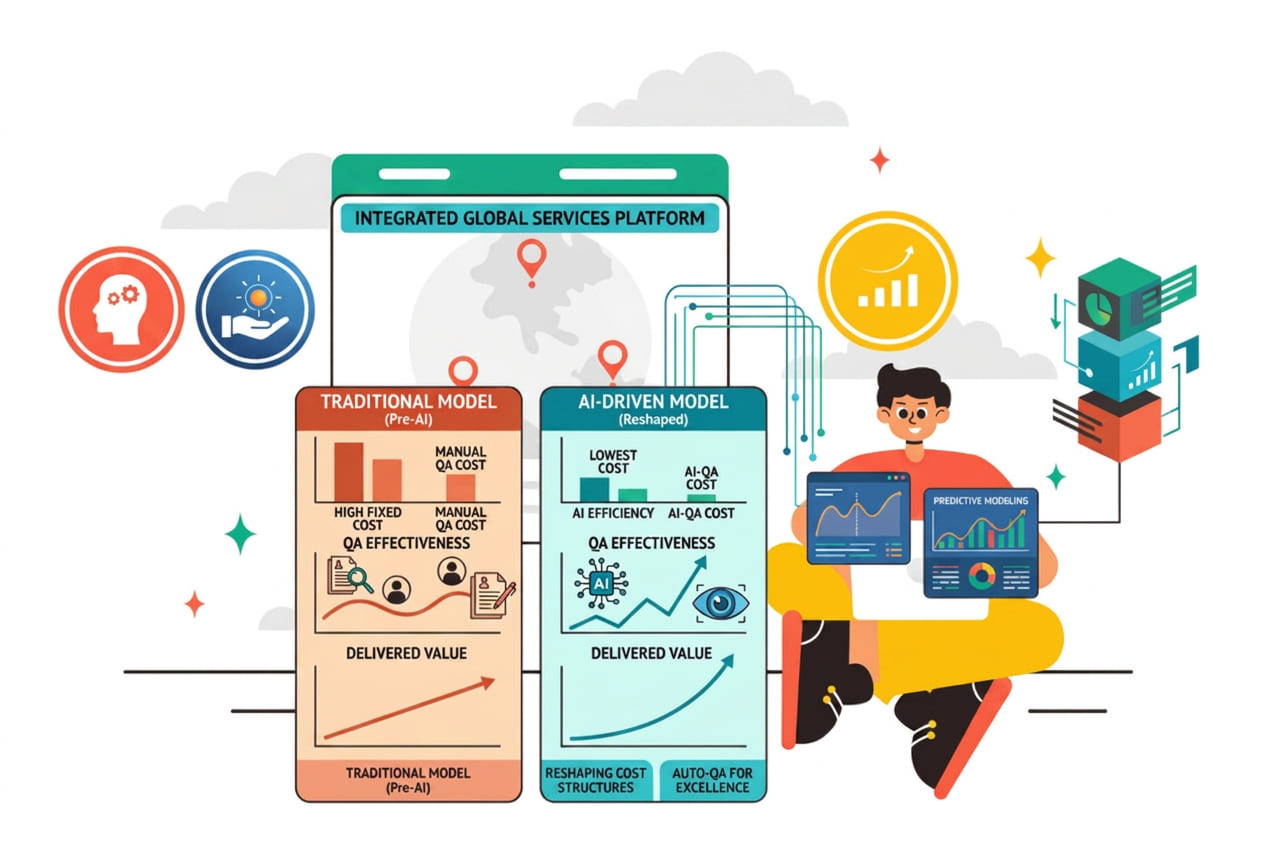
Quick distinction: AI is a pricing input, not a pricing model
| Pricing question | What AI changes | What should not change |
|---|---|---|
| Billing unit | AI may reduce human effort or add usage-based costs | The contract still needs a clear billing unit |
| Cost baseline | Baselines may include human work, AI usage, review, and exception handling | Buyers should not accept unmeasured “AI efficiency” claims |
| Risk allocation | AI can move risk toward model quality, security, data, and governance | Risk should still follow who controls the process |
| Performance metrics | Metrics may include accuracy, rework, cycle time, automation rate, and human review | SLAs should not reward speed while ignoring quality |
| Value sharing | Productivity gains can be shared, retained, or reinvested | The sharing logic should be explicit before signature |
The AI cost stack buyers should price before signing
AI-enabled work may be cheaper in one part of delivery and more expensive in another. FinOps guidance for AI highlights the need to track usage, quotas, GPU allocation, cost-per-token, and volatile AI workload costs rather than assuming AI cost behaves like a normal software subscription [7], [8]. Deloitte also frames AI economics around tokens, models, infrastructure, and value, which makes cost visibility central to commercial design [9].
| Cost component | What it covers | Pricing implication |
|---|---|---|
| Human delivery effort | Analysts, engineers, QA, service managers, SMEs, reviewers | Still needed for judgment, supervision, exception handling, and accountability |
| AI software licenses | SaaS AI tools, copilots, embedded platform AI, automation tools | Should be separated from labor rate when material |
| API and token usage | Prompts, model calls, embeddings, inference, agent workflows | Often better handled with usage caps, pass-through rules, or pre-approved tiers |
| Cloud / GPU / infrastructure | Compute, storage, orchestration, observability, security tooling | Should be estimated and monitored because AI workloads can be volatile |
| Data preparation | Data cleaning, labeling, access, integration, retrieval setup | Often belongs in setup, discovery, or implementation pricing |
| Human review and QA | Validation, accuracy checks, rework, escalation, audit sampling | Must be priced into AI-enabled delivery, not treated as optional overhead |
| Governance and compliance | Risk review, documentation, model-use policy, data protection, reporting | Should be tied to contract obligations and auditability |
| Monitoring and improvement | Drift monitoring, prompt updates, model changes, incident handling | Fits ongoing managed service, retainer, or hybrid pricing |
| Remediation and exception handling | Fixing wrong outputs, quality failures, security issues, handback work | Should have ownership, SLA, and commercial consequence rules |
How AI affects common outsourcing pricing models
Gartner’s research abstracts describe AI services as shifting pricing focus from labor toward results and outcome-aligned value, while ISG describes AI as weakening the old linkage between software value and headcount or seat count [10], [11]. IBM’s BPO overview also notes that outsourcing contracts commonly use structures such as fixed price and time and materials, which is why AI should be applied to existing commercial structures rather than treated as a standalone model [13]. That does not mean every outsourcing deal should become outcome-based. It means the buyer should update the control layer around the pricing model already in use.
| Pricing model | How AI changes the economics | Best-fit use | Control buyers should add |
|---|---|---|---|
| Fixed price | AI can improve provider margin if automation lowers effort, but the buyer may not see savings unless the contract defines gain-sharing | Stable scope with clear deliverables and acceptance criteria | Define assumptions, AI-use disclosure, change control, quality acceptance, and rework ownership |
| Time and materials | AI may reduce hours but add tool, token, or review costs | Discovery, evolving scope, AI experimentation, or product work with unclear requirements | Require transparent timesheets, AI usage reporting, pre-approved tools, and productivity review points |
| FTE / dedicated team | AI-assisted staff may produce more output than a traditional FTE but still need oversight and QA | Ongoing capacity where the buyer directs work | Clarify whether AI tools are included, reimbursed, capped, or buyer-provided |
| Transaction-based | AI can reduce unit handling cost and shift humans toward exception work | Repeatable operational processes with high volume and clear unit definitions | Separate straight-through units, exception units, rework, and quality thresholds |
| Output-based | AI can accelerate deliverables, but quality and acceptance become more important than speed | Deliverables that can be clearly inspected, accepted, and version-controlled | Define output standards, acceptance tests, rework limits, and human review requirements |
| Outcome-based | AI may support value-linked pricing when outcomes are measurable and attributable | Mature processes with baseline data and shared governance | Lock baseline, attribution logic, data access, quality guardrails, and dispute resolution |
| Hybrid pricing | AI often requires a mix of setup fee, capacity, usage pass-through, unit pricing, and incentives | Most real-world AI-enabled outsourcing programs | Make each layer visible so buyers know what they are paying for |
When AI supports outcome-based pricing and when it does not
Outcome-based pricing is strongest when outcomes can be measured and controlled. IBM defines SLAs as agreements that describe the service, expected performance, measurement, approval, and what happens if service levels are not met [12]. AI-enabled outcome pricing needs the same discipline, with added attention to model risk, data quality, human oversight, and auditability.
| Condition | Outcome-based AI pricing may work | Outcome-based AI pricing is risky |
|---|---|---|
| Measurable baseline | There is historical cycle time, cost, quality, or revenue data | The buyer cannot prove the starting point |
| Attribution | The provider can reasonably influence the result | Outcomes depend mostly on buyer-controlled data, demand, product, or operations |
| Quality standard | Accuracy, acceptance, rework, and exception rules are defined | The only metric is speed or cost reduction |
| Data access | Data is available, usable, lawful, and stable enough | Data is incomplete, restricted, fragmented, or changing |
| Governance | The parties agree review cadence, escalation, model-use rules, and audit rights | AI is treated as a black box |
| Risk tolerance | The buyer can tolerate performance variation inside agreed guardrails | Errors create legal, financial, safety, or customer-trust risk |
| Commercial maturity | Both sides can price upside, downside, and dispute logic | The contract has no gain-share, cap, or fallback model |
Commercial controls to add before accepting AI-enabled pricing
NIST AI RMF positions AI risk management around governance, mapping, measurement, and management of risks, while the OECD AI Principles emphasize trustworthy AI that respects human rights and democratic values [3], [4]. In commercial terms, that means buyers should not accept opaque AI pricing without operating controls.
- AI-use disclosure: which tools, models, or automation layers may be used, and for which tasks.
- Cost visibility: what is included in the base rate, what is pass-through, and what needs pre-approval.
- Usage controls: caps, quotas, alerts, approval thresholds, and unit economics reporting for tokens, APIs, cloud, or AI licenses.
- Productivity review points: scheduled reviews that compare baseline effort, automation impact, cost, quality, and rework.
- Human review rules: where human validation is mandatory, optional, or risk-based.
- Quality metrics: acceptance criteria, accuracy thresholds, rework rules, exception handling, and escalation paths.
- Data and security controls: access, retention, confidentiality, model training restrictions, logging, and incident notification.
- Audit and evidence: the right to review delivery records, usage reports, AI-enabled workflow documentation, and governance evidence.
A practical workflow for pricing AI-enabled outsourcing
- Start with the work type. Separate exploratory work, repeatable operations, deliverable production, and outcome-linked work.
- Build a baseline. Record current cost, cycle time, volume, quality, rework, exception rate, and staffing assumptions.
- Identify AI-enabled tasks. Separate automation-ready tasks from tasks that require human judgment, customer context, or regulated decision-making.
- Price the full cost stack. Include people, tools, tokens, infrastructure, data preparation, QA, governance, monitoring, and remediation.
- Choose the pricing layer. Use T&M for discovery, fixed price for defined setup, FTE or retainer for capacity, transaction/output pricing for repeatable work, and outcome pricing only where attribution is measurable.
- Add guardrails. Define usage caps, AI-use disclosure, quality thresholds, security controls, audit rights, and change-control rules.
- Review after a real operating period. Reprice only after evidence shows whether AI changed cost, quality, speed, and accountability in practice.
How to avoid pricing AI as a vague discount
AI-enabled pricing is easier to negotiate when both parties separate the commercial question from the technology promise. The buyer should not ask only whether the provider uses AI. The stronger question is whether AI changes the billing unit, cost baseline, quality risk, review burden, and accountability model.
For example, an AI-assisted QA or development workflow may reduce some manual effort, but it may also require stronger test coverage, prompt governance, code review, security checks, model-use restrictions, and remediation rules. That means the pricing model should be reviewed together with SLA, security, IP, data-use, and service-management terms rather than treated as a discount conversation only [3], [12], [14].
Common mistakes to avoid
- Treating AI as a universal discount instead of pricing the full cost stack.
- Moving directly to outcome-based pricing before defining baselines, attribution, and quality thresholds.
- Letting the provider keep AI productivity gains while the buyer also pays opaque AI surcharges.
- Pricing token or API usage without usage caps, alerts, or approval thresholds.
- Ignoring human review, QA, rework, and exception handling when AI is used in production work.
- Asking for AI-enabled speed improvements without updating security, privacy, IP, and audit terms.
- Measuring only cost reduction while ignoring service quality, defect rate, customer impact, and operational risk.
FAQ
Is AI creating a new outsourcing pricing model?
Not usually. AI is better understood as a cost, productivity, and governance variable inside existing pricing models. It can make consumption-based, output-based, outcome-based, or hybrid pricing more relevant, but it does not remove the need to define scope, unit, baseline, quality, and risk.
Should buyers expect lower outsourcing prices when providers use AI?
Sometimes, but not automatically. AI may reduce some labor effort while adding tool, API, cloud, data, security, monitoring, and human review costs. The contract should explain how productivity gains and AI costs are handled [7], [8], [9].
When does outcome-based pricing make sense for AI-enabled outsourcing?
It works best when the outcome is measurable, repeatable, attributable to the provider’s work, and protected by quality and governance controls. It is risky when data quality is poor, the buyer controls most success factors, or the outcome cannot be audited [10], [11], [12].
What should be included in an AI pricing clause?
A practical clause should cover approved AI tools, usage reporting, cost caps, data-use restrictions, human review, quality thresholds, security controls, model-change notification, audit rights, and treatment of productivity gains [3], [5], [6], [14].
Is T&M still useful when AI improves productivity?
Yes, especially during discovery or uncertain scope. But T&M should be paired with usage transparency, productivity reviews, tool-cost rules, and a path to fixed, output, transaction, or hybrid pricing once the work becomes repeatable.
What to Keep in Mind
- Do not price AI-enabled outsourcing only by hours saved; price the full delivery system.
- Use outcome-based pricing only where the baseline, attribution, quality, and governance are measurable.
- Keep AI costs visible: tools, tokens, cloud, data preparation, QA, monitoring, and remediation.
- Add contract controls for usage, security, human review, auditability, and change management.
- Treat AI as a pricing input and operating-control issue, not as a standalone outsourcing model.
References
- International Organization for Standardization, “ISO 37500:2014, Guidance on outsourcing,” ISO, 2014. Accessed: May 14, 2026. [Online]. Available: https://www.iso.org/standard/56269.html
- Deloitte, “Global outsourcing survey 2024,” Deloitte, 2024. Accessed: May 14, 2026. [Online]. Available: https://www.deloitte.com/global/en/issues/work/global-outsourcing-survey.html
- National Institute of Standards and Technology, “Artificial Intelligence Risk Management Framework (AI RMF 1.0),” NIST, 2023. Accessed: May 14, 2026. [Online]. Available: https://www.nist.gov/publications/artificial-intelligence-risk-management-framework-ai-rmf-10
- Organisation for Economic Co-operation and Development, “AI principles,” OECD, 2019. Accessed: May 14, 2026. [Online]. Available: https://www.oecd.org/en/topics/ai-principles.html
- European Commission, “AI Act,” Shaping Europe’s Digital Future, 2026. Accessed: May 14, 2026. [Online]. Available: https://digital-strategy.ec.europa.eu/en/policies/regulatory-framework-ai
- European Commission, “Navigating the AI Act,” Shaping Europe’s Digital Future, 2026. Accessed: May 14, 2026. [Online]. Available: https://digital-strategy.ec.europa.eu/en/faqs/navigating-ai-act
- FinOps Foundation, “FinOps for AI Overview,” FinOps Foundation, 2025. Accessed: May 14, 2026. [Online]. Available: https://www.finops.org/wg/finops-for-ai-overview/
- FinOps Foundation, “Cost Estimation of AI Workloads,” FinOps Foundation, 2025. Accessed: May 14, 2026. [Online]. Available: https://www.finops.org/wg/cost-estimation-of-ai-workloads/
- Deloitte, “Navigate the economics of AI,” Deloitte, 2026. Accessed: May 14, 2026. [Online]. Available: https://www.deloitte.com/global/en/services/consulting/perspectives/how-to-navigate-economics-of-ai.html
- Gartner, “How to Evolve Your Pricing Model for AI Services,” Gartner, 2025. Accessed: May 14, 2026. [Online]. Available: https://www.gartner.com/en/documents/7059898
- ISG, “Pricing AI and Software Value for Enterprises,” ISG Research, 2026. Accessed: May 14, 2026. [Online]. Available: https://research.isg-one.com/analyst-perspectives/pricing-ai-and-software-value-for-enterprises
- IBM, “What Is an SLA (service level agreement)?,” IBM Think, 2024. Accessed: May 14, 2026. [Online]. Available: https://www.ibm.com/think/topics/service-level-agreement
- IBM, “What Is Business Process Outsourcing (BPO)?,” IBM Think, n.d.. Accessed: May 14, 2026. [Online]. Available: https://www.ibm.com/think/topics/business-process-outsourcing
- National Institute of Standards and Technology, “Security and Privacy Controls for Information Systems and Organizations, NIST SP 800-53 Rev. 5,” NIST, 2020. Accessed: May 14, 2026. [Online]. Available: https://csrc.nist.gov/pubs/sp/800/53/r5/upd1/final
- Bestarion, “Outsourcing Pricing Models Compared: 5 Best-Fit Use Cases,” Bestarion, 2026. Accessed: May 14, 2026. [Online]. Available: https://bestarion.com/outsourcing-pricing-models/
- Bestarion, “Staff Augmentation Services,” Bestarion, n.d.. Accessed: May 14, 2026. [Online]. Available: https://bestarion.com/services/staff-augmentation/
- Bestarion, “Software Development,” Bestarion, n.d.. Accessed: May 14, 2026. [Online]. Available: https://bestarion.com/services/software-development/