Outsourcing Vendor Due Diligence Explained: How to Evaluate Security, Delivery Capability, Compliance, Financial Stability, and Contract Risk
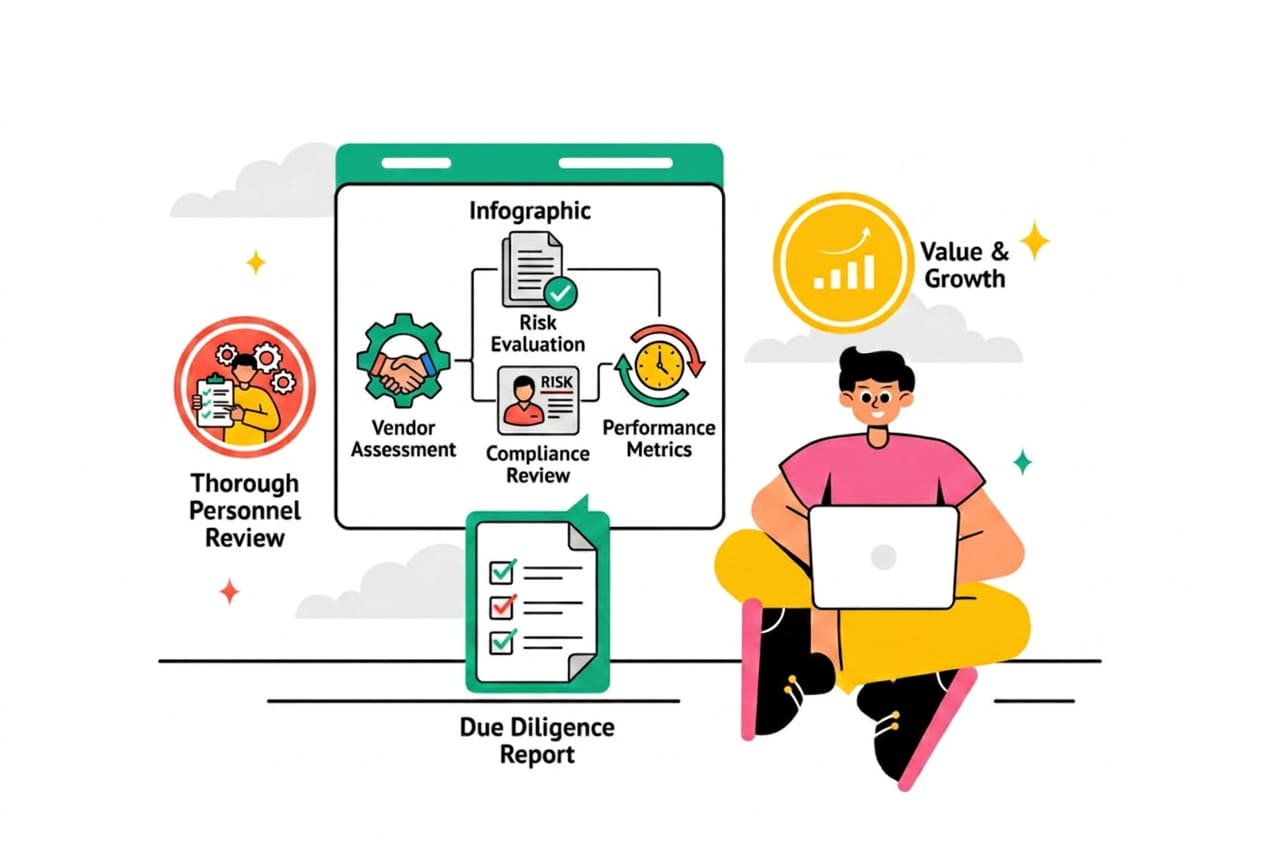
Outsourcing vendor due diligence is the structured review a buyer runs before selecting, contracting with, or transitioning work to an outsourcing provider. It should test whether the vendor can actually deliver the work, protect data, support compliance, operate transparently, and exit cleanly if the relationship changes.
This guide is a business review checklist, not legal, security, tax, or regulatory advice. Use it to prepare questions and evidence requests before involving legal, procurement, finance, security, and delivery leaders.
Where vendor due diligence usually breaks down
- The buyer reviews price and case studies, but does not test whether the vendor’s operating model fits the actual scope, risk, and governance needs.
- Security is treated as a certificate check instead of a control review tied to systems access, data exposure, incident response, and subcontractors.
- Financial stability, staffing continuity, and replacement capacity are discussed late, after the vendor has already become the preferred choice.
- SLAs are negotiated as generic uptime or response-time language, but not connected to the work being outsourced, the escalation path, or the buyer’s real business impact.
- Exit planning is left until renewal or conflict, even though vendor lock-in, knowledge transfer, and access removal should be reviewed before signing.
Key Takeaways
- Outsourcing vendor due diligence should cover six areas: business stability, delivery capability, security and privacy, compliance fit, commercial terms, and exit readiness.
- A strong review separates vendor claims from evidence: contracts, policies, audit reports, security controls, delivery artifacts, references, and escalation procedures.
- The level of diligence should be risk-based. A low-risk task vendor does not need the same review as a provider handling production systems, regulated data, or critical customer operations.
- Cybersecurity and third-party risk guidance from NIST and financial regulators points toward lifecycle management: assess before selection, define controls in the contract, monitor during delivery, and plan for exit [2], [3].
- Due diligence should not be a one-time procurement document. It should become the evidence base for the SOW, SLA, governance cadence, transition plan, and renewal review.
What outsourcing vendor due diligence should verify
Outsourcing vendor due diligence is not just a vendor comparison exercise. It is a risk-based verification process that asks a practical question: can this provider perform the work in a way the buyer can trust, manage, measure, and unwind?
ISO 37500 describes outsourcing as a governed lifecycle that includes strategy, initiation, transition, delivery, and exit management [1]. That lifecycle framing matters because many outsourcing failures do not come from a poor shortlist. They come from weak handoff, unclear accountability, unmanaged risk, or an exit path that was never designed.
For most outsourcing decisions, due diligence should verify five things:
- Fit: whether the vendor’s delivery model, skills, location, staffing, pricing, and governance match the work.
- Evidence: whether claims about experience, controls, quality, and capacity are supported by documents or references.
- Risk: whether security, privacy, operational, legal, continuity, and subcontractor risks are understood.
- Control: whether the contract, SLA, reporting, escalation, and ownership model create manageable accountability.
- Exit: whether the buyer can recover knowledge, data, access, and continuity if the relationship changes.
The review should become more detailed as the outsourced work becomes more critical. Due diligence for a short-term design support vendor can be lightweight. Due diligence for a software development, finance, healthcare, infrastructure, or customer-data provider should be much deeper.
Outsourcing vendor due diligence checklist
| Review area | What to check | Evidence to request | Escalate if |
|---|---|---|---|
| Business stability | Company history, ownership, financial health, legal entity, insurance, continuity | Company profile, financial summary where appropriate, insurance certificate, legal entity details | The vendor cannot identify the contracting entity or show operational continuity |
| Relevant experience | Similar scope, industry exposure, technology stack, delivery complexity | Case summaries, anonymized project examples, references, portfolio, capability matrix | Experience is described only in broad marketing language |
| Delivery model fit | Who manages work, who owns outcomes, how the team is staffed, how handoffs work | Delivery model description, RACI, sample governance cadence, staffing plan | The vendor promises managed outcomes but expects the buyer to direct all daily work |
| Talent and capacity | Hiring process, screening, seniority, backup coverage, replacement process | Screening process, sample role profile, replacement policy, onboarding plan | The vendor has no measurable replacement or backup process |
| Security posture | Access control, MFA, device policy, secure development, logging, vulnerability handling | Security policy, access control evidence, ISO/IEC 27001 or SOC 2 materials where relevant, incident process | Certification is presented as a substitute for explaining actual controls |
| Privacy and data handling | Data categories, processing purpose, subprocessors, cross-border transfer, retention, deletion | DPA template, data flow, subprocessor list, retention/deletion rules | The vendor cannot explain what data it will access or how it is processed |
| Compliance fit | Sector requirements, audit support, regulatory responsibilities, record retention | Compliance matrix, audit reports, policy excerpts, responsibility matrix | The vendor says “compliant” without identifying which obligation applies |
| Commercial and SLA fit | Pricing model, billing unit, change control, service levels, response/resolution targets | Rate card, SOW, SLA, change request process, invoice sample | Price is clear but scope, change control, and service obligations are vague |
| Governance | Reporting cadence, escalation path, risk review, steering meetings, issue ownership | Governance calendar, sample report, escalation matrix, KPI dashboard | There is no named owner for delivery, security, commercial, or executive escalation |
| Exit readiness | Knowledge transfer, access removal, data return, transition support, termination rights | Exit plan, offboarding checklist, documentation plan, data return/destruction process | Termination is allowed but handover and access removal are not operationalized |
Evidence matrix: what to ask for before signing
| Evidence item | Why it matters | How to use it |
|---|---|---|
| Master service agreement and SOW draft | Shows whether legal terms and operating reality match | Compare scope, accountability, IP, liability, confidentiality, termination, and handover language |
| Delivery model / RACI | Reveals who owns decisions, delivery, acceptance, and escalation | Use it to prevent mismatch between staff augmentation, project outsourcing, and managed service expectations |
| Security policy summary | Shows whether controls are operational, not only claimed | Map controls to access, systems, data, development, monitoring, and incident risks |
| SOC 2 report or ISO/IEC 27001 certificate where relevant | Provides assurance or management-system evidence for security controls | Verify scope, period, exceptions, and whether it covers the service you will use [5], [6] |
| Data processing agreement | Clarifies controller/processor responsibilities where personal data is involved | Check data categories, subprocessors, processing instructions, deletion, and audit rights [8] |
| Incident response procedure | Shows whether the vendor can notify, investigate, contain, and communicate incidents | Align notification timelines and evidence duties with your internal response process [7] |
| SLA and KPI definitions | Converts service expectations into measurable obligations | Confirm response time, resolution time, availability, quality, reporting, and escalation rules [9], [10] |
| Staffing and replacement policy | Protects continuity when people leave, underperform, or need to be changed | Add measurable replacement timelines and knowledge-transfer expectations to the SOW |
| Reference calls or customer proof | Tests whether the vendor has delivered comparable work | Ask about communication, ownership, quality, escalation, turnover, and hidden costs |
| Exit and transition plan | Reduces lock-in and protects continuity | Define documentation, data return, access removal, transition assistance, and final handover |
1. Review business stability and strategic fit
Business stability review should answer whether the vendor is likely to remain a reliable operating partner across the contract period. This does not always require a full financial audit, but it should go beyond checking the homepage.
Review the contracting entity, ownership, years in operation, leadership continuity, relevant insurance, location footprint, service history, hiring capacity, and whether the vendor depends too heavily on one small team or subcontractor. Deloitte’s 2024 outsourcing survey indicates that outsourcing remains part of broader workforce and capability strategy, with many executives maintaining or increasing outsourcing investment [11]. That context makes vendor selection more strategic: buyers are not just purchasing hours, they are extending how work gets done.
A useful question is: if this vendor loses a key person, faces a local disruption, or needs to replace a team, can the service continue without making the buyer rebuild the work from scratch?
2. Test delivery capability against the real outsourcing model
Delivery capability should be reviewed against the work you are actually outsourcing. A vendor can be strong at staff augmentation but weaker at managed delivery. Another vendor may be strong at project-based execution but not suited to ongoing production support. Due diligence should therefore test the model, not just the vendor’s general reputation.
Ask how the vendor scopes work, assigns roles, manages backlog or tickets, handles quality review, reports progress, escalates issues, replaces people, and transfers knowledge. For software outsourcing, ask for examples of development process, QA approach, release controls, documentation, and delivery governance. For business process outsourcing, ask how the provider controls accuracy, turnaround time, exception handling, data access, and continuity.
The most important fit question is simple: does the vendor’s accountability match the model you are buying? If the vendor will own outcomes, the SOW and SLA should define deliverables, acceptance criteria, reporting, and remedies. If the buyer will direct the work, the contract should focus more on role quality, availability, replacement, confidentiality, IP, and access control.
3. Review security, privacy, and subcontractor risk before transition
Security due diligence should start before transition, not after accounts and repositories have already been opened. NIST SP 800-161 frames cybersecurity supply chain risk management as a process for identifying, assessing, and mitigating cybersecurity risks throughout the supply chain [3]. For outsourcing, that means vendor review should cover not only the provider but also subprocessors, tools, infrastructure, and handoffs.
Use security certificates and reports carefully. ISO/IEC 27001 can indicate that the vendor operates an information security management system and risk-management process [5]. SOC 2 can provide assurance about controls relevant to security, availability, processing integrity, confidentiality, or privacy [6]. But due diligence should still check scope: what service, office, system, period, control exceptions, and remediation items are actually covered?
For higher-risk work, ask how the vendor handles least privilege, MFA, device security, secure coding, code review, vulnerability management, logging, backups, data retention, and incident response. NIST SP 800-53 provides a broad catalog of security and privacy controls that can help buyers structure this review [4]. NIST SP 800-61 Rev. 3 also emphasizes preparing for incident response, reducing incident impact, and improving detection, response, and recovery activities [7].
4. Separate compliance claims from compliance responsibilities
A vendor saying it is “compliant” is not enough. Due diligence should ask: compliant with what, for which service, in which jurisdiction, for which data, under which contractual responsibility, and with what evidence?
If personal data is involved, the data processing arrangement may need to define subject matter, duration, nature and purpose of processing, categories of data, data subjects, controller obligations, and processor obligations. GDPR Article 28 is one example of a processor-contract framework that requires processing to be governed by a contract or other legal act [8]. Similar logic applies more broadly: the contract should assign responsibilities, not rely on general trust.
For regulated industries, compliance review should include legal, security, and business owners. The vendor may support evidence, controls, reporting, and audit cooperation, but the buyer may still retain accountability for the process, customer obligations, or regulatory exposure.
5. Connect commercial terms, SLAs, and governance
Commercial review should not stop at the rate card. The vendor may look cost-effective until the buyer checks onboarding delay, change requests, overtime, minimum billing periods, travel expenses, idle time, replacement windows, escalation labor, and transition support.
An SLA should define measurable expectations. IBM describes SLAs as agreements that define service expectations and performance measures, with metrics such as availability, error rates, response time, resolution time, and mean time to recovery [9]. IBM also explains that response time and resolution time are common SLA metrics for service requests and incidents [10]. For outsourcing vendor due diligence, the buyer should check whether those metrics are actually relevant to the service.
A staff augmentation engagement may need replacement speed, candidate quality, attendance, communication, and escalation SLAs. A managed service may need uptime, incident response, resolution, reporting, and root-cause-analysis commitments. A project-based engagement may need milestone acceptance, defect handling, change control, and warranty rules.
The governance package should connect the contract to operations: meeting cadence, report owner, KPI dashboard, escalation path, security review, risk register, steering committee, and renewal review.
Red flags that should stop or slow the decision
- The vendor cannot clearly explain whether it is offering staff augmentation, project-based outsourcing, managed service, or a hybrid model.
- Price is detailed, but scope, acceptance criteria, change control, and escalation are vague.
- Security proof is limited to logos or claims, with no scope, report period, exception handling, or control explanation.
- The vendor cannot identify subprocessors, tools, data locations, or who can access buyer systems.
- There is no documented replacement process for key people.
- References are generic and do not match the work, industry, complexity, or geography of your project.
- The vendor refuses reasonable contract language for confidentiality, IP, data protection, incident notice, or audit cooperation.
- The SLA measures easy items but avoids the failure modes that would actually hurt the business.
- Exit terms exist legally but do not explain knowledge transfer, documentation, data return, and access removal.
- The vendor is willing to start quickly but cannot show a transition plan.
A practical due diligence workflow
- Define the work first. Clarify scope, systems, data, users, expected outcomes, internal owner, and decision criteria.
- Classify risk. Decide whether the work is low, medium, or high risk based on data sensitivity, operational criticality, customer impact, regulatory exposure, and switching cost.
- Request evidence by risk level. Do not ask every vendor for every document. Ask for the evidence that fits the service and risk profile.
- Run cross-functional review. Procurement, legal, finance, security, privacy, IT, and delivery should review different parts of the evidence.
- Map findings into the SOW and contract. Every critical risk should become a term, control, SLA, reporting item, or escalation rule.
- Decide with conditions. Approve, reject, or approve with remediation requirements, such as updated SLA language, security addendum, DPA, stronger exit plan, or reference call.
- Carry findings into onboarding. Due diligence is wasted if transition teams do not inherit the evidence, risks, and agreed controls.
- Re-review during renewal. Vendor due diligence should continue through performance reviews, incidents, scope changes, and renewal decisions, consistent with lifecycle risk management [2].
FAQ
What is outsourcing vendor due diligence?
Outsourcing vendor due diligence is the review process used to verify whether a provider is operationally, financially, legally, technically, and commercially suitable before work is contracted or transitioned. It should test claims against evidence, not just compare proposals.
When should due diligence happen?
It should start before vendor selection and continue through contracting, transition, ongoing monitoring, renewal, and exit. Third-party risk guidance commonly treats vendor management as a lifecycle rather than a one-time procurement task [2].
What documents should a buyer request from an outsourcing vendor?
Common documents include the MSA, SOW, SLA, rate card, security policy summary, SOC 2 or ISO/IEC 27001 evidence where relevant, DPA, incident response process, subprocessor list, insurance certificate, reference details, onboarding plan, replacement policy, and exit plan.
Is SOC 2 or ISO/IEC 27001 enough to approve a vendor?
No. They can be useful evidence, but buyers still need to check service scope, control coverage, exceptions, data access, incident process, subcontractors, and whether the report or certificate applies to the service being purchased [5], [6].
Who should be involved in vendor due diligence?
Procurement usually coordinates the process, but legal, finance, security, privacy, IT, delivery leadership, and the business owner should review the areas they own.
What to Keep in Mind
- Review the vendor against the actual work, data, systems, and accountability you are outsourcing.
- Ask for evidence, not just claims, especially around security, delivery quality, financial stability, replacement, and exit readiness.
- Make the diligence outcome operational: update the SOW, SLA, security addendum, DPA, governance cadence, and transition plan.
- Treat certifications as helpful inputs, not automatic approval.
- Revisit due diligence during major scope changes, incidents, renewals, and exit planning.
References
- International Organization for Standardization, “ISO 37500:2014, Guidance on outsourcing.” Accessed: May 11, 2026. [Online]. Available: https://www.iso.org/standard/56269.html
- Federal Deposit Insurance Corporation, “Interagency Guidance on Third-Party Relationships: Risk Management.” Accessed: May 11, 2026. [Online]. Available: https://www.fdic.gov/news/financial-institution-letters/2023/fil23029.html
- National Institute of Standards and Technology, “Cybersecurity Supply Chain Risk Management Practices for Systems and Organizations, NIST SP 800-161 Rev. 1.” Accessed: May 11, 2026. [Online]. Available: https://csrc.nist.gov/pubs/sp/800/161/r1/final
- National Institute of Standards and Technology, “Security and Privacy Controls for Information Systems and Organizations, NIST SP 800-53 Rev. 5.” Accessed: May 11, 2026. [Online]. Available: https://csrc.nist.gov/pubs/sp/800/53/r5/upd1/final
- International Organization for Standardization, “ISO/IEC 27001:2022, Information security management systems — Requirements.” Accessed: May 11, 2026. [Online]. Available: https://www.iso.org/standard/27001
- AICPA & CIMA, “SOC 2® – SOC for Service Organizations.” Accessed: May 11, 2026. [Online]. Available: https://www.aicpa-cima.com/topic/audit-assurance/audit-and-assurance-greater-than-soc-2
- National Institute of Standards and Technology, “Incident Response Recommendations and Considerations for Cybersecurity Risk Management, NIST SP 800-61 Rev. 3.” Accessed: May 11, 2026. [Online]. Available: https://csrc.nist.gov/pubs/sp/800/61/r3/final
- Intersoft Consulting, “Art. 28 GDPR – Processor.” Accessed: May 11, 2026. [Online]. Available: https://gdpr-info.eu/art-28-gdpr/
- IBM, “What Is an SLA (service level agreement)?.” Accessed: May 11, 2026. [Online]. Available: https://www.ibm.com/think/topics/service-level-agreement
- IBM, “Types of Service Level Agreement (SLA) Metrics.” Accessed: May 11, 2026. [Online]. Available: https://www.ibm.com/think/topics/sla-metrics
- Deloitte, “Global outsourcing survey 2024.” Accessed: May 11, 2026. [Online]. Available: https://www.deloitte.com/global/en/issues/work/global-outsourcing-survey.html
- Bestarion, “Bestarion: Top ITO & BPO Solution Provider In Vietnam.” Accessed: May 11, 2026. [Online]. Available: https://bestarion.com/
- Bestarion, “Software Development Services.” Accessed: May 11, 2026. [Online]. Available: https://bestarion.com/services/software-development/
- Bestarion, “Staff Augmentation Services.” Accessed: May 11, 2026. [Online]. Available: https://bestarion.com/services/staff-augmentation/