Offshore Outsourcing Explained: What It Is, How It Works, Benefits, Risks, and When to Use It
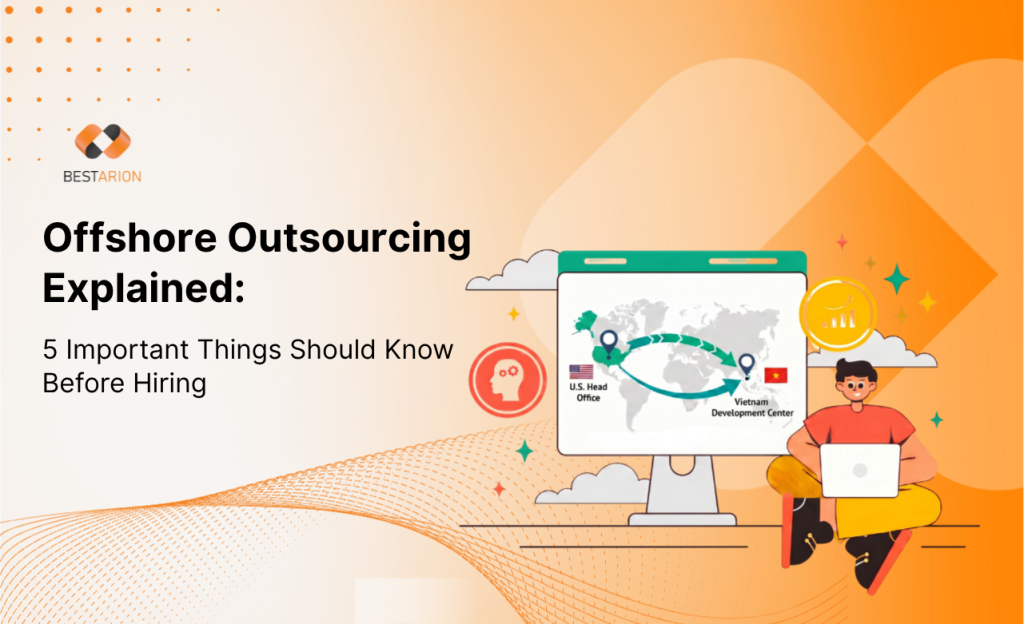
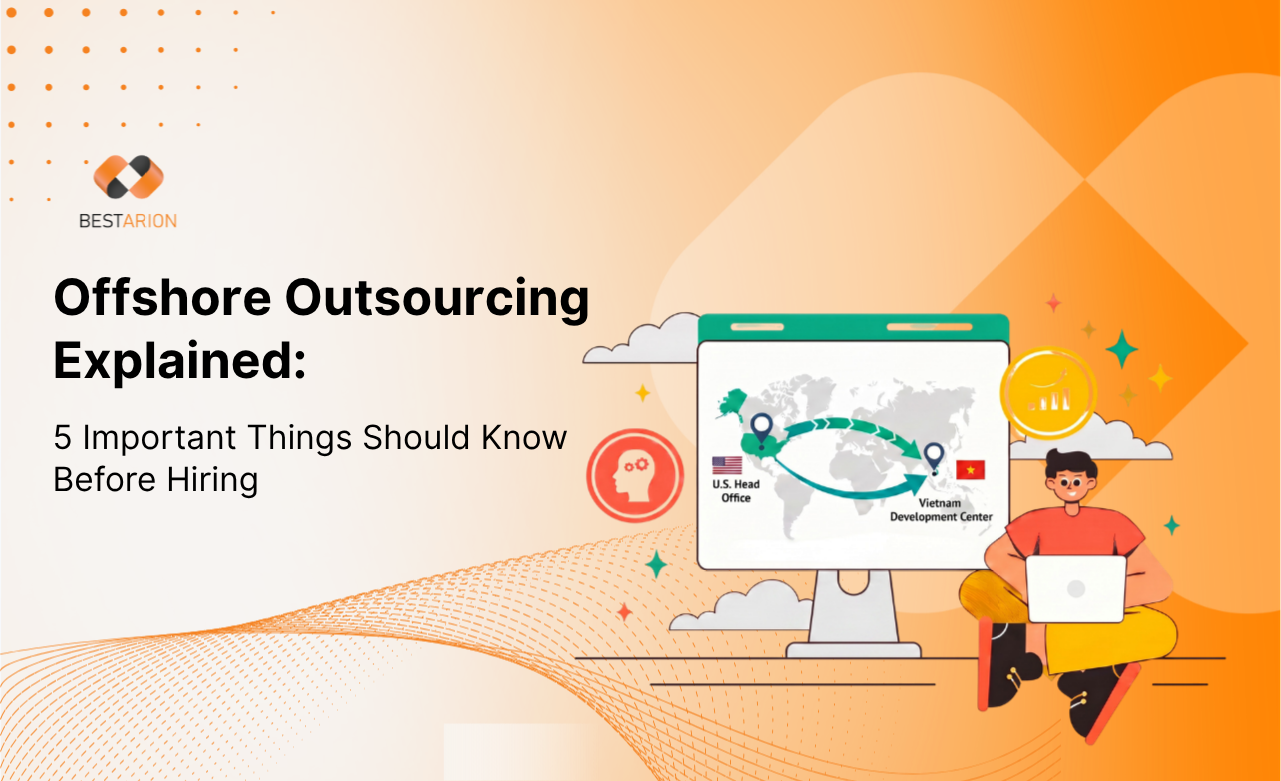
Offshore outsourcing is the practice of hiring an external provider in another country to deliver work that would otherwise be handled in-house or domestically. The important part is that “offshore” only describes location. It does not, by itself, tell you whether the work is staff augmentation, a managed service, a project engagement, a dedicated team, BPO, or an outcome-based arrangement.
Where buyers usually get offshore outsourcing wrong
- They treat offshore outsourcing as a pricing model, when it is primarily a location model.
- They compare offshore rates without deciding who owns delivery, quality, security, and communication.
- They expect cost savings but underestimate governance, onboarding, handoff, and review time.
- They choose offshore for speed, then assign work that requires constant real-time stakeholder alignment.
- They use one contract structure for different work types, such as software development, customer support, finance operations, and data processing.
Key Takeaways
- Offshore outsourcing combines two ideas: work is performed in another country, and an external provider performs it. OECD distinguishes outsourcing from offshoring by ownership and location, which is why the terms should not be treated as identical [1].
- Offshore outsourcing can work well for scalable, repeatable, or talent-constrained work, but it requires explicit governance, risk controls, and collaboration routines [2], [3].
- Cost is only one part of the decision. Deloitte’s 2024 outsourcing survey shows organizations are managing a broader sourcing ecosystem that includes outsourcing providers, GICs, AI-enabled delivery, and outcome-based models [4].
- Security, data access, supplier visibility, and control ownership need to be defined before work moves offshore, especially for technology or data-heavy work [5], [8].
- Offshore outsourcing is not automatically better than nearshore or onshore. The right location model depends on the work’s collaboration intensity, risk profile, urgency, and tolerance for time-zone distance [1], [9].
What offshore outsourcing means
Offshore outsourcing means a company contracts work to an external provider located in another country, usually farther away from the buyer’s home market.
That definition has two parts:
- Offshore: the work is performed abroad.
- Outsourcing: the work is performed by an external provider rather than an internal team.
OECD explains that outsourcing and offshoring are related but not the same: outsourcing is about whether a task is performed by an external supplier, while offshoring is about whether the task is performed abroad [1]. IBM defines BPO as hiring external service providers to handle business functions or processes, often including back-office and front-office activities [2].
So, offshore outsourcing sits at the intersection of both ideas: external provider plus foreign delivery location.
Offshore outsourcing vs. offshoring vs. nearshoring vs. onshoring
| Term | What it means | Provider ownership? | Location logic | Simple example |
|---|---|---|---|---|
| Offshore outsourcing | External provider in another country performs the work | Yes | Abroad, often farther away | A US company hires a Vietnam-based software development provider |
| Offshoring | Work moves abroad, but it may be internal or external | Not always | Abroad | A company opens its own offshore delivery center |
| Nearshoring | External or internal work moves to a nearby country | Depends | Nearby country or region | A US company works with a Mexico-based team |
| Onshoring | Work stays within the same country | Depends | Domestic | A US company hires a US-based vendor |
| Outsourcing | External provider performs the work | Yes | Any location | A company hires an outside payroll, IT, or customer support provider |
What companies usually outsource offshore
Offshore outsourcing is common when the work can be structured, documented, reviewed asynchronously, and scaled through a specialized delivery team.
Common examples include:
- Software development, QA, application maintenance, and DevOps support.
- IT help desk, infrastructure monitoring, cloud operations, and data support.
- Finance and accounting operations such as bookkeeping, AP/AR support, reconciliation, and reporting.
- Customer support, back-office operations, content moderation, data entry, and business process support.
- Analytics, research support, automation, and specialized knowledge work when scope and review criteria are clear.
NetSuite classifies outsourcing across function, location, and scope, while IBM notes that BPO covers both back-office and front-office functions and is increasingly connected to technology, automation, and expertise access [2], [7].
When offshore outsourcing makes sense
| Situation | Why offshore may fit | What to verify first |
|---|---|---|
| You need specialized talent that is hard to hire locally | Offshore providers can expand access to broader talent pools | Skill depth, language proficiency, portfolio, seniority mix |
| You have ongoing workload that can be documented | Repeatable work can benefit from process standardization | SOPs, acceptance criteria, review cadence |
| You need extended coverage across time zones | Offshore teams can support handoffs or longer operating windows | Response-time expectations and escalation rules |
| You want cost flexibility without overhiring | External offshore capacity can reduce fixed hiring commitments | Total cost, not just hourly rate |
| You can manage work through clear outputs | Offshore execution improves when tasks have measurable deliverables | Definition of done, quality checks, ownership model |
When offshore outsourcing may not fit
Offshore outsourcing is less suitable when the work depends on constant real-time alignment, unresolved internal decision-making, highly sensitive data access without mature controls, or frequent executive-level ambiguity.
Use caution if:
- Requirements change daily and no one owns prioritization.
- Stakeholders expect live collaboration across all working hours.
- The work involves regulated or sensitive data but no access-control model is defined.
- The buyer has no internal owner for scope, quality, or acceptance.
- The provider is expected to deliver outcomes without access to the systems, decisions, or data required to influence those outcomes.
Bain’s nearshoring research also shows that companies often combine onshoring, nearshoring, and offshoring to balance resilience and cost rather than treating one location model as universally superior [9].
Main benefits of offshore outsourcing
| Benefit | What it can improve | What must be managed |
|---|---|---|
| Cost leverage | Lower delivery cost compared with many domestic labor markets | Total cost of management, onboarding, rework, and transition |
| Talent access | Broader access to specialized or scarce skills | Vetting, seniority mix, retention, communication quality |
| Scalability | Faster capacity expansion than internal hiring | Ramp plan, knowledge transfer, documentation |
| Focus | Internal teams can focus on higher-value or core work | Clear boundaries between retained and outsourced work |
| Extended coverage | Time-zone spread can support longer coverage windows | Handoff rules, escalation, service hours |
| Process maturity | Providers may bring tooling, automation, and delivery routines | Fit with buyer systems, data security, and governance |
Main risks of offshore outsourcing
| Risk | Why it happens | How to reduce it |
|---|---|---|
| Communication friction | Time-zone distance, language differences, unclear channels | Define meeting rhythm, escalation path, written decision logs |
| Hidden cost | Hourly rate excludes management, transition, rework, or change requests | Compare total cost and contract assumptions |
| Scope drift | Work is moved offshore before deliverables are stable | Lock requirements, acceptance criteria, and change-control rules |
| Data and cyber risk | Offshore providers may need access to systems, data, or customer information | Apply supplier risk assessment, access controls, and evidence reviews |
| Quality inconsistency | Definition of done is vague or review ownership is unclear | Use QA checklists, sample reviews, and performance metrics |
| Governance gaps | Buyer assumes provider owns more than the contract states | Define RACI, SLAs, KPIs, reporting, and decision rights |
The governance layer buyers should not skip
Offshore outsourcing should not be managed only through task assignment. It needs a governance layer.
At minimum, define:
- Scope owner: who decides what is in or out of scope.
- Delivery owner: who manages the offshore team or service.
- Security owner: who approves access to data, environments, tools, and systems.
- Quality owner: who accepts deliverables and signs off changes.
- Commercial owner: who tracks budget, change requests, invoices, and pricing assumptions.
- Escalation owner: who handles missed deadlines, quality issues, and unresolved dependencies.
ISO 37500 places governance, flexibility, risk identification, and collaborative client-provider relationships at the center of successful outsourcing arrangements [3]. AWS’s shared responsibility model is a useful operational analogy: even when a provider manages part of the environment, the buyer still needs to know which responsibilities remain with them [8].
How to decide whether offshore outsourcing is the right model
Use this checklist before shortlisting vendors:
- Work clarity: Can the work be documented, estimated, reviewed, and accepted?
- Collaboration intensity: Does the work require live collaboration every day, or can it run asynchronously with planned checkpoints?
- Risk level: Does the work involve sensitive data, regulated operations, critical infrastructure, or customer-facing risk?
- Internal ownership: Who on your side owns scope, priorities, quality, and vendor communication?
- Provider maturity: Can the provider show process, security, staffing, reporting, and escalation evidence?
- Commercial fit: Does the pricing model match the uncertainty of the work?
- Location fit: Is the time-zone gap a benefit, a manageable trade-off, or a blocker?
- Scale path: Can the setup grow from pilot to ongoing operation without losing control?
If the answer to several of these questions is unclear, the problem is not the offshore model itself. The problem is that the operating model is not ready.
Common mistakes to avoid
| Mistake | Why it creates problems | Better approach |
|---|---|---|
| Choosing offshore only because the hourly rate is lower | Cheap capacity can become expensive if rework, management, and delay increase | Compare total cost and governance effort |
| Treating offshore outsourcing as a complete model | Offshore only answers where work happens | Pair location with pricing, engagement, and delivery rules |
| Moving unclear work offshore too early | Offshore teams cannot fix unresolved strategy or unclear ownership | Run discovery first, then outsource defined work packages |
| Ignoring data and access controls | Offshore teams often need system access to deliver value | Define least-privilege access, monitoring, and evidence requirements |
| Expecting managed-service accountability from staff augmentation | A staffed team does not automatically own outcomes | Choose engagement model based on accountability needed |
| Not planning knowledge transfer | Offshore delivery depends on context, not just task assignment | Build onboarding, documentation, and review loops into the plan |
How to start with offshore outsourcing
A practical starting path is:
- Choose one workstream, not an entire operating function.
- Define the target outcome, deliverables, acceptance criteria, and excluded scope.
- Decide whether the provider is supplying people, delivering a project, or owning a managed process.
- Select pricing based on uncertainty: fixed scope, time and materials, capacity-based, output-based, or outcome-based.
- Create security and access rules before onboarding.
- Run a pilot with measurable outputs.
- Review quality, communication, cost, and governance before scaling.
Deloitte’s outsourcing research points to a more complex sourcing environment where organizations must govern providers, internal centers, AI-enabled delivery, and extended workforces more deliberately [4]. That is why a small, well-governed pilot is usually safer than moving too much work offshore at once.
FAQ
What is offshore outsourcing?
Offshore outsourcing means hiring an external provider in another country to perform work or services. It combines a location decision, offshore delivery, with a sourcing decision, external provider delivery [1], [2].
Is offshore outsourcing the same as offshoring?
No. Offshoring means work is performed abroad, but the work may be done by an internal foreign affiliate or an external provider. Offshore outsourcing specifically means the work is both abroad and externally provided [1].
What is the difference between offshore and nearshore outsourcing?
Offshore outsourcing usually involves a more distant country and may provide greater cost leverage or talent access. Nearshore outsourcing uses a nearby country and may improve time-zone overlap, travel ease, and collaboration, but it can reduce some cost advantage [7], [9].
What are the biggest risks of offshore outsourcing?
The biggest risks are unclear scope, communication gaps, hidden cost, quality inconsistency, data/security exposure, and weak governance. These risks are manageable only when roles, access, metrics, and escalation are defined upfront [3], [5], [6].
Is offshore outsourcing only for large companies?
No. Smaller companies can use offshore outsourcing for focused workstreams, but they still need a clear owner, documentation, quality review, and vendor management. Offshore outsourcing becomes risky when small teams outsource unclear work without enough internal oversight.
What to Keep in Mind
- Offshore outsourcing is a location-based model, not a full delivery strategy by itself.
- Use offshore when the work can be documented, reviewed, and governed across distance.
- Do not compare providers by hourly rate alone; compare total cost, control, risk, and accountability.
- Security and access rules should be designed before onboarding, not after work begins.
- The best offshore setups start with a narrow, measurable pilot and scale only after governance works.
References
[1] S. Broecke, “Offshoring, Reshoring, and the Evolving Geography of Jobs: A Scoping Paper,” OECD Social, Employment and Migration Working Papers, no. 308, Apr. 23, 2024. Accessed: Apr. 28, 2026. [Online]. Available: https://www.oecd.org/content/dam/oecd/en/publications/reports/2024/04/offshoring-reshoring-and-the-evolving-geography-of-jobs_bcef831d/adc9a9d5-en.pdf
[2] M. Scapicchio, M. Finio, and A. Downie, “What is business process outsourcing (BPO)?,” IBM Think, n.d.. Accessed: Apr. 28, 2026. [Online]. Available: https://www.ibm.com/think/topics/business-process-outsourcing
[3] International Organization for Standardization, “ISO 37500:2014 Guidance on outsourcing,” ISO, 2014. Accessed: Apr. 28, 2026. [Online]. Available: https://www.iso.org/standard/56269.html
[4] K. Aneja, J. Coronado, and M. Stoler, “Global Outsourcing Survey 2024: Multidimensional sourcing: Orchestrating the extended workforce ecosystem,” Deloitte, 2024. Accessed: Apr. 28, 2026. [Online]. Available: https://www.deloitte.com/us/en/services/consulting/articles/global-outsourcing-survey.html
[5] J. Boyens, C. Paulsen, R. Moorthy, N. Bartol, and S. Shankles, “Cybersecurity Supply Chain Risk Management Practices for Systems and Organizations, SP 800-161 Rev. 1,” NIST, May 2022. Accessed: Apr. 28, 2026. [Online]. Available: https://csrc.nist.gov/pubs/sp/800/161/r1/final
[6] Information Services Group, “Contractual Pricing Assurance: Beyond Benchmarking,” ISG, 2016. Accessed: Apr. 28, 2026. [Online]. Available: https://isg-one.com/docs/default-source/default-document-library/contractual-pricing-assurance.pdf
[7] A. Jenkins, “The 14 Types of Outsourcing: A Guide,” NetSuite, Jun. 27, 2025. Accessed: Apr. 28, 2026. [Online]. Available: https://www.netsuite.com/portal/resource/articles/erp/types-of-outsourcing.shtml
[8] Amazon Web Services, “Shared Responsibility Model,” AWS, n.d.. Accessed: Apr. 28, 2026. [Online]. Available: https://aws.amazon.com/compliance/shared-responsibility-model/
[9] P. Hanbury, J. Ciuró, C. Cruz, and S. Daubin, “Nearshoring: Overcoming the Obstacles,” Bain & Company, 2024. Accessed: Apr. 28, 2026. [Online]. Available: https://www.bain.com/insights/nearshoring-overcoming-the-obstacles/