
Comparing Popular AI Agent Frameworks: LangChain, AutoGen, and CrewAI – Which is the Best Choice for You?
If you search “LangChain vs AutoGen vs CrewAI”, you will see a mix of opinions, short rankings, and tool hype. That is rarely enough when you must ship an agent system that is reliable, testable, and maintainable.
This is a decision framework, not a tutorial. You will get:
A 60-second pick for three common scenarios
A decision-level architecture comparison (orchestration model and control surface)
Workload-fit guidance (what each is best for, and what it’s bad at)
A high-level production readiness checklist (without turning into a playbook)
A scorecard with scenario weights
A 1-week POC plan to validate with evidence
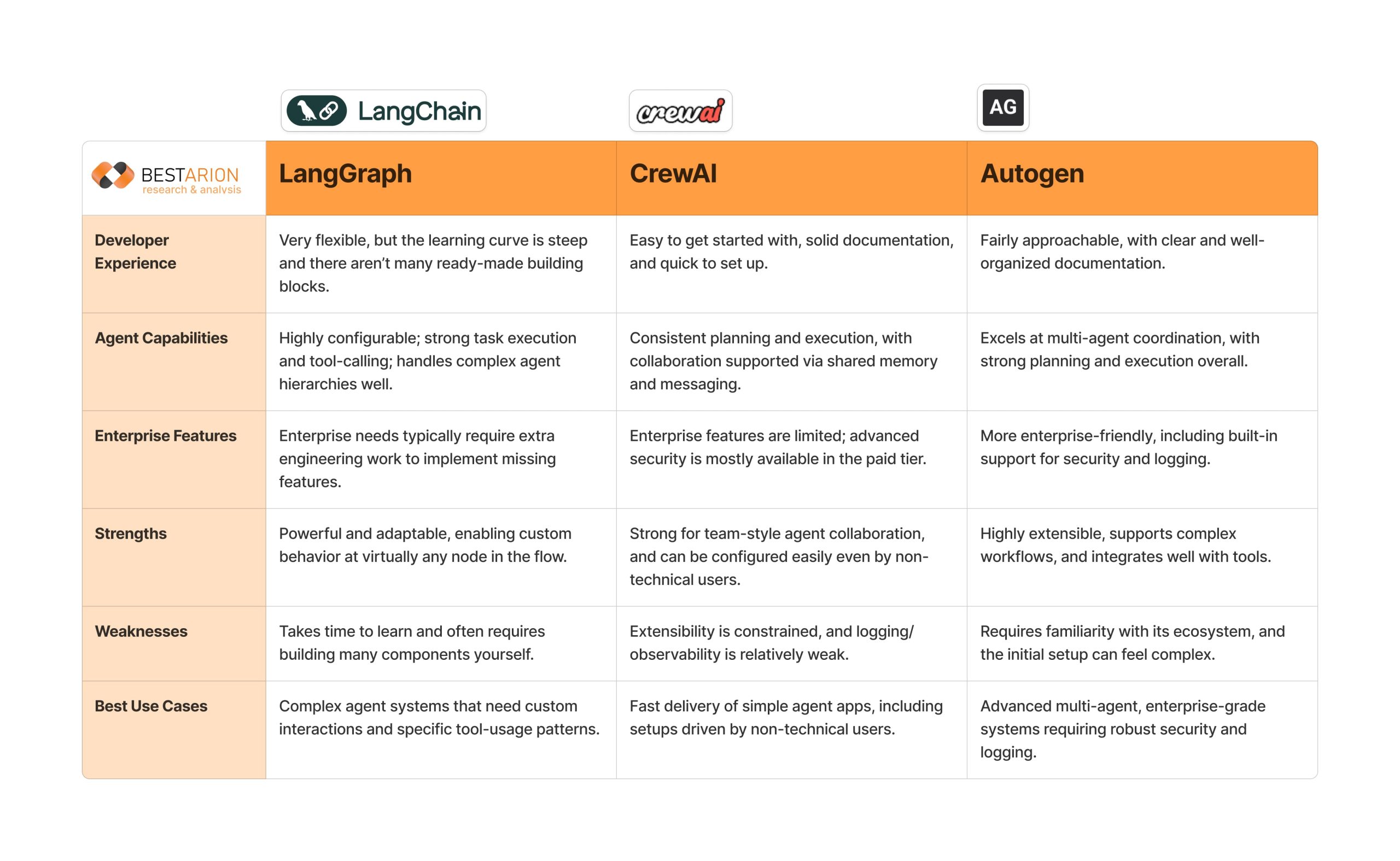
Terminology note: “LangGraph” often appears in these comparisons because LangChain’s agent runtime is graph-based and built on LangGraph. This article stays focused on the three frameworks in the title and references LangGraph only to clarify what “LangChain agents” means.
The 60-second answer: LangChain vs AutoGen vs CrewAI choose in 3 common scenarios
Scenario A: Tool-using assistant + RAG-first workflows
Best default: LangChain
-
Best when you want fast assembly (tools, retrieval, orchestration patterns) and broad ecosystem reuse
-
You can keep the system mostly deterministic, with only a few agentic steps where needed
Trade-offs:
-
You still need guardrails, evaluations, and operational ownership to make it production-grade
Scenario B: Multi-agent collaboration to solve tasks
Best default: AutoGen or CrewAI
-
Choose AutoGen when you want flexible multi-agent coordination and you’re comfortable designing constraints yourself.
-
Choose CrewAI when you want an opinionated “crews + flows” structure for collaboration and a stronger “rails” story.
Trade-offs:
-
.Multi-agent is easy to overuse and easy to break (loops, tool misuse, runaway costs.
Scenario C: Production workflows with state + approvals + durability
Best default: LangChain (structured) or CrewAI (flows)
-
If you need explicit orchestration and durable execution patterns, graph/flow primitives are usually easier to reason about
Trade-offs:
-
Do not confuse “framework choice” with “production readiness.” Your engineering practices matter more.
Comparison tables (core “vs” intent)
Table 1: At-a-glance comparison
| Dimension | LangChain | AutoGen | CrewAI |
|---|---|---|---|
| Best for (default fit) | Tool-using apps, RAG-first apps, broad ecosystem | Multi-agent collaboration, flexible coordination | Opinionated multi-agent systems with crews/flows |
| Orchestration style | Graph-based runtime under the hood (LangGraph) | Conversation-driven multi-agent coordination | Crews + Flows orchestration |
| Control vs speed | Good balance: speed with a path to explicit control | High flexibility; control depends on your design discipline | More structure by default; faster consistency for teams |
| Where it shines | Composability, ecosystem, structured orchestration | Agent collaboration patterns, experimentation | Team-like orchestration patterns, flow traceability |
| Main risk if misused | “Component soup” without standards | Loops, brittle coordination, cost explosion | Abstraction hides issues if not instrumented |
Table 2: Scenario mapping
| Scenario | Best default | Why it fits | Watch-outs |
|---|---|---|---|
| Tool-using assistant + RAG-first | LangChain | Strong ecosystem; graph-based runtime via LangGraph | Must still add guardrails and eval |
| Multi-agent collaboration | AutoGen or CrewAI | AutoGen is built for agentic/multi-agent apps ; CrewAI adds structured crews/flows | Over-agenting; constrain steps and costs |
| Production workflows with state + approvals | LangChain (structured) or CrewAI (flows) | Graph/flow improves auditability; LangGraph emphasizes durability/HITL | Don’t turn into a full playbook in this post |
What each framework is (and isn’t)
LangChain (and where LangGraph fits)
LangChain is a framework for building LLM applications with components for models, tools, retrieval, and agent-style execution. What matters for this comparison is that LangChain’s agent runtime is graph-based and built using LangGraph.
What that implies in decision terms:
-
Better path to explicit orchestration than “one loop forever”
-
A natural place to express deterministic steps plus limited agentic steps
-
A clear way to add approval points or structured transitions when your workflow grows
LangChain is not a full production platform by itself. You still need your own observability standards, evaluation loops, rollout practices, and ownership model.
AutoGen
AutoGen positions itself as a programming framework for agentic AI and explicitly targets multi-agent applications that can act autonomously or alongside humans.
Decision-level implications:
-
Strong fit when multi-agent collaboration is core to your product
-
Faster exploration of agent coordination patterns
-
Requires design discipline to avoid chaos (especially for production)
CrewAI
CrewAI emphasizes collaborative agents, “crews,” and “flows,” with guardrails and observability as part of the framework narrative.
Decision-level implications:
-
Opinionated structure can reduce ambiguity and improve team consistency
-
Flows can help trace execution steps and debug
-
Still needs evaluation and cost controls, but the structure can make that easier to integrate
Core architecture: orchestration model and control surface
Table 3: Architecture and control surface
| Architecture axis | LangChain | AutoGen | CrewAI |
|---|---|---|---|
| Primary primitive | Graph-based orchestration (LangGraph under the hood) | Multi-agent interaction model | Crews + Flows |
| State model | Strong fit when expressed as explicit nodes/edges; LangGraph focuses on persistence/durability | You design how state is shared/maintained across agents | Flow structure encourages explicit execution steps |
| Human-in-the-loop | Natural in graph/flow patterns; LangGraph highlights HITL | You implement approval gates in coordination | Fits well when you model approvals as flow steps |
| Debuggability | Improves with explicit orchestration boundaries | Can get hard if conversation is too free-form | Flows can be easier to trace and reason about |
| Typical failure modes | Unclear ownership of prompts/tools; poorly defined transitions | Coordination loops; tool misuse; runaway chatter | Abstraction hides root causes if not instrumented |
Key takeaway:
-
If you need repeatable, auditable execution, structured orchestration (graph/flow) is usually safer.
-
If your value depends on agent collaboration, multi-agent frameworks can work well, but only with tight constraints.
Workload fit (how to choose without opinions)
Tool-using assistants (actions + tools)
Decide based on:
-
Tool permissions (allow-lists), parameter validation, retries with budgets
-
Testability of tool selection (did the agent pick the right tool for the right reason?)
-
Traceability (can you inspect tool calls, errors, and outcomes?)
High-level recommendation:
-
LangChain is a strong default for “tools + RAG + orchestration”
-
CrewAI is strong when you want “team-like roles + structured flows”
-
AutoGen is strong if the tool use is part of multi-agent collaboration
Agentic RAG (retrieval decisions + grounding)
The key is not “does it support RAG,” but:
-
Can you structure retrieval steps explicitly?
-
Can you capture evidence artifacts (what was retrieved and why) for eval and debugging?
-
Can you stop the agent from hallucinating sources?
Graph/flow patterns tend to make these constraints explicit.
Multi-agent task decomposition
Use multi-agent when:
-
The task decomposes into real roles (planner, researcher, verifier, executor)
-
Collaboration improves quality via critique/cross-checking
-
You can constrain steps, costs, and tool usage
Avoid multi-agent when a deterministic workflow will do.
Developer experience (DX): learning curve, abstractions, maintainability
DX should be judged on operational outcomes, not preference:
-
How quickly can a new dev become productive?
-
How easy is it to debug a failed run?
-
How consistent is the structure across multiple contributors?
Practical DX heuristics:
-
More opinionated structure (CrewAI) can reduce team inconsistency.
-
More flexible coordination (AutoGen) can accelerate experiments but risks divergent patterns.
-
Ecosystem breadth and composability (LangChain) can speed delivery but requires governance to avoid “component sprawl.”
Production readiness checklist
Table 4: Production readiness checklist (high level)
| Production concern | What “good” looks like | Decision signal |
|---|---|---|
| Reliability | Clear timeouts, retries with budgets, graceful degradation | If you can’t define failure behavior, you’re not ready |
| State and durability | Resume/replay runs; persistence for long workflows | Prefer graph/flow primitives when state matters |
| Observability | Step traces, tool logs, cost per run, error taxonomy | Choose the tool that makes instrumentation easiest for your team |
| Safety/guardrails | Tool allow-lists, schema validation, max steps/tool calls | Multi-agent requires stricter guardrails |
| Governance | Prompt/version control, approvals for high-risk actions | If regulated, require explicit approval gates |
Ecosystem and integration fit
Table 5: Integration scoping checklist
| Area | Questions to answer | Output artifact |
|---|---|---|
| Models/providers | Which models, latency, data residency | Provider matrix + constraints |
| Tools | Which APIs/DBs/queues/webhooks | Tool inventory + permissions |
| Knowledge/RAG | Document pipeline, access control | Data contracts + retrieval rules |
| Runtime | Deployments, secrets, logging/tracing | Env plan + observability baseline |
| Ownership | Who owns prompts/tools/on-call | RACI + runbook outline |
Decision scorecard (10 criteria)
Table 6: Scorecard template
| Criterion | Weight | LangChain | AutoGen | CrewAI |
|---|---|---|---|---|
| Workload fit | ||||
| Orchestration control | ||||
| State and durability | ||||
| Human-in-the-loop | ||||
| Observability/debug | ||||
| Safety/guardrails | ||||
| DX/onboarding | ||||
| Maintainability/tests | ||||
| Integration effort | ||||
| Time-to-value vs control |
Weight presets:
-
Prototype-first: emphasize workload fit, DX, time-to-value
-
Production-first: emphasize orchestration control, state/durability, observability, safety
-
Regulated: emphasize state/durability, HITL, observability, governance
1-week validation plan (POC) to avoid “opinion-only decisions”
Table 7: POC evidence artifacts
| Evidence artifact | Why it matters | Minimum bar |
|---|---|---|
| Task rubric | Prevents “worked once” bias | 10 tasks with pass/partial/fail |
| Tool-call logs | Tool misuse is a top failure mode | Right tool, right params, error taxonomy |
| Cost snapshot | Prevents runaway spending | Budget + max steps/tool calls |
| Step traces | Enables debugging and replay | Step timeline + inputs/outputs |
| Risk register | Turns unknowns into plan | Top 5 risks + mitigations + owners |
POC rules (keep constant across frameworks):
-
Same model/provider, same tools, same data, same rubric
-
Measure success rate, failure taxonomy, cost per run, and “debug time to root cause”
AutoGen status note
AutoGen’s repository includes an “Important” note recommending newcomers check Microsoft Agent Framework, and it states AutoGen will still be maintained with bug fixes and critical security patches. Microsoft describes Agent Framework as an open-source kit for building agents and multi-agent workflows, bringing together and extending ideas from Semantic Kernel and AutoGen as a unified foundation going forward.
How to interpret this:
-
If you’re in Microsoft-heavy environments, evaluate Agent Framework alongside AutoGen.
-
If you’re choosing among LangChain, AutoGen, and CrewAI, treat AutoGen as viable but be intentional about long-term direction.
FAQs
Which is best for multi-agent workflows?
If multi-agent collaboration is core and you want flexibility, AutoGen is often a strong fit because it is explicitly framed as a multi-agent application framework. If you prefer more structure (crews/flows) and an “observability-first” posture, CrewAI can be compelling.
Which is easiest to productionize with a small team?
If your team benefits from clear orchestration structure and traceability, graph/flow oriented approaches can reduce operational ambiguity. LangGraph emphasizes orchestration capabilities like durability and human-in-the-loop, and LangChain agents build on that. CrewAI highlights flow structure for tracing and debugging and recommends tracing for observability.
Do I need LangGraph to use LangChain agents?
Not necessarily. LangChain’s agents are built on top of LangGraph, but you can use LangChain agents directly and go deeper into LangGraph when you need more control.
What is the minimum POC to decide confidently?
A 1-week POC with 10 realistic tasks, fixed tools, fixed model, a clear rubric, and measurable budgets for cost and failure modes. The output must include logs, costs, and a risk register, not just “it worked on my laptop.”
When does a hybrid approach make sense?
When you need both deterministic workflows and agentic flexibility. You can structure deterministic steps as flows/graphs and use agentic steps only where needed, with guardrails.
