Managed Service Delivery Explained: Scope, SLAs, Governance, and Accountability
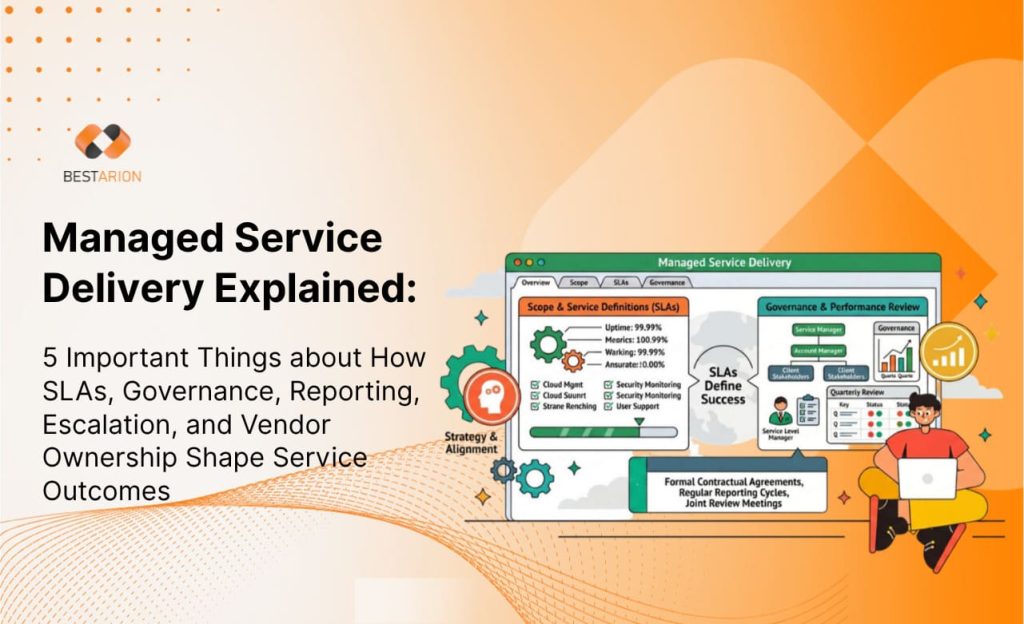
See how a managed service delivery model helps avoid delivery gaps with clear SLAs, governance, escalation paths, and ownership.
Key Takeaways
- Managed service delivery means a provider takes ongoing responsibility for a defined service or operation, with scope, service levels, reporting, and improvement expectations documented before delivery starts [1], [3].
- It is different from staff augmentation because the buyer is not simply adding people to internal management; the provider is expected to operate the service against agreed outcomes and governance routines [3], [7].
- The strongest model is built around a service catalog, SLA/KPI design, incident/request/change handling, ownership boundaries, reporting cadence, and continual improvement [1], [2], [4].
- Managed service delivery is a good fit when work is recurring, measurable, operationally important, and mature enough to be governed through service outcomes instead of task-by-task supervision.
- The biggest risk is false accountability: the vendor is blamed for outcomes, but the contract, access, decision rights, dependencies, and metrics do not give the vendor enough control to deliver them.
What managed service delivery means
Managed service delivery is an outsourcing model where a provider is responsible for running a defined service on an ongoing basis. The service may involve IT operations, application support, DevOps, QA, infrastructure, data operations, service desk, production support, or another repeatable business or technology function. The defining point is not the location of the team. It is the shift from “supply people or complete tasks” to “manage the service within agreed boundaries.”
A useful definition has four parts:
- A defined service scope: what the provider operates, supports, monitors, improves, and excludes.
- A delivery operating model: how requests, incidents, changes, reporting, and escalation are handled.
- A measurement model: which SLAs, KPIs, SLOs, or service health indicators show whether the service is working.
- A governance model: who decides priorities, reviews performance, approves changes, and handles unresolved risks.
This is why managed service delivery should not be treated as a generic synonym for outsourcing. ISO/IEC 20000-1 describes service management around establishing, implementing, maintaining, and continually improving a service management system, including planning, design, transition, delivery, and improvement of services [1]. ITIL is positioned as a best-practice framework for digital product and service management, focused on outcomes, reliability, value creation, and the service lifecycle [2]. In practical outsourcing terms, managed service delivery borrows from this service-management logic and applies it to a vendor-run service.
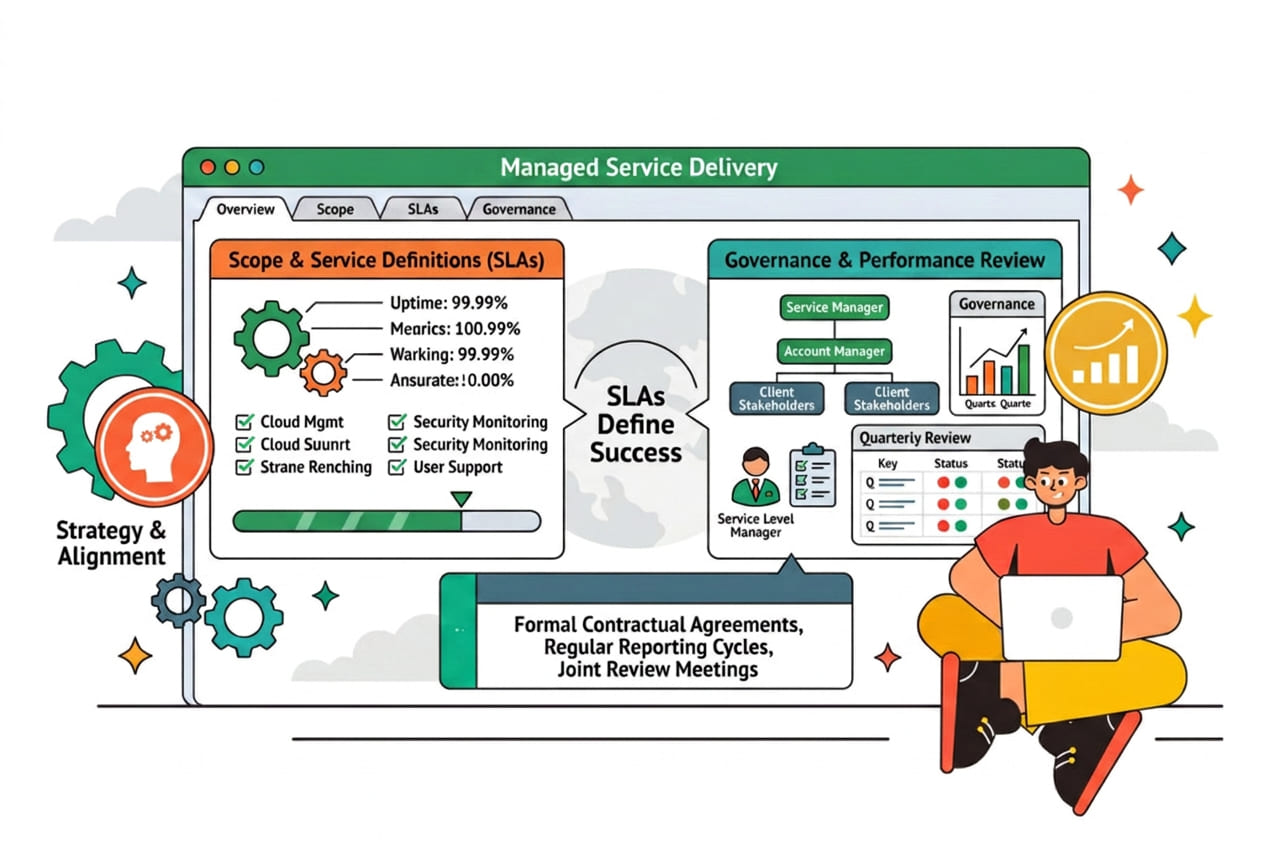
Managed service delivery boundary table
| Dimension | What managed service delivery is | What it is not | Why the boundary matters |
|---|---|---|---|
| Accountability | The provider owns agreed service activities and performance within a defined scope. | A vague promise that the vendor “handles everything.” | Accountability only works when scope, dependencies, and exclusions are clear. |
| Measurement | Performance is tracked through agreed SLAs, KPIs, service reviews, and improvement actions. | A staffing arrangement measured only by attendance or task volume. | IBM defines SLAs as agreements that specify the service, expected performance, measurement approach, and consequences if performance is not met [3]. |
| Operating rhythm | Delivery is managed through recurring operational routines: intake, prioritization, incident handling, reporting, and review. | Ad hoc support where the vendor waits for instructions every time something happens. | The buyer needs predictable service behavior, not just reactive availability. |
| Buyer control | The buyer keeps strategic ownership, budget priorities, business rules, and key approvals. | Total outsourcing of business responsibility. | Managed service delivery does not remove the buyer’s duty to govern priorities, access, risk, and business impact. |
| Improvement | The provider should surface recurring issues, root causes, automation opportunities, and service improvements. | A fixed task list with no learning loop. | IT service management frameworks emphasize continual improvement and service value, not only ticket closure [1], [4]. |
How managed service delivery works in practice
A managed service delivery model normally moves through five operating layers.
| Layer | What happens | Buyer responsibility | Provider responsibility | Output to check |
|---|---|---|---|---|
| 1. Service definition | Define the service catalog, scope, exclusions, hours, geographies, systems, dependencies, and user groups. | Confirm business priorities, systems in scope, risk tolerance, and non-negotiables. | Translate business needs into an operable service model. | Service catalog, scope statement, exclusions, responsibility map. |
| 2. Transition and onboarding | Move knowledge, access, tools, runbooks, backlog, reporting, and support channels into the provider’s operating model. | Provide access, SMEs, documentation, historical issues, and decision owners. | Build runbooks, stabilize handover, validate knowledge transfer. | Transition plan, knowledge base, access matrix, acceptance criteria. |
| 3. Operate and control | Run requests, incidents, changes, monitoring, support, or production workflows. | Make priority calls where business trade-offs are needed. | Own daily delivery, queue health, escalation, service discipline, and communication. | Ticket metrics, incident summaries, change logs, service reports. |
| 4. Measure and review | Compare performance against SLAs, KPIs, service trends, and customer-impact signals. | Review whether metrics reflect real business value, not just vendor activity. | Report performance, exceptions, root causes, improvement actions. | Monthly or quarterly service review, SLA report, KPI trend, risk log. |
| 5. Improve and reset | Identify recurring failures, automation opportunities, process fixes, and scope changes. | Approve roadmap, budget, and business-policy decisions. | Recommend improvements and execute approved operational changes. | Improvement backlog, action owners, change approvals, updated runbooks. |
The operational logic is simple: managed service delivery must be measurable enough to govern, but flexible enough to improve. ISO/IEC 20000-1 includes planning, design, transition, delivery, and improvement in the service management system scope [1]. ITIL 4 also frames service management as a flexible system for delivering value while adapting to each organization’s context [4]. That means the model should not freeze every step forever. It should define what is stable, what can change, and how change is approved.
Managed service delivery vs staff augmentation, project outsourcing, and dedicated team
| Model | Primary promise | Who manages daily work? | Best fit | Main risk if misunderstood |
|---|---|---|---|---|
| Staff augmentation | Add external talent to the buyer’s team. | Usually the buyer. | Skill gaps, temporary capacity, faster hiring, internal delivery control. | Treating added people as if they own service outcomes without giving them authority. |
| Dedicated team | Build a stable external team around a product or long-term roadmap. | Shared, depending on engagement design. | Long-running product work where continuity and domain knowledge matter. | Confusing team continuity with managed service accountability. |
| Project outsourcing | Deliver a defined project, feature set, or implementation. | Provider manages project delivery within agreed scope; buyer controls acceptance. | Clear deliverables, milestones, and acceptance criteria. | Using a project model for an ongoing operational service. |
| Managed service delivery | Operate a defined service on an ongoing basis against agreed service outcomes. | Provider owns service operations within agreed boundaries; buyer governs priorities and exceptions. | Recurring operations, production support, service desk, DevOps operations, maintenance, QA operations, data operations. | Weak scope, weak SLA design, unclear escalation, and poor governance create “accountability without control.” |
The easiest way to separate these models is to ask: are you buying capacity, a project, a team, or an outcome-managed service? If the buyer still assigns work every day and carries operational control, the model is closer to staff augmentation. If the provider runs a repeatable service, reports performance, manages incidents, and recommends improvements, it is closer to managed service delivery.
What changes when the provider owns a service
Managed service delivery changes the center of gravity from task execution to operating discipline. That affects scope, pricing, governance, risk, and performance management.
| Area | What changes | What to define before signing |
|---|---|---|
| Scope | The service needs a stable boundary, not a loose list of tasks. | Service catalog, inclusions, exclusions, coverage hours, systems, user groups, volume assumptions. |
| Metrics | Activity metrics are not enough. Service health and business impact matter. | SLA/KPI definitions, data source, reporting frequency, service credits or remediation process. |
| Governance | The buyer no longer manages every task, but still governs priorities and risk. | Steering rhythm, operational review cadence, escalation path, decision rights. |
| Knowledge | Provider continuity becomes critical because service quality depends on domain learning. | Knowledge transfer plan, runbook ownership, documentation standard, backup coverage. |
| Change control | Small changes can affect service stability. | Change categories, approval threshold, emergency change process, communication rules. |
| Security and access | The provider may need privileged access or sensitive operational visibility. | Access model, least privilege, audit logs, confidentiality, incident notification. |
| Exit risk | A service can become dependent on provider-specific knowledge. | Exit plan, data return, documentation handover, transition support, minimum notice period. |
IBM notes that SLAs usually include service description, stakeholder roles, performance tracking, exclusions, redress, review, and adjustment processes [3]. Those are not legal decorations. They are the operating frame that makes provider accountability practical.
When managed service delivery fits
Managed service delivery is usually a strong fit when the work has these traits:
- Recurring: the same function must be operated, supported, or improved continuously.
- Measurable: service health can be tracked through outcomes, service levels, quality signals, or queue trends.
- Operationally important: failure affects users, customers, revenue, compliance, or delivery continuity.
- Mature enough: the buyer can define scope, priorities, critical systems, dependencies, and escalation rules.
- Specialist-heavy: the buyer needs skills that are expensive, hard to retain, or not central enough to build fully in-house.
- Governable: both sides can commit to service reviews, data transparency, and improvement actions.
Deloitte’s 2024 Global Outsourcing Survey points to a more complex sourcing environment where organizations are orchestrating broader talent, skills, AI, automation, outsourcing, insourcing, and global in-house center choices [6]. Deloitte’s managed services research also frames newer managed services around value, agility, scarce skills, and specialized capability rather than cost reduction alone [7]. For buyers, this means managed service delivery should be evaluated as an operating model, not only a vendor-cost lever.
When managed service delivery is a poor fit
The model is usually weak when:
- The buyer cannot define the service boundary.
- The work changes direction every few days.
- Business priorities require constant executive judgment.
- No meaningful metric can separate provider performance from buyer-caused delays.
- The provider lacks access, authority, or information needed to operate the service.
- The buyer expects transformation outcomes but only funds basic support.
- The engagement needs experimentation before it needs a governed service.
A common mistake is moving too early. If the work is still exploratory, start with discovery, consulting, staff augmentation, or project-based delivery. Move to managed service delivery after the operating pattern is stable enough to define service levels, ownership, and improvement routines.
Decision matrix: should this be managed service delivery?
| Buyer situation | Managed service fit | Better alternative if not fit | Watch-out |
|---|---|---|---|
| You need ongoing production support with defined response and escalation needs. | High | Project outsourcing for one-time fixes; staff augmentation if you want direct control. | Define severity levels, response targets, after-hours coverage, and incident ownership. |
| You need a DevOps or cloud operations function but cannot build a full internal team. | Medium to high | Dedicated team if roadmap work dominates operations. | Separate operational support from platform transformation work. |
| You need temporary engineers for a deadline. | Low | Staff augmentation. | Do not pay for managed service governance if you only need capacity. |
| You need a vendor to maintain and improve a mature application. | High | Project outsourcing if the scope is a one-time modernization. | Include maintenance scope, release support, technical debt handling, and reporting. |
| You need a new product built from unclear requirements. | Low to medium | Discovery plus project outsourcing or dedicated team. | Managed service delivery cannot compensate for unresolved product strategy. |
| You need service desk or support operations with recurring ticket patterns. | High | Internal support team if volume is strategic and controllable in-house. | Track first response, resolution quality, backlog aging, and user satisfaction. |
| You need cybersecurity incident response or managed security operations. | Medium to high, but high governance need | Specialist MSSP/vendor evaluation process. | NIST emphasizes that effective incident response requires planning, resources, analysis, and appropriate response processes [5]. |
What to check before choosing a managed service delivery model
- Service catalog: Can you describe the service in plain terms, including what is in scope and out of scope?
- Ownership boundary: Which outcomes does the provider own, and which dependencies remain with your team?
- SLA/KPI design: Are metrics tied to actual service health, or only to vendor activity?
- Data source: Where will performance data come from, and can both sides trust it?
- Incident and request handling: Are severity levels, escalation paths, response targets, and communication rules defined?
- Change control: Which changes can the provider execute, and which require buyer approval?
- Knowledge transfer: Is there a transition plan, documentation standard, and acceptance test before steady-state delivery?
- Governance cadence: Will there be weekly operational reviews, monthly service reviews, or quarterly business reviews?
- Continuous improvement: Does the provider have to identify root causes and improvement opportunities, or only close tickets?
- Exit plan: If you change provider or bring the service back in-house, can knowledge, access, and data be transferred cleanly?
Common mistakes that weaken managed service delivery
1. Writing an SLA before defining the service
An SLA cannot rescue vague scope. If the service is unclear, the metric will either be too broad to enforce or too narrow to reflect business impact. Start with the service catalog, operating process, exclusions, and dependency map. Then define SLA/KPI targets.
2. Measuring speed but not quality
Fast response does not always mean good service. A provider can hit response targets while incidents repeat, users remain dissatisfied, or root causes stay unresolved. Pair speed metrics with quality, recurrence, backlog aging, defect leakage, customer impact, and improvement indicators.
3. Keeping decision rights vague
If the buyer wants the provider to own outcomes, the provider needs enough authority to act. If the provider must wait for approval on every operational decision, the buyer still owns the service rhythm. Define decision rights and escalation thresholds before the steady-state phase.
4. Treating managed service delivery as a cost-cutting label
Cost predictability is one benefit, but it should not be the only reason to choose the model. If the service is important, the stronger question is: will this model improve reliability, visibility, accountability, and learning speed? Deloitte’s managed services research describes the shift from simple cost-saving to more value-oriented and outcome-oriented engagements [7].
5. Forgetting the transition period
Many failures happen before the service is fully live. The provider inherits incomplete documentation, hidden dependencies, unstable tooling, unclear access, and unresolved backlog. A managed service should have a transition plan and a clear go-live acceptance point.
FAQ
Is managed service delivery the same as managed services?
They are closely related, but not identical. “Managed services” usually describes the commercial outsourcing model. “Managed service delivery” focuses on how the service is actually operated: scope, transition, SLAs, governance, reporting, escalation, and continual improvement.
Does managed service delivery always use fixed pricing?
No. A managed service can use fixed monthly fees, tiered service packages, capacity-based pricing, consumption-based pricing, outcome-linked components, or hybrid pricing. The pricing model should match service scope, volume variability, risk allocation, and measurement maturity.
Who controls the team in managed service delivery?
The provider usually manages day-to-day service operations within the agreed scope. The buyer still controls business priorities, strategic decisions, access approvals, budget decisions, and exceptions that affect business risk.
What should be in a managed service SLA?
At minimum, define the service, coverage period, roles, performance metrics, reporting method, exclusions, escalation, review process, and what happens when performance targets are missed. IBM’s SLA overview lists common components such as service description, stakeholder roles, performance tracking, exclusions, redress, review, and adjustment [3].
What to Keep in Mind
- Do not choose managed service delivery just because you want fewer internal tasks; choose it when the service can be defined, measured, governed, and improved.
- Lock the service boundary before debating price, because unclear scope turns every SLA into a dispute.
- Keep strategic ownership with the buyer, but give the provider enough operational authority to deliver the agreed service.
- Use the first 60-90 days to validate transition quality, reporting accuracy, escalation behavior, and knowledge transfer.
- Treat the provider’s improvement proposals as part of the service value, not as optional extras after tickets are closed.
References
- International Organization for Standardization, ISO/IEC 20000-1:2018 Information technology – Service management – Part 1: Service management system requirements, ISO. Accessed: May 6, 2026. [Online]. Available: https://www.iso.org/standard/70636.html
- PeopleCert, “ITIL framework,” PeopleCert. Accessed: May 6, 2026. [Online]. Available: https://www.peoplecert.org/Frameworks-Professionals/ITIL-framework
- IBM, “What is an SLA (service level agreement)?,” IBM Think. Accessed: May 6, 2026. [Online]. Available: https://www.ibm.com/think/topics/service-level-agreement
- Atlassian, “ITIL 4: Guiding principles and practices,” Atlassian. Accessed: May 6, 2026. [Online]. Available: https://www.atlassian.com/itsm/itil
- National Institute of Standards and Technology, “SP 800-61 Rev. 2, Computer Security Incident Handling Guide,” NIST Computer Security Resource Center. Accessed: May 6, 2026. [Online]. Available: https://csrc.nist.gov/pubs/sp/800/61/r2/final
- Deloitte, “Global Outsourcing Survey 2024,” Deloitte. Accessed: May 6, 2026. [Online]. Available: https://www.deloitte.com/global/en/issues/work/global-outsourcing-survey.html
- Deloitte, “Next-Generation Managed Services: Journey from Cost to Value,” Deloitte. Accessed: May 6, 2026. [Online]. Available: https://www.deloitte.com/za/en/services/consulting/perspectives/next-generation-managed-services-journey-cost-to-value.html
- Bestarion, “Top ITO & BPO Solution Provider In Vietnam,” Bestarion. Accessed: May 6, 2026. [Online]. Available: https://bestarion.com/
- Bestarion, “Software Development,” Bestarion. Accessed: May 6, 2026. [Online]. Available: https://bestarion.com/services/software-development/
- Bestarion, “Staff Augmentation Services,” Bestarion. Accessed: May 6, 2026. [Online]. Available: https://bestarion.com/services/staff-augmentation/
- Bestarion, “Bestarion Partnership Program,” Bestarion. Accessed: May 6, 2026. [Online]. Available: https://bestarion.com/bestarion-partnership-program/