Offshore vs Nearshore vs Onshore: How Each Outsourcing Location Model Compares by Cost, Risk, Time Zone, and Use Case
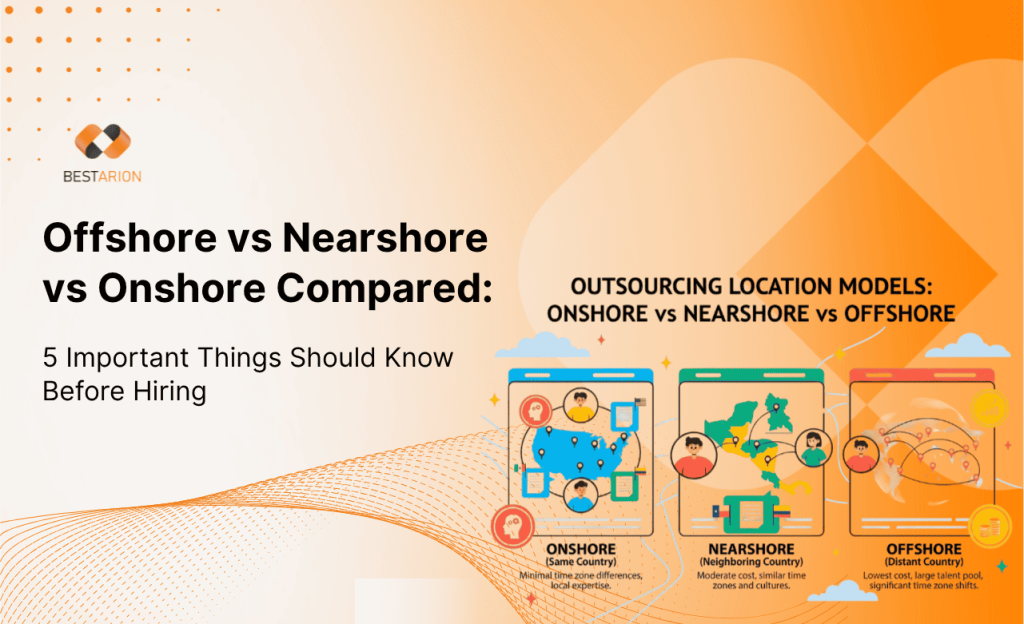
Offshore vs nearshore vs onshore outsourcing are not three versions of the same vendor pitch. They are three location models that change cost structure, collaboration rhythm, talent access, legal exposure, and how much governance the buyer must run. IBM defines nearshore outsourcing as working with a provider in a neighboring country, offshore outsourcing as contracting with a provider in a non-neighboring country, and onshore outsourcing as working with a provider in the same country.
NetSuite also treats these as location-based outsourcing types, separate from outsourcing by operation, function, or scope [1], [2].This comparison focuses only on the location decision. It does not decide whether you should use staff augmentation, a dedicated team, managed services, fixed price, or time and materials. Those are separate outsourcing model choices.
Where the decision gets messy
- Teams compare offshore, nearshore, and onshore mainly on hourly rate, then discover that collaboration cost was never priced.
- Buyers choose onshore for control but still fail if responsibilities, SLAs, and escalation paths are vague.
- Nearshore is often treated as a compromise, even though it can be the best fit when live collaboration matters.
- Offshore can scale talent and reduce cost, but it needs stronger documentation, handoff discipline, and governance.
- Regulated or security-sensitive work can break down when the location model is chosen before third-party risk and contract requirements are clear.
Key Takeaways
- Offshore, nearshore, and onshore are location models. They describe where the provider operates; they do not decide pricing, engagement structure, or delivery ownership [1], [2].
- Offshore usually fits cost leverage, global talent access, and scalable delivery, but it requires stronger operating discipline because distance and time-zone gaps increase coordination risk.
- Nearshore usually fits teams that need real-time collaboration, cultural proximity, and moderate cost leverage without moving fully domestic.
- Onshore usually fits sensitive, highly regulated, stakeholder-heavy, or discovery-heavy work where proximity and legal familiarity matter more than lowest cost.
- The best answer is often a blended location strategy, because modern sourcing decisions increasingly combine multiple talent and delivery options rather than relying on a single model [3], [4].
Offshore vs nearshore vs onshore at a glance
The easiest way to compare the three models is to separate five decision criteria: cost, collaboration, talent access, governance, and risk. Location affects all five, but it does not automatically make a provider more accountable. Accountability still depends on contract scope, delivery model, and governance [4], [9].
| Criteria | Offshore | Nearshore | Onshore |
|---|---|---|---|
| Basic meaning | Provider is in a distant or non-neighboring country | Provider is in a nearby country or similar region | Provider is in the same country |
| Best fit | Cost leverage, scale, global talent pools, 24-hour coverage | Time-zone overlap, agile collaboration, moderate cost savings | High-touch work, regulated work, domestic stakeholder access |
| Collaboration rhythm | More asynchronous; stronger documentation needed | More real-time overlap; easier agile ceremonies | Highest overlap; easiest live meetings |
| Cost profile | Usually lowest labor-cost potential, but management overhead must be included | Usually mid-range; less savings than offshore but less friction | Usually highest direct cost but lower coordination friction |
| Risk profile | Higher distance, time-zone, legal, continuity, and vendor-management complexity | Moderate cross-border risk; often easier to manage than distant offshore | Lower cross-border complexity, but not automatically lower vendor risk |
| Main watch-out | Do not confuse low rate with low total cost | Do not assume proximity removes governance needs | Do not overpay for proximity if the work is repeatable and well documented |
What each location model means
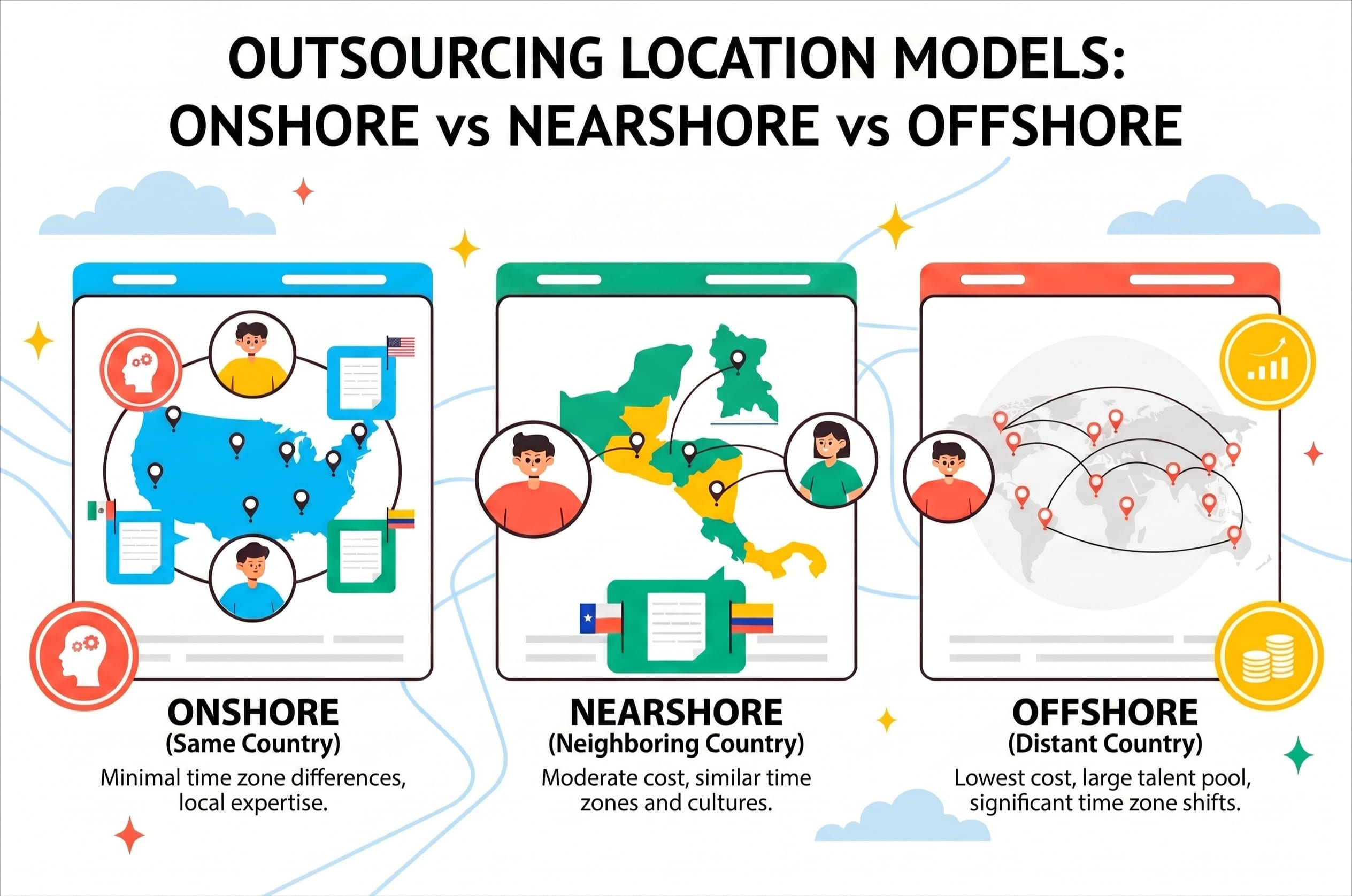
Onshore outsourcing means the client and provider operate in the same country. Nearshore outsourcing means the provider is in a nearby country, commonly with better time-zone overlap than distant offshore locations. Offshore outsourcing means the provider is in a more distant country or region [1].
These labels are useful only when treated as a first decision layer. NetSuite’s taxonomy separates location-based outsourcing from outsourcing by operation or function, which is why “offshore” should not be used as a shortcut for “managed service,” “low cost,” or “full delivery accountability” [2].
Decision criteria: when each model fits
| Decision criterion | Choose offshore when… | Choose nearshore when… | Choose onshore when… |
|---|---|---|---|
| Cost pressure | Budget leverage is a primary constraint and the work can be documented clearly | You need cost efficiency but cannot afford large time-zone friction | Direct cost is less important than proximity, compliance familiarity, or stakeholder access |
| Collaboration intensity | The work can run with structured handoffs, async updates, and clear acceptance criteria | Daily overlap, sprint ceremonies, or fast clarification are important | Live workshops, leadership alignment, or sensitive stakeholder management are central |
| Talent availability | You need access to larger global talent pools or specialized skills not available locally | You want broader talent access without distant delivery friction | You need domestic specialists, local certifications, or in-market experience |
| Risk and compliance | You can manage cross-border data, security, subcontracting, and continuity requirements | You want some geographic diversification with more manageable oversight | Domestic regulatory, customer, data, or contractual constraints are dominant |
| Maturity of internal process | Your requirements, documentation, QA, and ownership model are already mature | Your team can collaborate actively but needs external capacity | Your process is still ambiguous and needs close discovery or co-design |
Cost and control trade-offs
Cost should be evaluated as total operating cost, not just hourly rate. Offshore can reduce direct labor cost, but buyers must include program management, documentation, QA, time-zone handoff, security review, and rework risk. Nearshore often reduces collaboration friction while preserving some cost leverage. Onshore often has the highest rate card but can reduce travel, legal ambiguity, and live-collaboration friction when the work is sensitive or unclear.
Bain’s nearshoring research shows that companies moving closer to home still face barriers such as cost and complexity, data and supplier visibility gaps, and regulatory hurdles. That point matters for services too: moving work closer does not eliminate the need for a business case, governance model, and vendor controls [6].
Talent access and delivery model fit
Offshore is strongest when the buyer needs scale or specialized capacity across a broader global market. Nearshore is strongest when the work needs frequent interaction with internal teams. Onshore is strongest when domain context, sensitive data, domestic stakeholder access, or regulatory familiarity are more important than cost leverage.
Deloitte’s 2024 Global Outsourcing Survey frames sourcing as a multidimensional talent and capability decision, not simply a cost-cutting exercise. Its 2025 GBS survey also shows that global service delivery footprints continue to evolve, with organizations expanding capabilities and reassessing locations such as Mexico, Portugal, India, the United States, and Poland [3], [7].
Risk and governance comparison
| Risk area | Offshore risk pattern | Nearshore risk pattern | Onshore risk pattern | Control to require |
|---|---|---|---|---|
| Data security | Cross-border access, data transfer, subcontracting visibility | Cross-border but often closer oversight | Domestic access but still third-party exposure | Data handling rules, access control, audit rights, incident notification |
| Regulatory compliance | More jurisdictions and potentially more data-transfer complexity | Moderate jurisdictional complexity | Usually easier domestic alignment | Legal review, compliance obligations, evidence requests |
| Operational continuity | More dependency on handoff discipline and resilient delivery setup | Moderate continuity risk with better overlap | Lower location friction but provider failure still matters | BCP/DR expectations, backup staffing, escalation path |
| Delivery accountability | Misalignment if buyer expects managed outcomes from a staff model | Risk if collaboration roles are assumed rather than defined | Risk if proximity hides unclear ownership | RACI, SLA/KPI definitions, acceptance criteria |
| Supplier and subcontractor risk | Harder visibility into subcontractors and local practices | Better practical oversight but still third-party risk | Easier audits, not risk-free | Third-party due diligence, subcontracting approval, ongoing monitoring |
The more distance and operational complexity you add, the more explicit governance must become. ISO 37500 emphasizes outsourcing governance, flexibility, risk identification, and collaborative relationships. NIST SP 800-161 highlights the need to identify, assess, and mitigate cybersecurity supply chain risk across organizational levels [4], [8].
Regulated industries should also treat outsourcing as a third-party risk decision. U.S. interagency guidance for banking organizations notes that third-party relationships can reduce direct control and introduce operational, compliance, and strategic risks; it also emphasizes planning, due diligence, contract negotiation, ongoing monitoring, and termination stages [9].
A practical way to think about this is shared responsibility. AWS uses a shared responsibility model to clarify which responsibilities sit with the provider and which remain with the customer. The same logic applies to outsourcing: choosing a location model does not transfer every responsibility to the vendor [10].
Scenario-based recommendation
| Buyer situation | Best-fit location model | Why |
|---|---|---|
| You need the lowest feasible cost for well-documented recurring work | Offshore | Cost leverage matters, and the work can be managed through documented processes and measurable acceptance criteria |
| You need software development capacity with daily agile collaboration | Nearshore | Time-zone overlap and faster clarification may matter more than maximum cost reduction |
| You are handling regulated, sensitive, or executive-facing work | Onshore | Domestic familiarity, stakeholder access, and lower jurisdictional friction may outweigh cost savings |
| You need 24-hour support coverage | Offshore or hybrid | Distributed delivery can extend coverage, but escalation and handoff rules must be explicit |
| You need to rebalance concentration risk | Hybrid / multi-location | A blended model can reduce dependency on one country, provider, or delivery center |
| You are still defining the process or product requirements | Onshore or nearshore first | Closer collaboration can reduce discovery friction before scaling work elsewhere |
Trade-off summary
| Model | What you gain | What you give up | Best control mechanism |
|---|---|---|---|
| Offshore | Cost leverage, broad talent pools, scale, coverage | More coordination overhead and cross-border complexity | Detailed handoff process, QA gates, security controls, governance cadence |
| Nearshore | Overlap, collaboration speed, moderate savings | Less cost leverage than offshore | Shared sprint rhythm, clear ownership, escalation windows |
| Onshore | Proximity, legal familiarity, easier workshops | Higher direct cost and sometimes smaller talent pool | Tight scope control, clear business case, measurable outcomes |
Common mistakes to avoid
| Mistake | Why it hurts the decision | Better approach |
|---|---|---|
| Picking offshore only because the hourly rate is lower | The true cost includes management overhead, rework, QA, security, and communication delays | Compare total operating cost, not just rate card |
| Choosing onshore when the work is stable and repeatable | The buyer may pay for proximity that the work does not need | Use onshore for sensitive or ambiguous work, not by default |
| Assuming nearshore automatically solves communication problems | Proximity helps, but weak product ownership and unclear decision rights still break delivery | Define meeting cadence, RACI, and escalation rules |
| Treating location as the same thing as engagement model | A nearshore team can still be staff augmentation, project-based, or managed service | Separate location, pricing, engagement, and delivery ownership |
| Skipping third-party risk review for non-regulated work | Operational, data, and supplier risks still exist outside regulated industries | Use proportional due diligence and contract controls |
Decision shortcut
- Choose offshore when the work is well scoped, process maturity is high, cost pressure is real, and your team can manage async delivery.
- Choose nearshore when you need meaningful cost leverage but frequent collaboration, shared working hours, and fast iteration still matter.
- Choose onshore when the work is highly sensitive, ambiguous, regulated, executive-facing, or dependent on local market context.
- Choose hybrid when one location model cannot satisfy cost, coverage, resilience, and collaboration needs at the same time.
FAQ
Is nearshore better than offshore?
Not always. Nearshore is usually better when live collaboration and time-zone overlap matter. Offshore can be better when cost leverage, specialized talent, or distributed coverage matters more.
Is onshore outsourcing always safer?
No. Onshore can reduce cross-border and proximity issues, but it is still a third-party relationship. Risk depends on vendor controls, contract terms, data access, continuity planning, and governance [9].
Can a company use more than one location model?
Yes. Many organizations use hybrid or multi-location sourcing to balance cost, resilience, talent access, and collaboration needs. This is consistent with the broader shift toward multidimensional sourcing [3].
Which model is best for IT outsourcing?
For IT outsourcing, offshore can fit build capacity and support work, nearshore can fit agile product collaboration, and onshore can fit discovery, regulated work, enterprise architecture, or security-sensitive programs. The right answer depends on the work type and governance maturity.
What is the biggest mistake when comparing offshore, nearshore, and onshore?
The biggest mistake is treating location as the whole outsourcing model. Location decides where the work happens; it does not decide pricing, team structure, accountability, or service delivery ownership.
What to Keep in Mind
- Start with work type and collaboration intensity, not vendor location.
- Compare total operating cost, not just hourly rates.
- Use onshore for proximity and sensitive work, nearshore for collaboration balance, and offshore for scalable cost-efficient delivery.
- Put governance, data access, SLA/KPI ownership, and escalation rules in writing before the contract is signed.
- Consider hybrid delivery when one location model creates too much concentration risk.
References
[1] IBM, “What is business process outsourcing (BPO)?,” IBM Think. Accessed: Apr. 28, 2026. [Online]. Available: https://www.ibm.com/think/topics/business-process-outsourcing
[2] A. Jenkins, “The 14 types of outsourcing: a guide,” NetSuite, Jun. 27, 2025. Accessed: Apr. 28, 2026. [Online]. Available: https://www.netsuite.com/portal/resource/articles/erp/types-of-outsourcing.shtml
[3] Deloitte, “Global outsourcing survey 2024,” Deloitte, 2024. Accessed: Apr. 28, 2026. [Online]. Available: https://www.deloitte.com/global/en/issues/work/global-outsourcing-survey.html
[4] International Organization for Standardization, Guidance on outsourcing, ISO 37500:2014, 2014. [Online]. Available: https://www.iso.org/standard/56269.html
[5] OECD, “Offshoring, reshoring, and the evolving geography of jobs,” OECD, 2024. Accessed: Apr. 28, 2026. [Online]. Available: https://www.oecd.org/en/publications/offshoring-reshoring-and-the-evolving-geography-of-jobs_adc9a9d5-en.html
[6] Bain & Company, “Nearshoring: overcoming the obstacles,” Bain & Company. Accessed: Apr. 28, 2026. [Online]. Available: https://www.bain.com/insights/nearshoring-overcoming-the-obstacles/
[7] Deloitte, “2025 Global Business Services Survey,” Deloitte, 2025. Accessed: Apr. 28, 2026. [Online]. Available: https://www.deloitte.com/us/en/services/consulting/services/shared-services-survey.html
[8] J. Boyens et al., “Cybersecurity supply chain risk management practices for systems and organizations,” NIST SP 800-161 Rev. 1, May 5, 2022. Accessed: Apr. 28, 2026. [Online]. Available: https://csrc.nist.gov/pubs/sp/800/161/r1/final
[9] Board of Governors of the Federal Reserve System, FDIC, and OCC, “Interagency guidance on third-party relationships,” Jun. 2023. Accessed: Apr. 28, 2026. [Online]. Available: https://www.federalreserve.gov/frrs/guidance/interagency-guidance-on-third-party-relationships.htm
[10] Amazon Web Services, “Shared responsibility model,” AWS. Accessed: Apr. 28, 2026. [Online]. Available: https://aws.amazon.com/compliance/shared-responsibility-model/