
From “Vibe Coding” to “Agentic Software Engineering”: The Era of Autonomous Systems
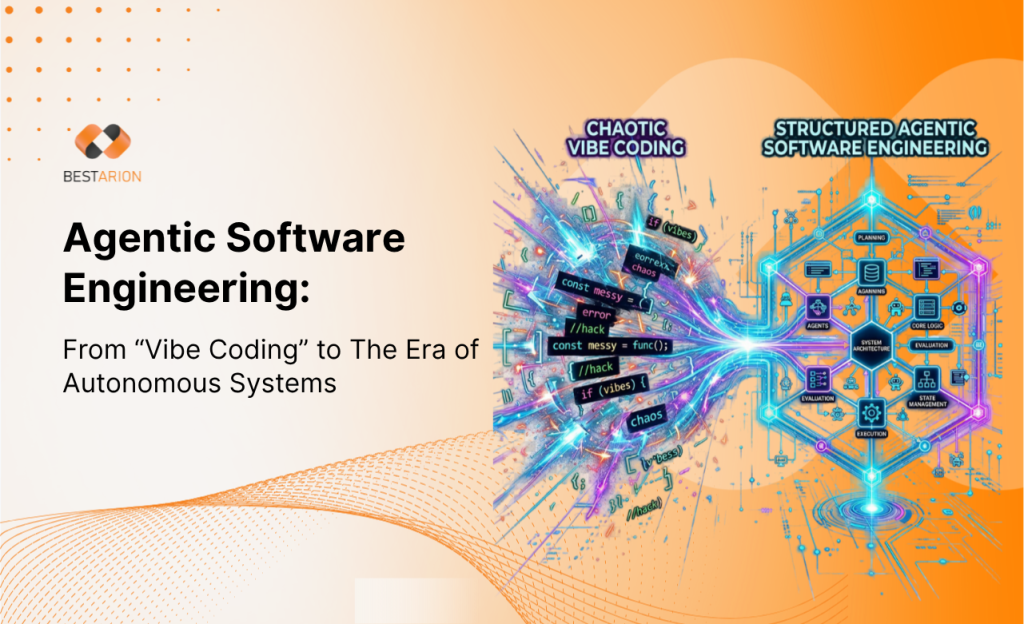
Vibe coding captured a real shift in software development: you describe what you want, the model writes code, and you move faster than old hand-written workflows allowed. For prototypes, throwaway tools, and exploratory building, that shift is genuinely powerful.
But enterprise software engineering in 2026 is already moving past that beginner framing. Teams are no longer asking whether AI can draft code. They are asking how coding agents should participate across specs, pull requests, testing, evaluation, release control, and system operations. That is the difference between vibe coding and agentic software engineering: the former is a prompt-led coding style, while the latter is an engineering system for autonomous and semi-autonomous software work.
Where teams get confused
- Your team can generate code quickly, but it still struggles to trust, review, test, and ship that code reliably.
- You need to know where vibe coding is still useful and where it becomes dangerous for production systems.
- You want a practical definition of agentic software engineering that goes beyond marketing language.
- You need a workflow that uses AI coding agents without losing architecture discipline, code review quality, or operational control.
- You are trying to understand how autonomous systems change the role of software engineers rather than replace engineering outright.
Key Takeaways
- Google Cloud describes vibe coding as a conversational workflow where the primary role shifts from writing code line by line to guiding AI to generate, refine, and debug an application.[1]
- Martin Fowler draws the sharper boundary: vibe coding is the end of the scale where you pay little attention to code, while agentic engineering is the professional use of coding agents to amplify existing expertise.[2]
- GitHub and Thoughtworks both argue that raw prompting is not enough for serious systems; reliable development needs context engineering, specs, structure, and auditable workflows.[3][4][5][8]
- Anthropic’s 2026 data suggest why software engineering is the frontier domain for this shift: software engineering accounts for nearly half of tool calls on its public API, and coding workflows are moving toward long-running and multi-agent patterns.[6][7]
- The era of autonomous systems does not remove the need for engineers. It raises the value of engineering judgment around architecture, verification, interfaces, security, and operational accountability.[2][8][9]
What vibe coding is good for and where it starts to break
Vibe coding deserves a fair reading before it gets criticized. It lowers the activation energy of software creation. You can turn an idea into a working proof of concept much faster because the model handles boilerplate, local refactors, and rough implementation. That is a real gain for prototypes, internal utilities, and exploratory product thinking.[1]
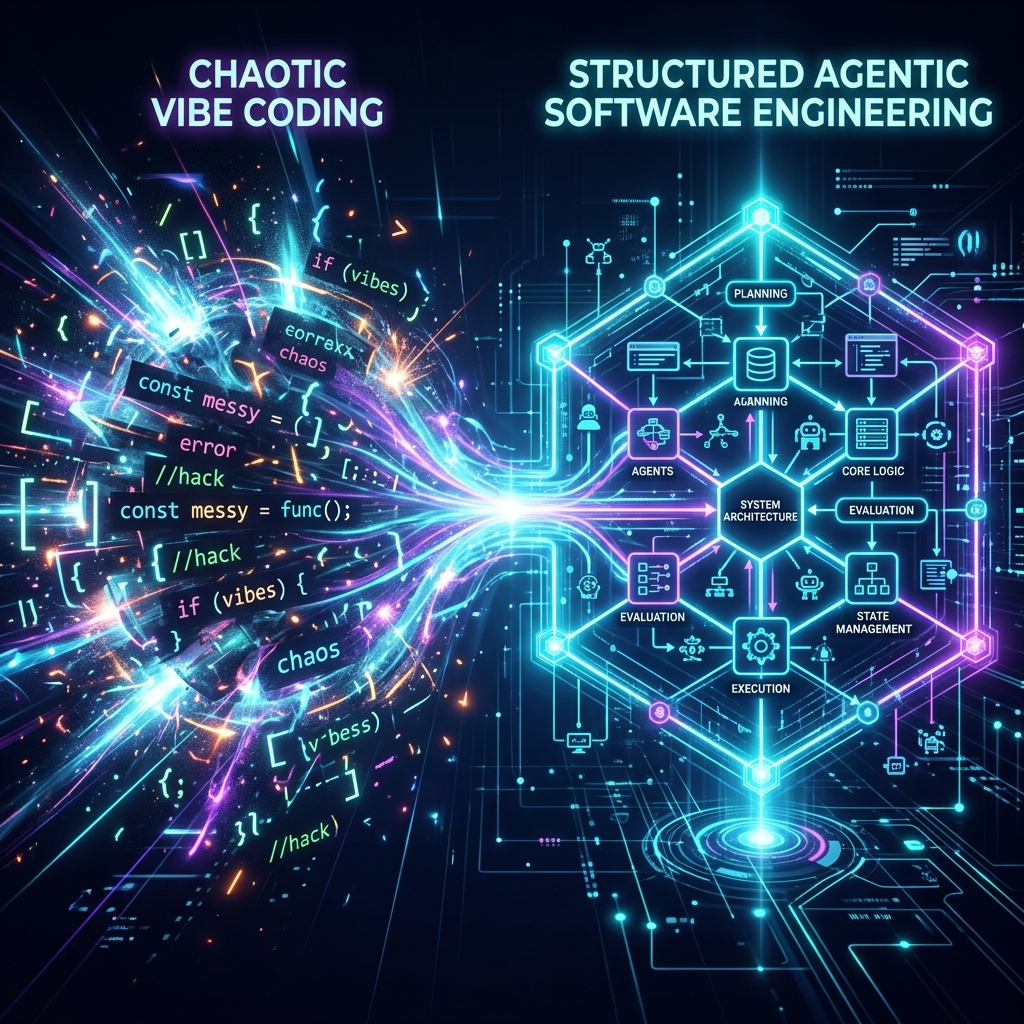
The break point comes when software stops being a toy and starts becoming a system. GitHub’s spec-driven development guidance says the pattern is now familiar: you describe the goal, get code back, and it often looks right but does not fully work, misses the real intent, or chooses an architecture you would not want in a serious codebase. Thoughtworks makes the same criticism more bluntly: throwing raw prompts at a chat interface and hoping for usable enterprise software does not work for production-grade, industrial-scale systems.[3][4][8]
What agentic software engineering changes
Agentic software engineering is not simply ‘more AI coding.’ It is the shift from AI as a drafting assistant to AI as a participant in an engineered workflow. The unit of work is no longer just the prompt. It is the loop: specification, context retrieval, implementation, test generation, review, evaluation, pull request, deployment checks, and sometimes runtime remediation.

Martin Fowler’s contrast is useful here. Vibe coding sits at the low-control end of the spectrum. Agentic engineering sits at the professional end, where teams use agents to improve and accelerate work but keep engineering responsibility. That is why the winning mental model is not ‘hands off the code.’ It is ‘hands on the system that governs the code.’[2][5][9]
From vibe coding to agentic software engineering
| Dimension | Vibe coding | Agentic software engineering |
|---|---|---|
| Primary unit of work | Prompt plus immediate code output | A structured workflow across spec, context, implementation, verification, and release |
| Best fit | Prototypes, throwaway tools, low-stakes experiments | Production systems, long-lived codebases, regulated or high-change environments |
| Human role | Idea giver and occasional checker | Architect, evaluator, reviewer, governor, escalation owner |
| Context model | Whatever is in the current prompt window | Managed context, specs, repository state, system rules, and task memory |
| Quality control | Manual spot checks or ad hoc fixes | Planned tests, review gates, policy checks, and evaluation loops |
| Failure mode | Looks right but hides architectural drift or broken assumptions | More overhead up front, but fewer surprises when the system scales |
The core shift is from raw output speed to controlled system throughput. In enterprise settings, that trade-off matters more than novelty.[2][3][4][5][8]
The new engineering stack for autonomous systems
The tools and practices now showing up across serious teams are starting to look like a stack.
First comes specification. Teams need explicit problem definitions, constraints, acceptance criteria, and interfaces before they let agents run. Second comes context engineering: the curated state, docs, code, policies, and repository signals that keep agents focused on the right problem. Third comes workflow orchestration, especially when different agents or tools should own planning, coding, testing, and review. Fourth comes evaluation: not just unit tests, but task-level scoring, review loops, and failure analysis. Fifth comes operational governance, because autonomous systems can now create changes that travel through pipelines, tickets, and production controls.[3][4][5][6]
A practical adoption path from vibe coding to agentic software engineering
Stage 1: AI-assisted coding
Use models to accelerate small coding tasks, documentation, and local refactors. This is where vibe coding often starts.
Stage 2: Spec- and context-driven development
Introduce explicit specs, context packs, and retrieval so the model works against a defined task rather than a vague prompt.
Stage 3: Agentic workflow design
Break the loop into planning, implementation, test, review, and release stages, each with its own rules and evaluation.
Stage 4: Multi-agent or long-running execution
Use specialized agents only when the workflow really benefits from role separation or sustained task execution.
Stage 5: Autonomous systems with governance
Allow bounded autonomy in production workflows only after you have observability, rollback, approval controls, and measurable trust.
This staged path matters because premature autonomy creates false confidence. Anthropic’s coding report and GitHub’s workflow guidance both point to the same reality: better outcomes come from structured loops, not from handing ever-larger tasks to a single undifferentiated agent.[5][6][7]
The control plane that keeps autonomous systems useful
- A clear system prompt is not a control plane. You still need specs, repository boundaries, and release rules.
- Code generation speed is not the same thing as engineering throughput if review, testing, and merge quality collapse.
- If an agent can change code, it also needs bounded permissions, observability, and rollback paths.
- Pull requests, test evidence, and evaluation traces are better control points than free-form chat alone.
- The more autonomous the system becomes, the more important human ownership becomes around architecture and failure handling.
Frequently Asked Questions
Is vibe coding bad?
No. It is useful for learning, prototyping, experiments, and low-stakes internal tools. The problem is not the method itself. The problem is treating it as sufficient for production software engineering.[1][3][4]
What makes software engineering ‘agentic’ rather than just AI-assisted?
The presence of governed workflows. Agentic engineering uses agents inside structured loops with context, evaluation, permissions, and handoffs, rather than relying on a single prompt-to-code jump.[2][5][6]
Will autonomous systems reduce the importance of engineers?
Routine drafting work may shrink, but the value of engineering judgment rises. Teams still need humans to define architecture, quality thresholds, operational controls, and accountability when autonomous systems act.[2][8][9]
What to Keep in Mind
- Vibe coding remains useful for fast starts, but it is not a complete operating model for enterprise engineering.
- Agentic software engineering is about workflow design, context, verification, and accountability, not just code generation.
- Autonomous systems raise the value of engineers who can design control planes, evaluation loops, and durable interfaces.
- If your question is less about code generation and more about enterprise transformation, read next: The Era of Autonomous AI 2026: Multi-Agent Architecture and the Digital Transformation Roadmap for Enterprises.
Sources
- [1] Google Cloud, “Vibe Coding Explained: Tools and Guides.” Used for a concise public definition of vibe coding and its conversational workflow. Read source ↩
- [2] Martin Fowler, “Fragments.” Used for the contrast between vibe coding and agentic engineering, where professionals use coding agents to amplify existing expertise. Read source ↩
- [3] Thoughtworks, “Beyond vibe coding: The five building blocks of AI-native engineering.” Used for the argument that enterprise engineering needs a structured AI engineering stack rather than raw prompting. Read source ↩
- [4] GitHub Blog, “Spec-driven development with AI: Get started with a new open source toolkit.” Used for the limitation of vibe coding on serious codebases and the case for spec-driven context. Read source ↩
- [5] GitHub Blog, “How to build reliable AI workflows with agentic primitives and context engineering.” Used for the shift from ad-hoc experimentation to repeatable engineering with agentic primitives and context engineering. Read source ↩
- [6] Anthropic, “2026 Agentic Coding Trends Report.” Used for the rise of multi-agent coding workflows and long-running agents that complete larger systems. Read source ↩
- [7] Anthropic, “Measuring AI agent autonomy in practice.” Used for evidence that software engineering is the most concentrated early domain for agent tool use. Read source ↩
- [8] Thoughtworks, “Beyond vibe coding: How AI can transform pull requests.” Used for the claim that vibe coding is insufficient for complex enterprise systems and that AI works better in structured, auditable loops. Read source ↩
- [9] GitHub Blog, “Why developer expertise matters more than ever in the age of AI.” Used for the argument that AI speed does not replace engineering judgment for resilience, scalability, and security. Read source ↩
