Outsourcing Service Delivery Models Explained: How Governance, SLAs, Reporting, and Vendor Responsibility Shape Delivery
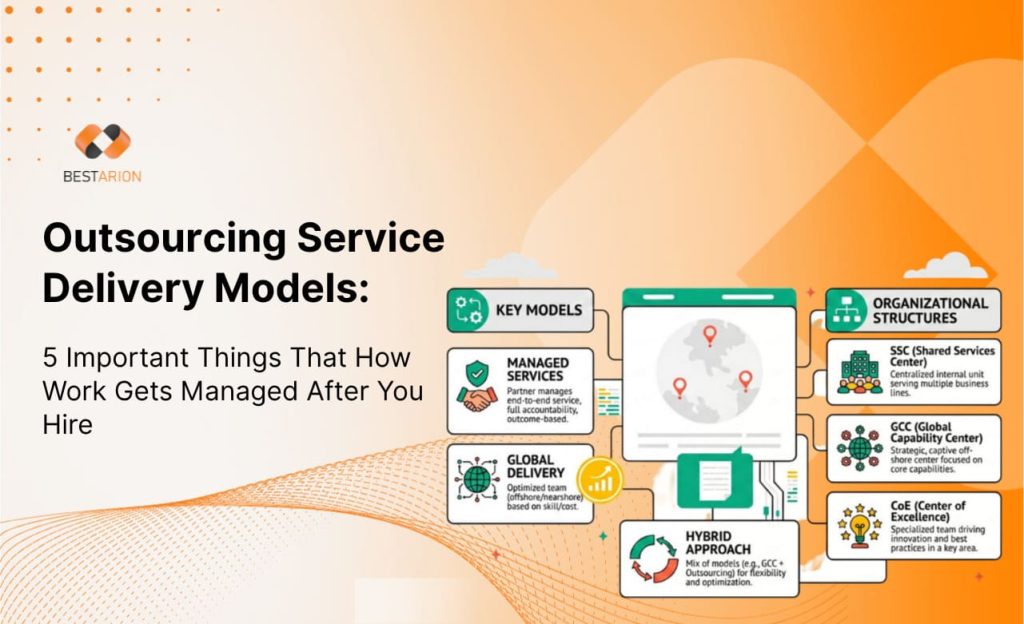
An outsourcing service delivery model explains how a service is organized and run. It is not the same as where the work happens, how the provider is paid, or whether the buyer uses staff augmentation, a dedicated team, or a project-based engagement. This distinction matters because buyers often compare vendors using one word, “outsourcing,” while the real decision involves several layers: location, pricing, engagement, and service delivery [1].
Where outsourcing delivery terms usually get mixed up
- Buyers may call something a “managed service” when they only mean a monthly pricing arrangement.
- A provider may describe “global delivery” as offshore staffing, even though a global delivery model is an operating network across locations, capabilities, coverage windows, and governance.
- Shared services, SSC, GCC, and CoE are often grouped together, but they describe different internal or enterprise-controlled service structures.
- Hybrid delivery can mean many things unless the mix is named clearly: internal plus external, centralized plus local, or one function split across multiple service structures.
- Service delivery language becomes risky when teams use it to make decisions about ownership, control, escalation, and capability without defining the operating setup.
Key Takeaways
- Service delivery models answer how the service is organized and run; they do not simply answer where the work sits, how the buyer pays, or how the commercial relationship is structured.
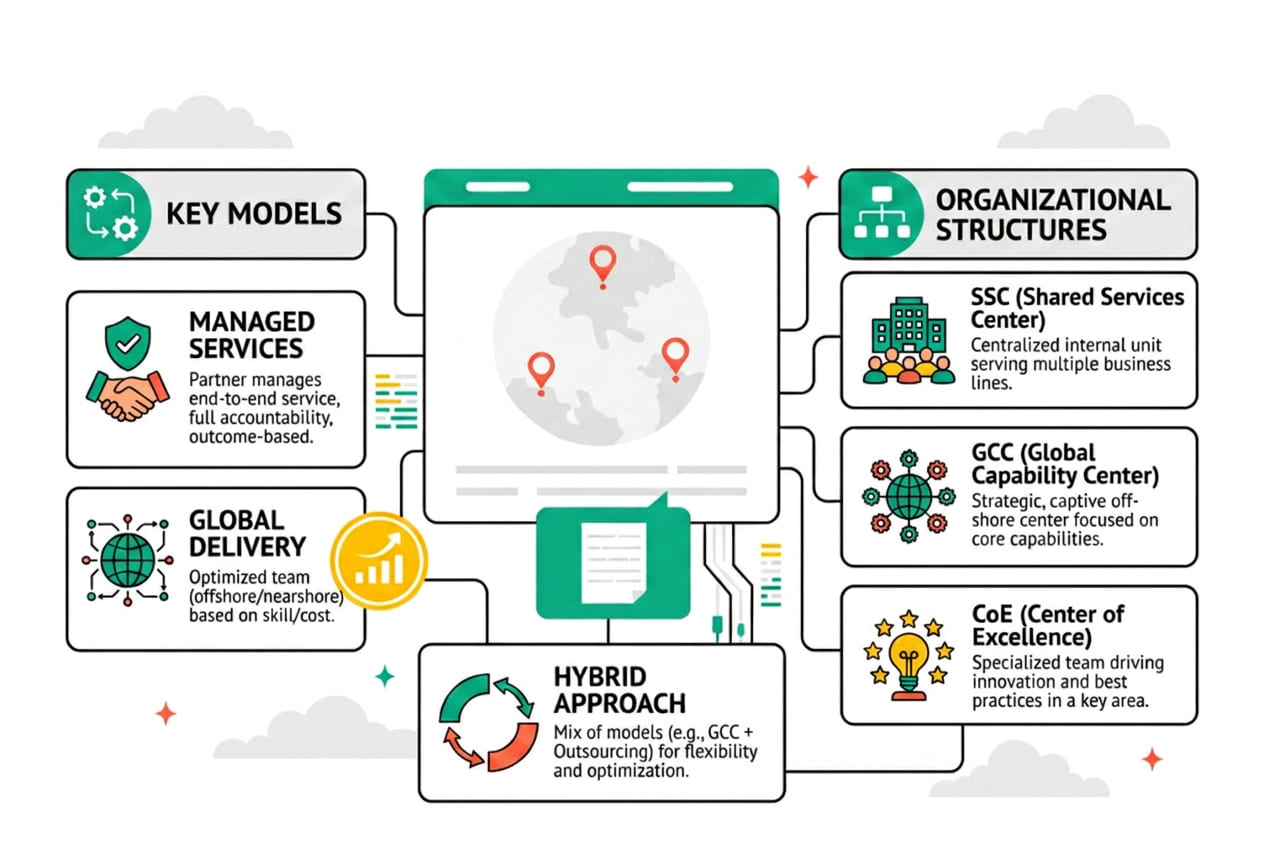
- The main service-delivery family in this guide includes managed service delivery, global delivery model, shared services / SSC / GCC, Center of Excellence (CoE), and hybrid delivery model.
- Managed service delivery is closest to provider-owned ongoing operation, while SSC, GCC, and CoE structures usually sit closer to internalized or enterprise-controlled capability.
- Global delivery is not just a synonym for offshore; it describes a multi-location service operation designed around scale, coverage, capability distribution, resilience, and governance.
- Use this article as a family-level taxonomy. For choosing among models, route to a service-delivery selection guide instead of turning this explainer into a vendor-evaluation checklist.
What service delivery models answer in outsourcing
A service delivery model answers one core question: how should the service be organized so work can be delivered, governed, improved, and scaled? In outsourcing, ISO 37500 frames outsourcing as a governed lifecycle involving roles, governance, risks, agreements, transition, and ongoing relationship management [2]. ISO/IEC 20000-1 similarly treats service management as a system for planning, designing, transitioning, delivering, and improving services to meet requirements and deliver value [3].
That makes service delivery different from a simple vendor label. A buyer can use an offshore location model, a time-and-materials pricing model, a dedicated-team engagement model, and a hybrid service delivery model in the same arrangement. The service delivery layer explains the operating structure behind the work: what is centralized, what is distributed, who owns day-to-day operation, where expertise sits, how service performance is managed, and how the model improves over time.
Quick definition: service delivery model
| Question | Short answer |
|---|---|
| What it is | The operating structure for how a service is organized, governed, delivered, improved, and scaled. |
| What it is not | It is not only a pricing model, location model, or engagement model. |
| Why it matters | It changes operating ownership, control, capability concentration, governance cadence, and how the service scales. |
| Typical examples | Managed service delivery, global delivery, shared services / SSC / GCC, CoE, and hybrid delivery. |
The main outsourcing service delivery models
| Service delivery model | Meaning | Best fit | Boundary |
|---|---|---|---|
| Managed service delivery | A provider operates a defined service or function against agreed service expectations, metrics, and governance. SLAs define the service level and measurement logic, but the model is broader than the SLA itself [4]. | Ongoing operations where the buyer wants the provider to own service execution, reporting, and continuous improvement. | Do not confuse it with retainer pricing or staff augmentation. Managed service delivery is about operating responsibility. |
| Global delivery model | Work is organized across multiple locations or capability nodes to support scale, coverage, resilience, and access to distributed talent. Deloitte’s outsourcing survey highlights maturing delivery models and the use of global in-house centers in enterprise sourcing strategies [5]. | Companies that need multi-location capability, time-zone coverage, scale, or access to specialized talent pools. | Do not reduce it to offshore delivery. Offshore is a location; global delivery is an operating network. |
| Shared services / SSC / GCC | A service center structure centralizes recurring services or enterprise capabilities, often under stronger enterprise control. Deloitte’s GBS survey focuses on shared services and global business services organizations, while KPMG describes GCCs as centers covering functions such as IT, finance, R&D, and customer service [6], [7]. | Enterprises that want consistency, scale, control, and institutional knowledge across recurring functions. | Not always third-party outsourcing. SSC and GCC models can be internal, captive, or enterprise-owned. |
| Center of Excellence (CoE) | A specialized capability hub that concentrates expertise, standards, methods, enablement, and best practices. IBM describes a CoE as an enduring construct to define, accelerate, and scale knowledge and best practices across the enterprise [8]. | Work that needs specialist expertise, standards, enablement, reusable methods, or governance across teams. | Not a full delivery factory by default. A CoE may enable delivery rather than own every service transaction. |
| Hybrid delivery model | A deliberate mix of internal and external, centralized and distributed, or provider-owned and enterprise-owned delivery structures. | Organizations that need flexibility, control, resilience, and access to multiple capability pools. | “Hybrid” must name what is being mixed; otherwise it becomes a vague label. |
Model 1: managed service delivery
Managed service delivery is the model most people think of when a provider “runs” a service. The provider is not just adding people or delivering a one-time project. It is operating a defined service scope with service expectations, governance cadence, reporting, and improvement responsibility.
This model is useful when the buyer wants to reduce day-to-day operational burden and make the provider accountable for a continuing service. The service may involve IT operations, application support, infrastructure management, help desk, QA operations, data operations, finance operations, or another recurring function. ITIL training materials focus on service management concepts and the service value system, which is relevant because managed service delivery depends on more than staffing; it depends on how service value is organized and managed [9].
The main caution is language drift. “Managed service” should not be used merely because the buyer pays monthly. Monthly billing is a pricing structure. Managed service delivery is an operating responsibility shift.
Model 2: global delivery model
A global delivery model organizes work across more than one delivery location or capability center. It can include offshore, nearshore, onshore, and hybrid location choices, but it is not identical to any one of them. The core idea is that the service operation is designed as a distributed network.
This can help buyers extend coverage windows, access larger talent pools, balance cost and capability, create follow-the-sun support, and improve resilience. It also increases the need for documented governance, handoff discipline, tool consistency, data access controls, and clear ownership.
The common mistake is to treat “global delivery” as a marketing phrase for cheaper offshore labor. A true global delivery model explains how work moves across locations, what each node owns, how teams coordinate, and how performance is measured.
Model 3: shared services, SSC, and GCC
Shared services, shared services centers (SSCs), and global capability centers (GCCs) belong in the service delivery family because they describe how recurring services or capabilities are organized. They are especially relevant for enterprise functions such as finance, HR, IT, analytics, customer operations, procurement, and R&D.
The important boundary is ownership. Outsourcing usually involves an external provider. A shared service, SSC, or GCC may be internal, captive, or enterprise-controlled. Deloitte’s 2025 GBS material frames shared services and outsourcing together under global business services evolution, while KPMG describes GCCs as important assets covering specialized functions and talent ecosystems [6], [7].
In a content hub, this model should not be over-explained inside the family pillar. The pillar only needs to clarify where SSC and GCC sit in the service delivery family, then route readers to a dedicated SSC/GCC explainer.
Model 4: Center of Excellence (CoE)
A Center of Excellence (CoE) is a capability-concentration model. It usually brings together expertise, standards, practices, playbooks, enablement, and governance for a specialized domain. A CoE can support cloud, AI, data, automation, cybersecurity, QA, finance transformation, or product operations.
IBM describes a CoE as an enduring construct for defining, accelerating, and scaling knowledge and best practices across the enterprise, while Deloitte describes an organization design CoE as a specialized team that connects business strategy with organizational capability and continuous improvement [8], [10].
A CoE is not the same as a vendor team. It can be internal, outsourced, co-created with a partner, or part of a broader GCC or hybrid delivery model. Its defining feature is not contract form; it is specialized capability concentration.
Model 5: hybrid delivery model
Hybrid delivery combines more than one delivery structure. For example, an enterprise may keep architecture and product ownership in-house, use a managed service provider for application support, run a GCC for analytics, and use a CoE for AI governance. The hybrid model is not automatically better; it is only useful when the mix is deliberate.
The rule is simple: state what is being mixed. Hybrid can mean internal plus external, global plus local, centralized plus embedded, managed service plus CoE, or provider operation plus enterprise governance. Without that detail, hybrid delivery becomes a vague label that hides ownership gaps.
Service delivery vs pricing vs engagement vs location
| Model family | The question it answers | Examples | What it does not decide by itself |
|---|---|---|---|
| Location model | Where is the work delivered from? | Onshore, nearshore, offshore, hybrid/multi-location | It does not decide service ownership, pricing, or the engagement relationship [11]. |
| Pricing model | How is the buyer charged? | Fixed price, T&M, retainer, FTE, transaction-based, output-based, outcome-based | It does not decide how the service is organized or who owns operations [12]. |
| Engagement model | How do the buyer and provider work together commercially and relationally? | Staff augmentation, dedicated team, project-based outsourcing, BOT/BOTT, managed services | It does not fully describe the operating structure across centers, capabilities, and governance [13]. |
| Service delivery model | How is the service organized and run? | Managed service delivery, global delivery, SSC/GCC, CoE, hybrid delivery | It does not replace pricing, location, or engagement decisions. |
Operating-setup comparison matrix
| Scenario | Best-fit service delivery direction | Why | Watch-out |
|---|---|---|---|
| The buyer wants a provider to run an ongoing service with reporting and improvement | Managed service delivery | Operating accountability can shift toward the provider when service scope, measures, and governance are defined. | Do not confuse monthly fees with managed service responsibility. |
| The work needs scale across regions, time zones, or talent pools | Global delivery model | Multi-location delivery can support coverage, resilience, and distributed capability. | Coordination debt rises if ownership, tooling, and handoffs are weak. |
| The enterprise wants repeatable internal services with stronger control | Shared services / SSC / GCC | Centralized or enterprise-controlled centers can standardize recurring services and preserve institutional knowledge. | It may require heavier internal governance, investment, and leadership ownership. |
| The work requires specialist methods, standards, and enablement across teams | CoE | A CoE concentrates expertise and turns it into reusable standards, practices, and support. | A CoE may enable delivery without owning all operational throughput. |
| The organization needs flexibility across internal teams, providers, and capability centers | Hybrid delivery model | A deliberate mix can balance control, speed, resilience, and capability access. | Hybrid fails when the mix is not named and ownership is not explicit. |
Terms buyers often confuse
- Managed service delivery vs retainer pricing: Retainer pricing explains recurring billing; managed service delivery explains operating responsibility.
- Global delivery vs offshore outsourcing: Offshore explains geography; global delivery explains a multi-location operating setup.
- GCC vs outsourcing: GCCs are often enterprise-owned or enterprise-controlled capability centers, while outsourcing uses an external provider.
- CoE vs delivery team: A CoE concentrates expertise, standards, and enablement; it may not execute every service request.
- Hybrid delivery vs hybrid work: Hybrid delivery mixes service structures, not just office and remote work patterns.
- Service delivery vs engagement model: Engagement describes the buyer-provider relationship; service delivery describes how the service is organized and run.
FAQ
What are outsourcing service delivery models?
Outsourcing service delivery models describe how a service is organized and run. They explain operating ownership, centralization, distribution, capability concentration, governance, and improvement rhythm. They are different from pricing, location, and engagement models.
Is managed service delivery the same as managed services?
They are closely related, but the wording matters. Managed services is often used as a market label. Managed service delivery refers more specifically to the operating setup where a provider runs a defined service with agreed expectations, reporting, and improvement responsibility.
Is global delivery the same as offshore outsourcing?
No. Offshore outsourcing is a location model. Global delivery is a service delivery model that organizes work across multiple locations or capability nodes. A global delivery model may include offshore teams, but it should also define how work is coordinated and governed.
Are shared services and GCCs outsourcing models?
They can be part of the broader service delivery discussion, but they are not always outsourcing. Shared services, SSCs, and GCCs are often internal or enterprise-controlled structures. They may coexist with outsourcing, replace part of it, or work alongside external providers.
Where does a Center of Excellence fit?
A CoE fits in the service delivery family as a specialized capability hub. It concentrates expertise, standards, playbooks, and enablement for a domain. It may support delivery teams, providers, SSCs, GCCs, or hybrid operating models.
What to Keep in Mind
- Service delivery models explain the operating setup, not only the commercial label.
- Keep location, pricing, engagement, and service delivery as separate decisions before comparing vendors.
- Use managed service delivery, global delivery, SSC/GCC, CoE, and hybrid delivery as the main service-delivery family.
- Do not over-expand spoke topics inside the taxonomy pillar; define the family, clarify boundaries, then route readers to the right next guide.
- A good service delivery model should make ownership, capability location, governance, and improvement rhythm easier to understand.
References
- Bestarion, “Outsourcing Models Explained: Location, Pricing, Engagement, and Service Delivery,” Bestarion. Accessed: May 8, 2026. [Online]. Available: https://bestarion.com/outsourcing-models-explain/
- International Organization for Standardization, “ISO 37500:2014, Guidance on outsourcing,” ISO. Accessed: May 8, 2026. [Online]. Available: https://www.iso.org/standard/56269.html
- International Organization for Standardization, “ISO/IEC 20000-1:2018, Information technology — Service management — Part 1: Service management system requirements,” ISO. Accessed: May 8, 2026. [Online]. Available: https://www.iso.org/standard/70636.html
- IBM, “What Is an SLA (service level agreement)?,” IBM Think. Accessed: May 8, 2026. [Online]. Available: https://www.ibm.com/think/topics/service-level-agreement
- Deloitte, “Global outsourcing survey 2024,” Deloitte. Accessed: May 8, 2026. [Online]. Available: https://www.deloitte.com/global/en/issues/work/global-outsourcing-survey.html
- Deloitte, “2025 Deloitte’s Global Business Services (GBS) Survey,” Deloitte. Accessed: May 8, 2026. [Online]. Available: https://www2.deloitte.com/us/en/services/consulting/services/shared-services-survey.html
- KPMG, “Global Capability Centres,” KPMG India. Accessed: May 8, 2026. [Online]. Available: https://kpmg.com/in/en/insights/global-capability-centres.html
- IBM, “What is a Cloud Center of Excellence (CCoE)?,” IBM Think. Accessed: May 8, 2026. [Online]. Available: https://www.ibm.com/think/topics/cloud-center-of-excellence
- PeopleCert, “ITIL 4 Foundation,” PeopleCert. Accessed: May 8, 2026. [Online]. Available: https://www.peoplecert.org/browse-certifications/it-governance-and-service-management/ITIL-1/itil-4-foundation-2565
- Deloitte, “The Transformational Role of Organization Design Centers of Excellence,” Deloitte. Accessed: May 8, 2026. [Online]. Available: https://www.deloitte.com/nl/en/services/consulting/perspectives/designing-the-future-the-transformational-role-of-organization-design-centers-of-excellence.html
- Bestarion, “Outsourcing Location Models Explained: What Offshore, Nearshore, and Onshore Actually Change,” Bestarion. Accessed: May 8, 2026. [Online]. Available: https://bestarion.com/outsourcing-location-models/
- Bestarion, “Outsourcing Pricing Models Explained: How Pricing Structure Impacts Scope, Quality, Vendor Incentives, and Delivery Risk,” Bestarion. Accessed: May 8, 2026. [Online]. Available: https://bestarion.com/outsourcing-pricing-models/
- Bestarion, “Outsourcing Engagement Models Explained,” Bestarion. Accessed: May 8, 2026. [Online]. Available: https://bestarion.com/outsourcing-engagement-models/
- Bestarion, “Superior ITO & BPO Services in Vietnam,” Bestarion. Accessed: May 8, 2026. [Online]. Available: https://bestarion.com/