Outsourcing Engagement Models Explained: How Each Model Changes Client Control, Team Integration, Delivery Ownership, and Project Risk
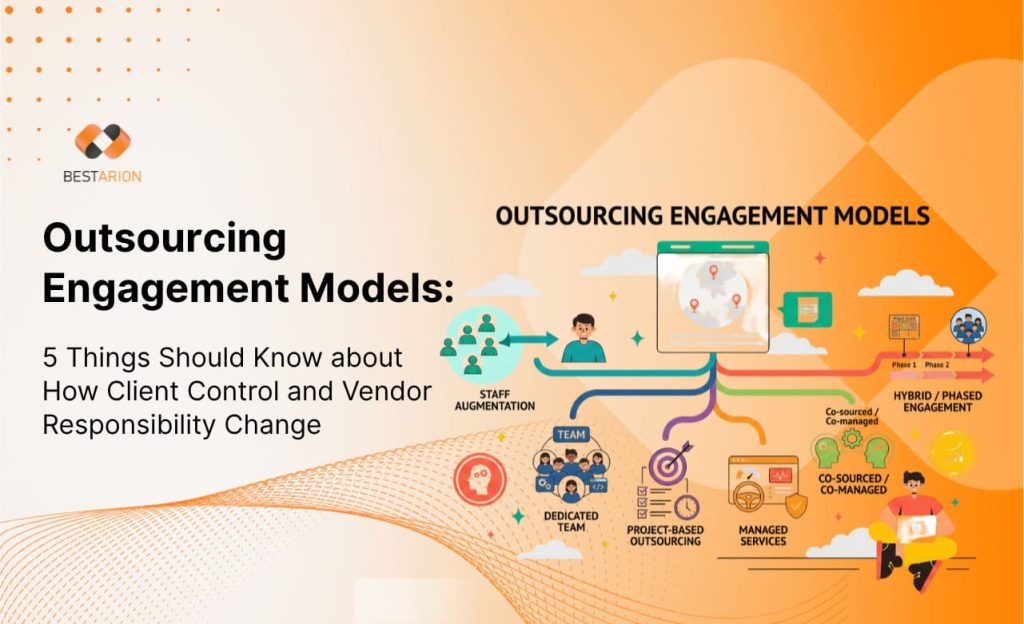
Outsourcing engagement models define how a buyer and provider work together after the contract is signed. They determine who manages the work, who owns delivery, how decisions are made, and how accountability is shared. This matters because outsourcing is not one operating model.
A company can outsource a business process to an external provider, but the working relationship can still range from staff augmentation to a dedicated team, project-based outsourcing, co-sourcing, or a fully managed service. IBM describes BPO as contracting an external service provider to fulfill a business function or process, while ISO 37500 frames outsourcing arrangements around governance, flexibility, risk identification, and collaborative relationships [1], [2].
Where buyers get engagement models wrong
- They buy staff augmentation but expect the provider to own end-to-end outcomes.
- They choose a project-based model while requirements are still changing.
- They set up a dedicated team but do not assign an internal product owner, technical lead, or process owner.
- They choose managed services but keep micromanaging individual resources instead of managing service levels and governance.
- They confuse engagement model with pricing model, location model, or service delivery model.
Key Takeaways
- An outsourcing engagement model defines the working relationship between buyer and provider: control, management responsibility, decision rights, and delivery accountability.
- Engagement model is different from location model and pricing model. Wirtek separates outsourcing models into location, relationship, and pricing categories; relationship-wise models include staff augmentation, project-based outsourcing, and dedicated teams [4].
- Staff augmentation gives the buyer the most day-to-day control, but the buyer usually keeps delivery ownership. Managed services shift more operating responsibility to the provider through defined service levels and governance [5], [6].
- Dedicated teams sit between staff augmentation and managed services: they provide stable capacity and continuity, but the buyer still needs internal leadership and shared operating discipline [4].
- Modern outsourcing is becoming more multidimensional, so engagement model choice should be tied to governance, risk, ownership, and ecosystem coordination rather than cost alone [3], [7].
What outsourcing engagement models mean
An outsourcing engagement model is the structure that defines how the buyer and provider collaborate. It answers five practical questions:
- Who manages day-to-day work?
- Who owns the roadmap, backlog, scope, or operating process?
- Who is accountable for delivery quality?
- How are decisions, escalations, and approvals handled?
- What does success look like: capacity, deliverables, service levels, or outcomes?
This is not the same as pricing. A staff augmentation engagement can be billed by time and materials. A dedicated team can be billed by FTE/month or pod/month. A project-based engagement can use fixed price or milestone payments. A managed service can use a monthly service fee, SLA tier, or outcome-linked fee.
It is also not the same as location. A provider can deliver staff augmentation, dedicated teams, projects, or managed services from onshore, nearshore, offshore, or hybrid locations. The engagement model explains how the relationship works; the location model explains where the work happens.
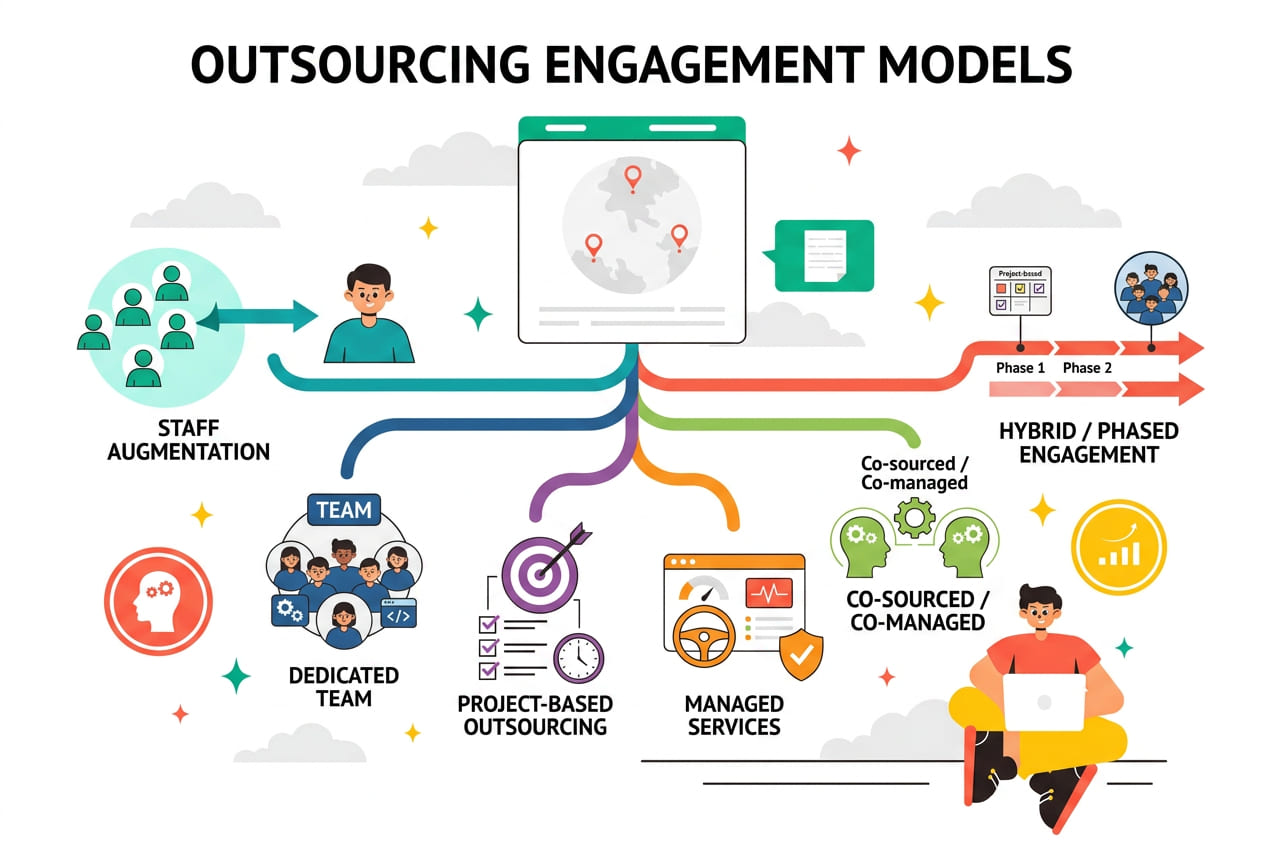
Outsourcing engagement models at a glance
| Engagement model | What you are buying | Buyer owns | Provider owns | Best fit | Control to add |
|---|---|---|---|---|---|
| Staff augmentation | Individual specialists added to your team | Day-to-day management, backlog, priorities, quality ownership | Talent supply, HR/admin support, replacement support | Skill gaps, temporary capacity, internal leadership already exists | Role scorecard, onboarding plan, timesheet/sprint review, security access control |
| Dedicated team / managed team | Stable team capacity integrated with your organization | Product vision, roadmap, business priorities, shared governance | Team setup, continuity, delivery support, team administration | Long-term product, engineering, analytics, or operations support | RACI, delivery cadence, velocity/productivity metrics, knowledge retention |
| Project-based outsourcing | A defined project or work package | Requirements clarity, approvals, change control, acceptance | Delivery of agreed scope, project execution, resource planning | Stable scope, clear deliverables, limited internal delivery capacity | Scope baseline, acceptance criteria, milestone sign-off, change request process |
| Managed services | Ongoing service operation against SLAs/KPIs | Governance, business priorities, service review, escalation decisions | Service delivery, operating process, reporting, improvement plan | Recurring support, maintenance, operations, process outsourcing | SLA/KPI set, service credits, incident/escalation rules, review cadence |
| Co-sourced / co-managed | Shared operating responsibility between internal and provider teams | Selected functions, business decisions, internal capability ownership | Complementary functions, specialist support, management discipline | Capability gaps where the buyer still wants internal participation | Joint RACI, handoff rules, shared backlog, governance forum |
| Hybrid / phased engagement | Different models across phases or workstreams | Model boundary decisions, vendor governance, transition decisions | Phase-specific delivery responsibilities | Transformation, multi-service outsourcing, long-term partnerships | Engagement map, phase gates, ownership map, transition criteria |
1. Staff augmentation
Staff augmentation adds external specialists to your existing team. The provider supplies people, but your organization usually manages priorities, delivery process, quality expectations, and daily work.
Wirtek describes staff augmentation as a model where the buyer borrows resources from a specialized provider to supplement an internal team and retains control over delivery and outcomes [4]. Deloitte also describes staff augmentation as a support model where a third-party provider supplies resources to help build capabilities and capacity quickly [5].
Use staff augmentation when
- You already have a product owner, engineering lead, process owner, or delivery manager.
- You need specific skills quickly.
- You want to keep control of roadmap, backlog, architecture, process, or workflow.
- The work changes often, but internal leadership can manage priorities.
- You need flexible capacity without changing your operating model.
Avoid staff augmentation when
- You expect the provider to own end-to-end outcomes.
- You do not have time to manage the work.
- The internal team cannot define priorities or quality standards.
- You need a recurring service level rather than individual contributors.
Control to include
- Role scorecard and skill requirements
- Onboarding and access-control checklist
- Timesheet or sprint review
- Delivery ownership map
- Knowledge transfer and replacement rule
2. Dedicated team / managed team
A dedicated team gives you a stable group of external specialists focused on your work over a longer period. It is more integrated than short-term staff augmentation, but it does not automatically mean the provider owns business outcomes.
Wirtek describes dedicated teams as a model where the buyer and outsourcing provider create an integrated team and share responsibility over execution and deliverables [4]. That makes this model useful when continuity, domain learning, and collaboration matter.
Use a dedicated team when
- You need stable capacity over months or years.
- Knowledge retention is important.
- Requirements evolve, but the product vision needs continuity.
- You have an internal product owner, process owner, or technical leader.
- You want more continuity than staff augmentation but more control than managed services.
Avoid a dedicated team when
- You need the provider to own a defined service outcome.
- The workload is too volatile to reserve capacity.
- You cannot provide internal direction.
- You need a fixed deliverable with limited collaboration.
Control to include
- RACI by role and decision type
- Sprint or operating cadence
- Velocity, throughput, productivity, or output metrics
- Team stability and replacement SLAs
- Knowledge retention and documentation rules
3. Project-based outsourcing
Project-based outsourcing gives the provider responsibility for delivering a defined scope, work package, or project. It works best when the buyer can define requirements, dependencies, acceptance criteria, and change-control rules before the work starts.
PMI defines a project as a temporary endeavor undertaken to create a unique product, service, or result, with phases that move through design, build, test, deploy, and close [9]. That is why project-based outsourcing needs a clear beginning, end, deliverable structure, and acceptance process.
Wirtek describes project-based outsourcing as a model where the provider commits to deliver a project within a fixed budget and timeline based on well-defined specifications [4]. PMI’s requirements management guidance also emphasizes requirements verification and change management as essential components for ensuring that requirements are satisfied and changes are handled properly [10].
Use project-based outsourcing when
- The scope is stable enough to estimate.
- Deliverables and acceptance criteria are clear.
- You need the provider to manage execution.
- Internal resources are limited.
- Procurement needs a defined scope, budget, or timeline.
Avoid project-based outsourcing when
- Discovery is still active.
- Requirements are likely to change frequently.
- The buyer wants to adjust priorities every sprint.
- The provider cannot control key dependencies.
Control to include
- Statement of work and scope baseline
- Acceptance criteria by deliverable
- Milestone sign-off
- Change request process
- Dependency and assumption log
4. Managed services
Managed services shift responsibility from supplying people or delivering a one-time project to operating an ongoing service. The provider is accountable for a defined service scope, usually measured through SLAs, KPIs, reporting cadence, incident handling, and improvement plans.
Deloitte describes Application Management Systems as a model where support is outsourced fully to a third party through a long-term arrangement [5]. IBM defines an SLA as a contract that defines the service, expected performance level, measurement, approval, and remedies when performance levels are not met [6].
Use managed services when
- The work is recurring.
- Service levels can be measured.
- The provider can own operating process and improvement.
- The buyer wants less day-to-day resource management.
- Escalation and service review can be governed through KPIs.
Avoid managed services when
- The work is still undefined or exploratory.
- The buyer wants to control individual daily tasks.
- Service levels are hard to measure.
- The provider cannot influence service performance.
Control to include
- SLA/KPI set
- Response and resolution targets
- Service credits or remedy logic
- Incident and escalation process
- Monthly or quarterly service review
5. Co-sourced / co-managed engagement
A co-sourced or co-managed engagement splits responsibility between the buyer and provider. This model works when the buyer wants to keep certain capabilities in-house but needs external support for specialist skills, management discipline, scale, or coverage.
Deloitte describes co-sourcing as a team effort where the provider and client collaboratively support a system, with each side contributing different functional or technical responsibilities [5]. This model is useful when full outsourcing would remove too much control, but staff augmentation alone would not provide enough operating discipline.
KPMG’s managed service example also shows a continuum from time-and-materials staff augmentation to outsourcing a body of work and then to a fully managed service, with responsibilities shifting as the model matures [8].
Use co-sourcing when
- Internal capability exists but is incomplete.
- You want shared ownership rather than full provider ownership.
- The work requires both business context and external specialist skills.
- You need knowledge transfer while still keeping internal teams involved.
- Governance can clearly separate responsibilities.
Avoid co-sourcing when
- Nobody owns final decisions.
- RACI is vague.
- Both sides duplicate work.
- The buyer expects managed-service accountability without granting operating authority.
Control to include
- Joint RACI
- Split of functional vs technical support
- Escalation route
- Shared backlog or service board
- Knowledge transfer cadence
6. Hybrid / phased engagement
Many outsourcing relationships do not stay in one engagement model forever. A buyer might start with staff augmentation for discovery, move into a dedicated team for product buildout, use project-based outsourcing for a defined migration, and later shift recurring support into managed services.
Deloitte’s 2024 Global Outsourcing Survey describes modern sourcing as multidimensional, with organizations using different alternatives to source talent, skills, and capabilities and needing to govern the extended workforce ecosystem [3]. KPMG similarly argues that organizations should build structured decision frameworks, establish layered governance, clarify ownership and accountability, and align delivery models with enterprise maturity [7].
Use a hybrid engagement when
- Work moves through discovery, build, transition, and operations.
- Different workstreams need different levels of buyer control.
- Some work is capacity-based while other work is service-level based.
- The relationship is long term and expected to mature.
- You need a transition path from support to managed operations.
Avoid hybrid engagement when
- Model boundaries are unclear.
- Pricing and accountability are mixed together without rules.
- Teams do not know who owns which decisions.
- Governance cannot handle multiple workstreams.
Control to include
- Engagement model map
- Phase gate and transition criteria
- Ownership map by workstream
- Pricing and engagement boundary
- Governance cadence across models
How to choose the right outsourcing engagement model
Use the engagement model to decide how much control you want to keep and how much accountability you want the provider to own.
| Decision question | If yes, consider | Why it fits | Control before signing |
|---|---|---|---|
| Do you already have internal leadership but need extra skills? | Staff augmentation | You keep delivery control and add capacity quickly | Role scorecard, onboarding, delivery ownership |
| Do you need stable capacity for a long-term roadmap? | Dedicated team / managed team | You get continuity and domain learning | RACI, operating cadence, productivity metrics |
| Is the scope defined enough to hand over as a project? | Project-based outsourcing | The provider can deliver against scope and milestones | SOW, acceptance criteria, change control |
| Is the work an ongoing service with measurable service levels? | Managed services | The provider can own service performance | SLA/KPI set, escalation, service review |
| Do you want shared responsibility while retaining internal capability? | Co-sourced / co-managed | You keep participation while adding external discipline | Joint RACI, handoff rules, governance forum |
| Does the work change by phase or workstream? | Hybrid / phased engagement | Different models can fit different parts of the lifecycle | Phase gates, model boundaries, ownership map |
Engagement model is not the same as pricing or delivery model
| Decision layer | What it answers | Examples | Common mistake |
|---|---|---|---|
| Engagement model | How buyer and provider work together | Staff augmentation, dedicated team, project-based, managed services | Expecting provider-owned outcomes from a capacity model |
| Pricing model | How the provider is paid | T&M, fixed price, FTE-based, SLA-based, outcome-based | Assuming the billing unit defines accountability |
| Location model | Where the work is delivered | Onshore, nearshore, offshore, hybrid | Treating offshore as a complete operating model |
| Service delivery model | How the ongoing service is run and governed | Co-managed delivery, managed service, BPO, platform-enabled service | Signing a contract without clear operating cadence |
Common mistakes to avoid
| Mistake | Why it creates risk | Better approach |
|---|---|---|
| Buying staff augmentation but expecting managed outcomes | The buyer still owns daily management and delivery control | Use managed services or define provider-owned deliverables |
| Choosing project-based outsourcing for unclear scope | Requirements changes create budget, timeline, and quality pressure | Run discovery first or use T&M/dedicated team before fixed scope |
| Treating dedicated team as automatic accountability | Dedicated capacity improves continuity but does not replace product/process ownership | Add RACI, internal owner, and delivery KPIs |
| Choosing managed services but micromanaging resources | The buyer pays for service accountability but manages like staff augmentation | Manage through SLAs, incidents, service reviews, and escalations |
| Using co-sourcing without RACI | Shared responsibility becomes unclear ownership | Define which side owns each function, decision, and escalation |
| Mixing models without transition rules | Hybrid engagement creates confusion when responsibilities shift | Use phase gates, model boundaries, and transition criteria |
FAQ
What are the main outsourcing engagement models?
The main outsourcing engagement models are staff augmentation, dedicated team or managed team, project-based outsourcing, managed services, co-sourced/co-managed engagement, and hybrid or phased engagement.
Is staff augmentation an outsourcing engagement model?
Yes. Staff augmentation is an engagement model where a provider supplies specialists who work within the buyer’s team. The buyer usually retains daily management, priorities, and delivery ownership [4], [5].
Is a dedicated team the same as staff augmentation?
Not exactly. Staff augmentation usually adds individual specialists to an internal team. A dedicated team provides a more stable, integrated external team focused on the buyer’s work over time. The buyer still needs product, process, or technical leadership.
What is the difference between project-based outsourcing and managed services?
Project-based outsourcing focuses on delivering a defined project, scope, or work package. Managed services focus on operating an ongoing service against SLAs, KPIs, and service review cadence [5], [6].
Can one outsourcing relationship use multiple engagement models?
Yes. A long-term relationship can start with staff augmentation, move into a dedicated team, use project-based delivery for defined work packages, and later shift recurring operations into managed services. The key is to define model boundaries and transition criteria [3], [7].
What to Keep in Mind
- Choose an engagement model based on control and accountability, not labels.
- Staff augmentation works when you can manage the work yourself.
- Dedicated teams work when continuity and shared delivery discipline matter.
- Project-based outsourcing works when scope and acceptance criteria are clear.
- Managed services work when the provider can own a measurable ongoing service.
- Co-sourced and hybrid models need the clearest RACI because responsibility is shared.
References
[1] M. Scapicchio, M. Finio, and A. Downie, “What is business process outsourcing (BPO)?,” IBM Think. Accessed: May 4, 2026. [Online]. Available: https://www.ibm.com/think/topics/business-process-outsourcing
[2] International Organization for Standardization, “ISO 37500:2014 Guidance on outsourcing,” ISO. Accessed: May 4, 2026. [Online]. Available: https://www.iso.org/standard/56269.html
[3] J. Coronado and M. Stoler, “Global Outsourcing Survey 2024,” Deloitte Global, 2024. Accessed: May 4, 2026. [Online]. Available: https://www.deloitte.com/global/en/issues/work/global-outsourcing-survey.html
[4] Wirtek, “How do you select the right IT outsourcing collaboration model?,” Wirtek. Accessed: May 4, 2026. [Online]. Available: https://www.wirtek.com/blog/how-do-you-select-the-right-it-outsourcing-collaboration-model
[5] Deloitte, “AMS Blog Series: Operate Support Models,” Deloitte Global. Accessed: May 4, 2026. [Online]. Available: https://www.deloitte.com/global/en/alliances/workday/blogs/ams-blog-series-operate-support-models.html
[6] M. Goodwin, “What is an SLA (service level agreement)?,” IBM Think, May 30, 2024. Accessed: May 4, 2026. [Online]. Available: https://www.ibm.com/think/topics/service-level-agreement
[7] KPMG LLP, “The Future of Outsourcing: Rethink Everything,” KPMG LLP, 2025. Accessed: May 4, 2026. [Online]. Available: https://kpmg.com/kpmg-us/content/dam/kpmg/pdf/2025/future-outsourcing-rethink-everything.pdf
[8] KPMG International, “Model Risk Management as a managed service,” KPMG, 2021. Accessed: May 4, 2026. [Online]. Available: https://assets.kpmg.com/content/dam/kpmg/xx/pdf/2021/10/model-risk-management.pdf
[9] Project Management Institute, “Projects and The Project Lifecycle,” PMI. Accessed: May 4, 2026. [Online]. Available: https://www.pmi.org/about/what-is-a-project
[10] J. D. Borchers, “Effective requirements management,” PMI, 2003. Accessed: May 4, 2026. [Online]. Available: https://www.pmi.org/learning/library/effective-requirements-management-project-success-8181