
Software Outsourcing Contract Guide: When to Use NDA, MSA, SOW, and SLA

A software outsourcing contract is rarely one document. In a practical outsourcing engagement, the contract stack usually includes an NDA for confidential pre-sales exchange, an MSA for the legal and commercial baseline, a SOW for project-specific scope and delivery, and an SLA when the work involves support, maintenance, production operations, or measurable service commitments.
This guide is written for buyers, procurement teams, legal teams, product owners, CTOs, and operations leaders who need to review a software outsourcing agreement before signing. It is not legal advice, and it should not replace review by qualified counsel. It is a practical decision guide for understanding which document should control which outsourcing risk.
Why Software Outsourcing Contracts Are Easy to Misread
Many outsourcing agreements look acceptable on the first read because the commercial terms are visible: rate, start date, team size, payment terms, and termination notice. The operational risks usually sit one layer deeper.
- The NDA is treated as a delivery control. Confidentiality is necessary, but it does not define acceptance, IP transfer, code repository access, release governance, or production support.
- The MSA is signed before the delivery model is clear. A fixed-scope project, dedicated team, staff augmentation agreement, and long-term managed service need different operating assumptions.
- The SOW is vague about “done.” If deliverables, acceptance criteria, dependencies, review cycles, and excluded work are unclear, the project may drift even when the legal contract is signed.
- The SLA is copied from generic IT support language. Development work, production support, incident response, and maintenance each need different service levels and escalation paths.
- The exit path is missing. A buyer may get the source code but still struggle to continue operations if access, documentation, knowledge transfer, build scripts, infrastructure handover, and data return are not defined.
Key Takeaways
- Use the NDA early, but do not overuse it. It protects confidential information during evaluation, discovery, and due diligence; it does not replace the outsourcing contract.
- Use the MSA as the relationship baseline. It should cover legal, commercial, governance, confidentiality, IP, liability, data, payment, termination, and dispute rules across the relationship.
- Use the SOW as the delivery control. It should translate the business goal into scope, deliverables, roles, milestones, assumptions, exclusions, acceptance criteria, and change control.
- Use the SLA only where service levels are measurable. Uptime, response time, recovery targets, support hours, reporting cadence, and escalation rules need operational evidence, not generic promises.
- Review the stack by risk, not by file name. For a mature software outsourcing contract, each business risk should have one owner document and one operational pass signal.
NDA, MSA, SOW, SLA: What Each Document Should Control
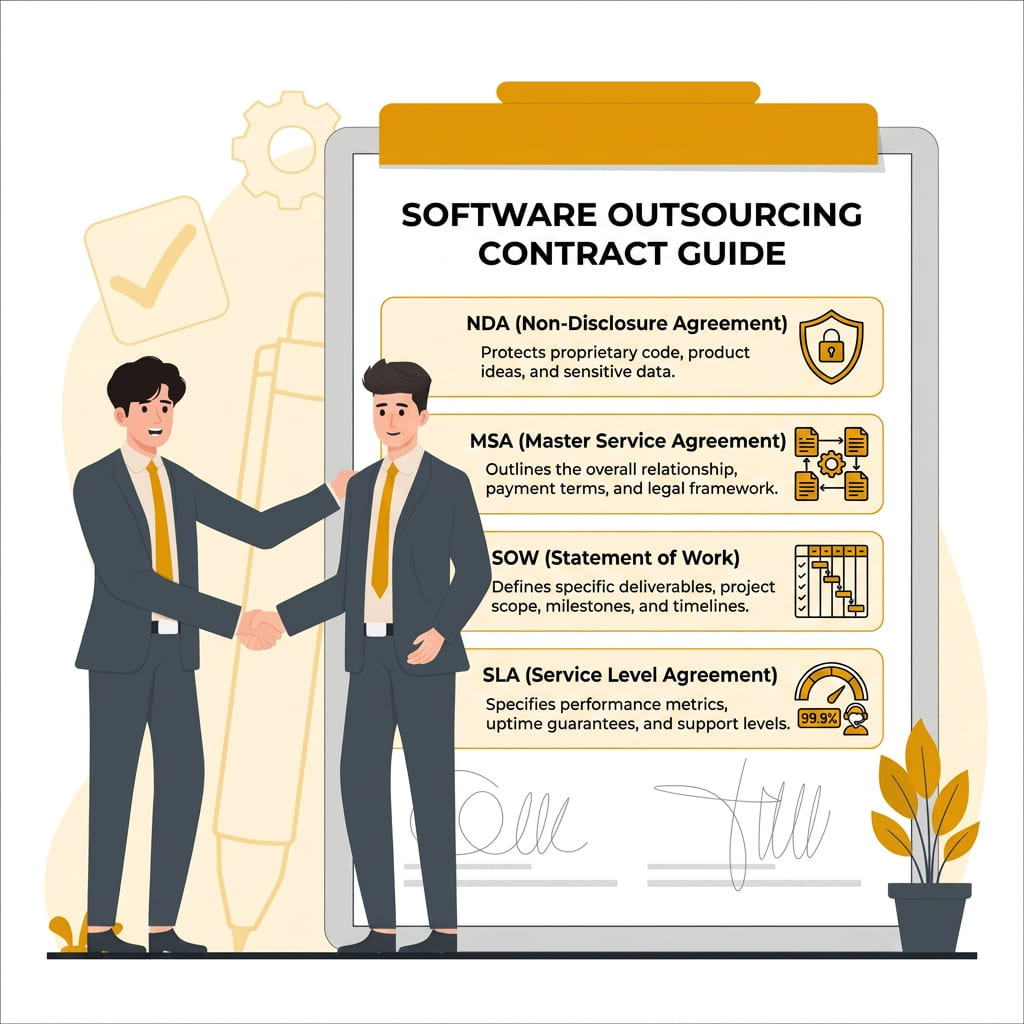
The table below is the cleanest way to avoid cannibalizing the role of each document. For a buyer, the question is not “Do we have all four files?” The better question is “Does each contract risk have the right place to live?”
| Document | When it is used | What it should control | What it should not control | Buyer decision |
|---|---|---|---|---|
| NDA | Before detailed discovery, technical review, proposal preparation, or sharing sensitive business, product, system, client, or data information. | Definition of confidential information, permitted use, disclosure restrictions, exclusions, duration, return or destruction, and who may access the information. | Delivery scope, acceptance criteria, service levels, payment triggers, production support, or IP transfer. | Can we safely share enough information for vendor evaluation without exposing uncontrolled business or technical details? |
| MSA | When the buyer expects an ongoing relationship, multiple projects, phased delivery, or repeated work orders. | Relationship-wide legal and commercial terms, payment, confidentiality, IP ownership, liability, indemnity, data protection, audit, subcontracting, dispute resolution, termination, and document precedence. | Detailed sprint backlog, feature-level acceptance, named deliverables for one project, or daily delivery ceremonies. | Does the outsourcing MSA make the relationship controllable across more than one project or phase? |
| SOW | For a specific project, phase, work package, team engagement, migration, integration, or support transition. | Objectives, scope, deliverables, timeline, roles, responsibilities, assumptions, dependencies, acceptance criteria, change control, and project-specific fees. | Relationship-wide liability, governing law, general confidentiality, or reusable commercial terms unless the MSA allows the SOW to override them. | Can the delivery team execute from this SOW without relying on verbal assumptions? |
| SLA | When services require measurable performance, support, maintenance, production monitoring, incident handling, or availability commitments. | Service hours, severity levels, response time, resolution targets, uptime or availability where applicable, recovery expectations, reporting, escalation, exclusions, and remedies. | Feature scope, product roadmap, acceptance criteria, or commercial pricing model unless tied to support scope. | Which services are measurable enough to commit to, and which are better managed through governance and reporting? |
How the Contract Stack Works Across the Outsourcing Lifecycle
A software outsourcing agreement should move with the lifecycle of the relationship. The contract stack below helps procurement and delivery teams avoid two common mistakes: signing too early before scope is known, or delaying contract review until the team is already expected to start.
| Lifecycle stage | Primary document | Control question | Useful evidence before moving forward |
|---|---|---|---|
| Initial discussion and discovery | NDA | Can both sides share enough information to evaluate fit without uncontrolled disclosure? | Mutual NDA, list of shared materials, access rules, and permitted evaluation purpose. |
| Commercial and legal baseline | MSA | Do the relationship terms support the intended delivery model, risk allocation, and future work orders? | Draft MSA, document precedence clause, vendor proposal incorporated where relevant, and exit provisions. ABA guidance for technology service agreements recommends paying attention to proposal incorporation and exit strategy in vendor contracts [5]. |
| Project or phase kickoff | SOW | Can the delivery team identify scope, roles, milestones, deliverables, assumptions, and acceptance signals? | Approved SOW, backlog or requirements baseline, acceptance criteria, dependency list, and change request process. |
| Delivery execution | SOW plus governance terms in the MSA | How are scope changes, blockers, quality issues, team changes, and client-side dependencies handled? | Change log, sprint reports, decision register, acceptance records, QA evidence, and escalation path. |
| Support, maintenance, or production operations | SLA plus support SOW | Which service commitments are measurable, and what happens when severity, urgency, and business impact differ? | Severity matrix, support calendar, response and resolution definitions, uptime exclusions, monitoring ownership, and reporting format. |
| Renewal, exit, or vendor transition | MSA plus transition SOW | Can the buyer continue, transfer, or insource the work without losing code, data, access, documentation, or context? | Exit checklist, access inventory, repository handover, data return or deletion plan, KT schedule, and final acceptance record. |
Review the Contract Stack by Risk, Not by File Name
A useful checklist for outsourcing agreements should start from the risk the buyer is trying to control. This is especially important when the project involves customer data, regulated workflows, healthcare data, financial systems, production environments, open-source components, or AI-enabled engineering practices.
| Risk to control | Where it should appear | What to check before signing | Practical pass signal |
|---|---|---|---|
| Confidentiality and evaluation-stage disclosure | NDA, then MSA confidentiality clause | Confidential information definition, exclusions, permitted use, allowed representatives, duration, compelled disclosure, and return or destruction procedure. | You can identify what was shared, who may access it, why they may use it, and what happens when evaluation ends. |
| Scope ambiguity and change requests | SOW, with MSA change-control baseline | In-scope work, out-of-scope work, assumptions, client dependencies, estimate basis, change approval flow, and commercial impact of changes. | A new stakeholder can read the SOW and know what is included, what is excluded, and how scope changes are approved. |
| Acceptance and payment disputes | SOW, payment section, acceptance clause | Acceptance criteria, review windows, deemed acceptance, defect severity, rework process, milestone payment triggers, and evidence needed for approval. | Each deliverable has an observable acceptance method, not only a subjective “client satisfaction” phrase. |
| Personal data and regulated information | MSA, DPA, BAA where applicable, SOW data appendix | Data categories, processing purpose, processing duration, sub-processors, cross-border transfer, data subject rights support, security measures, audit support, breach reporting, and return or deletion. GDPR Article 28 requires processor contracts to set out core processing details and obligations; HIPAA business associate contracts must clarify permitted uses and safeguards for protected health information where HIPAA applies [6] [7]. | The team can answer: what data is touched, why, where it is stored, who can access it, and what must happen at termination. |
| Secure software development and vulnerability handling | MSA security exhibit, SOW engineering practices, support SLA where relevant | Secure coding expectations, vulnerability triage, dependency management, access control, code review, testing, release approval, incident escalation, and remediation responsibilities. NIST SSDF provides a common vocabulary for secure software development that purchasers and suppliers can use in acquisition and management activities [8]. | Security expectations are connected to engineering activities, not written as one generic “vendor shall be secure” sentence. |
| IP ownership and reusable assets | MSA IP clause, SOW deliverables, open-source and third-party component terms | Ownership of custom work product, pre-existing IP, vendor tools, open-source components, third-party licenses, assignment mechanics, moral rights where relevant, and use of reusable frameworks. U.S. copyright law treats work made for hire differently from ordinary author ownership, so buyers should not assume code ownership without clear written terms [9]. | You can distinguish buyer-owned deliverables from vendor pre-existing assets, open-source components, and third-party materials. |
| Support performance and production accountability | SLA, support SOW, escalation exhibit | Service hours, severity definitions, response time, resolution or workaround targets, uptime calculation, exclusions, monitoring ownership, reporting, and service credits if applicable. Microsoft’s SLA guidance notes that SLAs often cover uptime or availability, but may also define performance, recovery time, or data durability [10]. | Severity levels are tied to business impact, not only technical labels. |
| Exit, transition, and continuity | MSA termination section, transition assistance clause, final SOW or exit plan | Notice periods, termination for convenience, termination for cause, data return, repository access, documentation, knowledge transfer, pending work, invoice closeout, and transition support fees. | The buyer can continue operations or transition to another team without relying on informal cooperation after termination. |
Contract Review Checklist by Stakeholder
A software development outsourcing agreement is rarely reviewed by one person. Each stakeholder should review the clauses that affect their risk area.
| Stakeholder | Review focus | Evidence to request | Pass signal |
|---|---|---|---|
| Legal | MSA structure, order of precedence, confidentiality, IP, indemnification, liability cap, governing law, dispute resolution, termination. | Marked-up MSA, work-statement attachment, security exhibit, data processing terms if applicable. | No conflict between parent terms and SOW-specific terms. |
| Procurement | Pricing model, payment schedule, invoicing, renewal, termination for convenience, change order approval, vendor onboarding. | Commercial proposal, work-statement pricing table, change request workflow, billing assumptions. | Costs and approval points are clear before work starts. |
| CTO / Engineering | Technical scope, architecture ownership, code review, repository access, environments, delivery cadence, Definition of Done, acceptance method. | work statement, delivery plan, access matrix, tooling list, handoff plan, test strategy. | The team can start work without relying on verbal assumptions. |
| Security / Compliance | Data access, secrets handling, access control, audit rights, incident notice, secure development, third-party tools, subcontractors. | Security questionnaire, SOC 2 or ISO evidence where applicable, access-control policy, secure SDLC process, incident response process. | Controls are reviewable and responsibilities are assigned, not merely promised. |
| Product / Project Owner | Milestones, priorities, backlog governance, acceptance criteria, change control, dependency management, stakeholder approvals. | work statement, project plan, acceptance checklist, RACI, communication cadence. | A missed dependency or unclear requirement has an agreed decision path. |
| Finance | Billing unit, currency, taxes, expense handling, payment timing, rate cards, budget cap, approval thresholds. | Pricing exhibit, invoice sample, rate card, expense policy, change budget rules. | The cost model matches how delivery will actually be managed. |
Security and Control Clauses Buyers Should not Leave Vague
Security language in an outsourcing contract should be specific enough to create evidence, not just comfort. Buyers can use those categories as a practical lens when deciding which controls and evidence belong in the parent agreement, SOW, SLA, or security exhibit.
| Control area | Contract question | Where it usually belongs | Red flag |
|---|---|---|---|
| Access control | Who can access repositories, cloud environments, production systems, credentials, and customer data? | security exhibit and access matrix. | Shared accounts, unclear offboarding, or no named approval process. |
| Secure development | How are code review, dependency review, vulnerability handling, and release controls managed? | delivery process, security exhibit, or engineering appendix. | No defined secure SDLC expectations or no evidence of implementation. |
| Incident notification | What must be reported, to whom, how quickly, and with what follow-up? | MSA security clause and incident process. | Notification only after “confirmed breach” with no initial escalation path. |
| Subcontractors and tools | Can the provider use subcontractors, AI coding tools, offshore personnel, or third-party platforms? | MSA, data protection terms, AI/tooling policy, and project-specific terms if needed. | Unrestricted subcontracting or tool use without disclosure and approval rules. |
| Audit and evidence | What evidence can the buyer review before and during the engagement? | parent audit rights, vendor management process, and periodic governance reviews. | The contract requires compliance but gives no way to verify it. |
How to Choose the Right Contract Structure
Not every software development agreement needs every document at the same level of detail. The structure should match the delivery model, operational risk, and expected duration of the relationship.
| Scenario | Recommended stack | Why this structure fits | Watch-out |
|---|---|---|---|
| One-time discovery or technical assessment | NDA plus short SOW or order form | The buyer needs confidentiality and a bounded deliverable, but may not need a full long-term MSA yet. | Do not allow discovery access without data, system, and repository access rules. |
| Fixed-scope MVP or product build | NDA, MSA, detailed SOW | The SOW must define the MVP boundary, acceptance criteria, assumptions, dependencies, and change control. | Avoid vague “complete app” language without feature scope, excluded work, and release criteria. |
| Dedicated development team | NDA, MSA, team SOW, governance appendix | The buyer is usually buying team capacity and delivery governance, not only predefined deliverables. | A staff augmentation contract should still define reporting, working hours, replacement process, confidentiality, IP, and security obligations. |
| Production support or managed maintenance | MSA, support SOW, SLA, runbook | Support work needs clear service scope, severity levels, escalation paths, support hours, and reporting. | Do not promise uptime if the vendor does not control hosting, architecture, third-party services, or deployment approval. |
| Healthcare, fintech, or regulated workflow | NDA, MSA, SOW, data processing terms, security exhibit, and BAA where applicable | The contract must connect delivery work with data handling, access control, audit, breach reporting, and regulatory obligations. | Do not treat “we follow best practices” as a substitute for explicit data and security responsibilities. |
Decision Checklist Before Signing a Software Outsourcing Agreement
Use this checklist before approving an outsourcing agreement, software outsourcing agreement template, or draft outsourcing agreement. The goal is not to make the contract longer; it is to make the operating model harder to misunderstand.
- Document precedence: If the MSA, SOW, SLA, DPA, BAA, proposal, and order form conflict, which one controls?
- Delivery model: Is the contract for fixed-scope delivery, dedicated team, staff augmentation, managed service, or hybrid work?
- Scope baseline: Are objectives, deliverables, assumptions, dependencies, exclusions, acceptance criteria, and change control explicit?
- Commercial triggers: Are invoices tied to time, milestones, deliverables, team capacity, or service commitments?
- IP ownership: Does the buyer own the custom work product, and are pre-existing vendor tools, open-source components, and third-party licenses carved out clearly?
- Data handling: Are personal data, production data, PHI, customer data, logs, backups, and test data treated differently where needed?
- Security operations: Are access rights, environments, secrets, vulnerability handling, code review, deployment approval, and incident escalation defined?
- SLA realism: Are service commitments measurable and within the vendor’s actual control?
- People and governance: Are team roles, replacement rules, communication cadence, reporting format, escalation path, and decision authority clear?
- Exit readiness: Are repository access, documentation, KT, data return or deletion, pending defects, and transition assistance covered?
Common Red Flags in Outsourcing Contract Management
Some contract issues only become visible during delivery. These red flags are worth checking before the team starts work.
| Red flag | Why it matters | Repair action before signing |
|---|---|---|
| The SOW says “develop the platform” without feature boundaries. | The phrase sounds clear commercially but is not executable by a delivery team. | Add module list, release scope, exclusions, dependencies, and acceptance criteria. |
| The proposal promises capabilities not incorporated into the contract. | Sales materials may not be enforceable unless correctly referenced in the agreement. | Incorporate the final proposal or define the same commitments in the SOW. |
| The SLA has response targets but no severity definition. | A “fast response” promise is hard to manage if severity and business impact are undefined. | Add severity levels, examples, response targets, escalation steps, and exclusions. |
| The buyer owns “the software” but third-party components are not identified. | Ownership of custom code does not automatically solve license, dependency, or vendor-tool questions. | Separate custom work product, pre-existing IP, open-source components, licensed tools, and third-party services. |
| Security obligations are broad but not operational. | Generic security language may not tell the engineering team what evidence to produce. | Add access control, environment rules, vulnerability handling, incident reporting, code review, and release approval expectations. |
| Termination is defined, but transition assistance is not. | A buyer can have the right to terminate yet still lack a practical path to continue operations. | Add transition assistance scope, data return, repository handover, documentation, KT, and final invoice process. |
How Bestarion Can Help
Bestarion provides software development services that can be custom-tailored to buyer needs, including custom software development, software testing, DevOps, and related delivery support [11]. In a contract discussion, Bestarion can help buyers translate business goals into delivery-ready artifacts so the MSA, SOW, and SLA support the way the team will actually work.
- Scope clarification: turn product goals, technical requirements, assumptions, and dependencies into SOW-ready delivery scope.
- Delivery model alignment: separate fixed-scope, dedicated team, staff augmentation, support, and maintenance expectations before contract finalization.
- Operational handoff planning: define working cadence, QA evidence, release support, documentation, knowledge transfer, and transition items early.
FAQ
Is an MSA the same as a software outsourcing contract?
No. An MSA is usually the relationship-wide legal and commercial baseline. A complete software outsourcing contract may also include an NDA, one or more SOWs, SLA terms, data processing terms, security exhibits, order forms, and other attachments depending on the engagement.
Do I need an SLA for every outsourcing agreement?
No. An SLA is useful when the service level is measurable, such as support response time, resolution target, uptime, recovery target, or reporting cadence. For early product development, a SOW with acceptance criteria and governance cadence may be more useful than a generic SLA.
Can I use a software outsourcing contract template?
A template can help you start, but it should not be treated as the final contract. Template language must be checked against delivery model, data sensitivity, IP ownership, security expectations, jurisdiction, service levels, and the actual SOW. For high-risk or regulated work, legal review is important.
What is the difference between a staff augmentation agreement and a project SOW?
A staff augmentation agreement usually focuses on team capacity, roles, working model, rate, replacement process, confidentiality, IP, and governance. A project SOW focuses more on deliverables, scope, milestones, acceptance criteria, and change control. Some outsourcing arrangements need both.
What to Keep in Mind
- Start with the operating model. Contract wording should match how the team will actually deliver, support, communicate, and hand over work.
- Give each document a clear owner role. NDA protects disclosure, MSA controls the relationship, SOW controls delivery scope, and SLA controls measurable service commitments.
- Avoid template comfort. A sample outsourcing agreement is useful only after it is adapted to project risk, data exposure, IP ownership, delivery model, and support needs.
- Check evidence before signing. Ask for the artifacts that make the contract executable: scope baseline, acceptance criteria, access plan, security process, reporting cadence, and exit checklist.
- Bring legal and delivery together. Legal review controls enforceability; delivery review controls whether the agreement can actually be executed.
References
- Cornell Law School Legal Information Institute, “Non-disclosure agreement (NDA),” Wex. Accessed: Jun. 22, 2026. [Online]. Available: https://www.law.cornell.edu/wex/non-disclosure_agreement_%28nda%29
- American Bar Association, “Tech From the Trenches: The Customer’s Guide to Master Service Agreements,” Law Practice Magazine. Accessed: Jun. 22, 2026. [Online]. Available: https://www.americanbar.org/groups/law_practice/resources/law-practice-magazine/2021/tech-trenches-customers-guide-master-service-agreements/
- Texas Department of Information Resources, “Statement of Work (SOW) Process.” Accessed: Jun. 22, 2026. [Online]. Available: https://dir.texas.gov/it-solutions-and-services/buying-through-dir/statement-work-sow
- National Institute of Standards and Technology, “SLA,” Computer Security Resource Center Glossary. Accessed: Jun. 22, 2026. [Online]. Available: https://csrc.nist.gov/glossary/term/SLA
- American Bar Association, “Seven Tips for Better Technology Services Agreements,” Business Law Today. Accessed: Jun. 22, 2026. [Online]. Available: https://www.americanbar.org/groups/business_law/resources/business-law-today/2023-may/seven-tips-for-better-technology-services-agreements/
- Intersoft Consulting, “Art. 28 GDPR – Processor,” General Data Protection Regulation. Accessed: Jun. 22, 2026. [Online]. Available: https://gdpr-info.eu/art-28-gdpr/
- U.S. Department of Health & Human Services, “Business Associate Contracts.” Accessed: Jun. 22, 2026. [Online]. Available: https://www.hhs.gov/hipaa/for-professionals/covered-entities/sample-business-associate-agreement-provisions/index.html
- National Institute of Standards and Technology, “SP 800-218, Secure Software Development Framework (SSDF) Version 1.1: Recommendations for Mitigating the Risk of Software Vulnerabilities,” Computer Security Resource Center. Accessed: Jun. 22, 2026. [Online]. Available: https://csrc.nist.gov/pubs/sp/800/218/final
- U.S. Copyright Office, “Chapter 2: Copyright Ownership and Transfer,” Copyright Law of the United States. Accessed: Jun. 22, 2026. [Online]. Available: https://www.copyright.gov/title17/92chap2.html
- Microsoft, “How to Read a Service-Level Agreement (SLA),” Microsoft Learn. Accessed: Jun. 22, 2026. [Online]. Available: https://learn.microsoft.com/en-us/azure/reliability/concept-service-level-agreements
- Bestarion, “Software Development.” Accessed: Jun. 22, 2026. [Online]. Available: https://bestarion.com/services/software-development/