
Hybrid Outsourcing Model Explained: What It Is, How It Works, Benefits, Risks, and When It Makes Sense
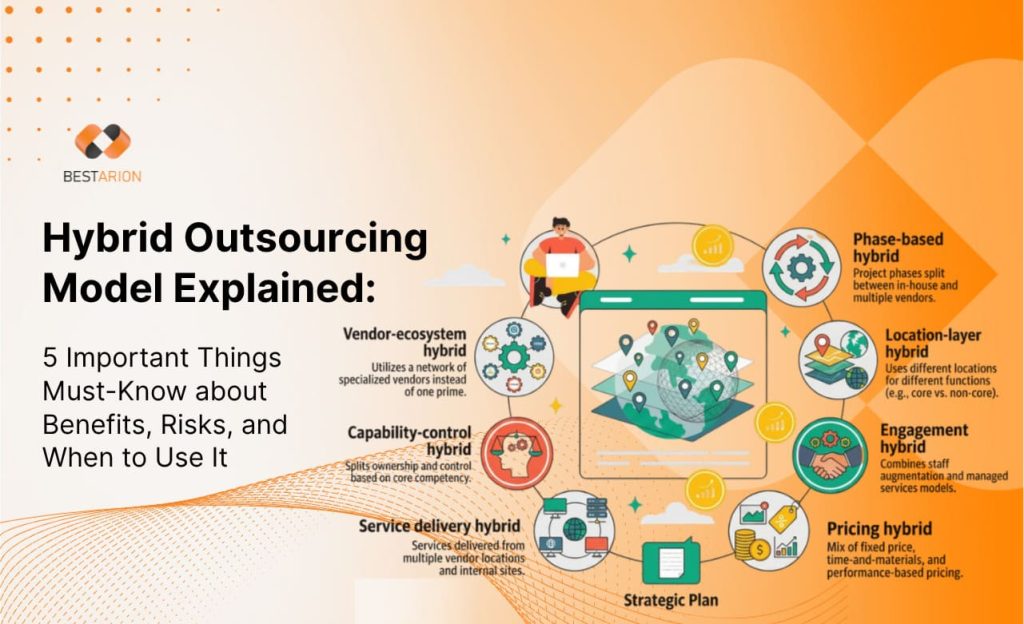
A hybrid outsourcing model is not just “using offshore plus onshore.” It is a deliberate mix of outsourcing choices across location, pricing, engagement, and service delivery. That matters because a company may use offshore delivery for cost and talent access, nearshore coverage for collaboration, time-and-materials pricing during discovery, fixed-price delivery for a stable build, managed services for support, and an internal CoE or GCC for control. Treating all of that as one generic “hybrid” model makes the agreement hard to manage.
Where hybrid outsourcing usually gets misunderstood
- Teams call any multi-vendor or multi-location setup “hybrid,” even when the model has no clear ownership rules.
- Buyers combine staff augmentation, project outsourcing, and managed services without defining which party owns backlog, delivery quality, service levels, and escalation.
- Pricing is mixed by phase, but the contract does not say when T&M ends, when fixed price starts, or when service-level pricing applies.
- Location decisions are treated as the strategy, even though location only explains where work happens, not how accountability is shared.
- Internal teams, vendors, GCCs, SSCs, and CoEs may all participate, but no one maps which capability stays internal and which capability is outsourced.
Key Takeaways
- A hybrid outsourcing model combines more than one outsourcing choice across location, pricing, engagement, and service delivery; it is not a standalone replacement for those model families.
- The model is useful when work changes by phase, risk level, capability, or operating layer. It is weak when “hybrid” simply means “we have not chosen a clear model.”
- The four model families must be separated before they are combined: location answers where work is delivered, pricing answers how the buyer pays, engagement answers how buyer and provider collaborate, and service delivery answers how the service is organized and run [10], [11], [12], [13], [14].
- Hybrid outsourcing needs a control layer: clear ownership, phase gates, service boundaries, reporting, transition rules, and escalation paths.
- For complex work, hybrid can reduce lock-in and improve flexibility, but it can also increase coordination cost if the operating model is not explicit.
What a hybrid outsourcing model means
A hybrid outsourcing model is a structured combination of two or more outsourcing models used in the same sourcing strategy, program, or operating environment. It can combine locations, engagement structures, pricing mechanisms, and service delivery structures.
It is best understood as a composition layer. The buyer does not choose “hybrid” instead of location, pricing, engagement, or service delivery. The buyer chooses a mix across those dimensions and then defines how the mix will be governed. ISO 37500 frames outsourcing around governance, life-cycle phases, relationship management, risk, and sustained arrangements, which is why a hybrid model needs clear operating rules rather than a loose label [1], [2].
Deloitte’s outsourcing research also points to multidimensional sourcing and the need to govern extended workforce ecosystems across internal, external, and partner capability pools [4], [5]. IBM’s BPO overview also separates outsourcing by location and service type, reinforcing why hybrid should be mapped by dimension rather than treated as one undifferentiated category [6].
What hybrid is and what it is not
| Question | Short answer |
|---|---|
| What it is | A deliberate mix of outsourcing models across location, pricing, engagement, and service delivery. |
| What it is not | A vague synonym for offshore outsourcing, multi-vendor sourcing, or “some work internal, some work external.” |
| Why it matters | It changes ownership, coordination, contract structure, reporting, vendor accountability, and the buyer’s internal management load. |
| When it fits | When work has different phases, risk levels, capability needs, operating layers, or collaboration requirements. |
| Main risk | The buyer gains flexibility but loses clarity if model boundaries and decision rights are not defined. |
The four dimensions a hybrid outsourcing model can combine
| Dimension | What it answers | Hybrid example | Boundary to keep clear |
|---|---|---|---|
| Location model | Where the work is delivered from | Onshore product leadership, nearshore collaboration team, offshore delivery team | Location does not define pricing, ownership, or service accountability [11]. |
| Pricing model | How the buyer pays and how commercial risk is shared | T&M for discovery, fixed price for a stable module, monthly retainer or SLA-based pricing for support | Pricing does not define who manages the work or how the service operates [12]. |
| Engagement model | How buyer and provider collaborate | Staff augmentation for a product squad, project outsourcing for a discrete build, managed team for ongoing delivery | Engagement describes collaboration and control, not geography or billing by itself [13]. |
| Service delivery model | How the service is organized, governed, delivered, improved, and scaled | Managed service for support, CoE for AI/data standards, GCC or shared service center for enterprise capability | Service delivery is the operating structure, not only an SLA or vendor label [14]. |
Common hybrid outsourcing patterns
| Hybrid pattern | What it combines | Best fit | Watch-out |
|---|---|---|---|
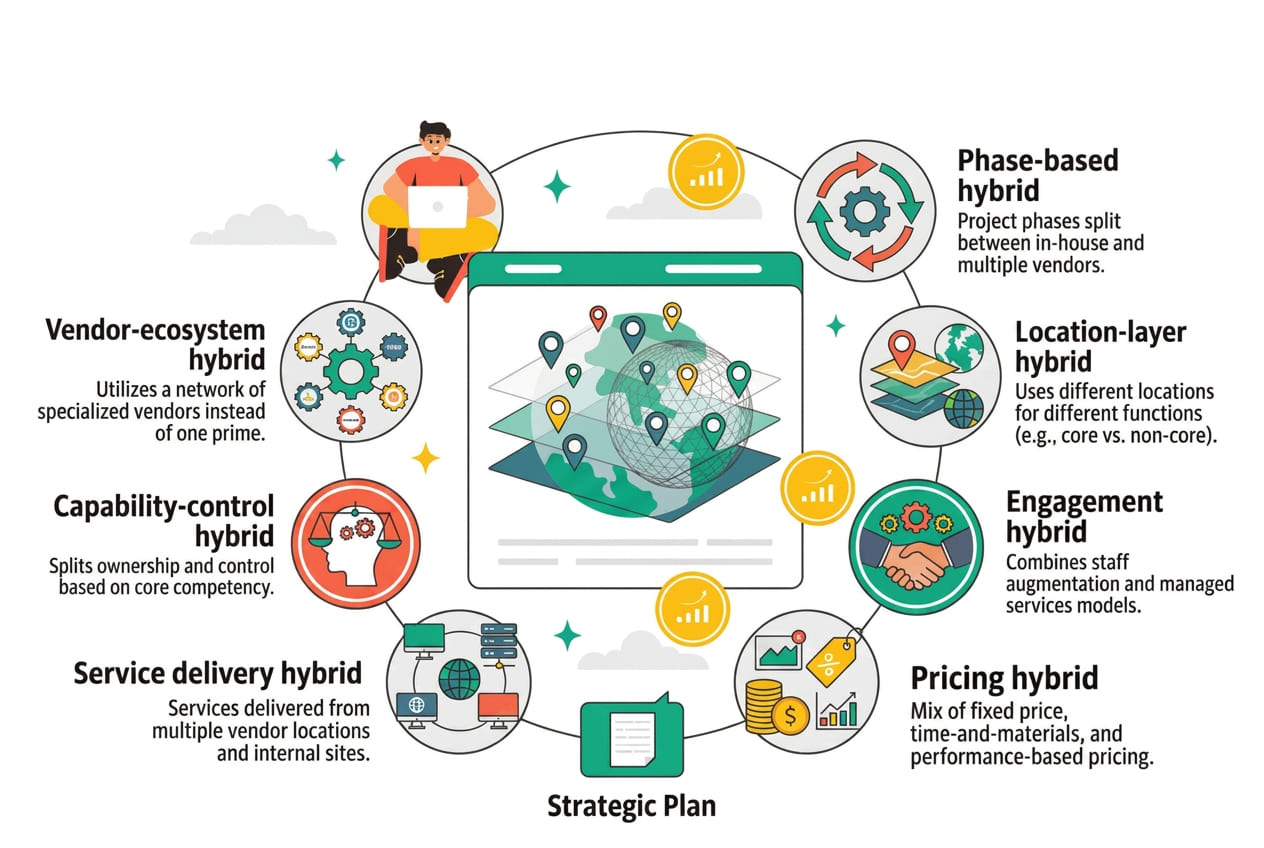
| Phase-based hybrid outsourcing model | Discovery, build, scale, and run use different pricing or engagement models | Product or software programs where uncertainty falls over time | Define phase gates clearly; otherwise the buyer pays for “hybrid” without knowing when model rules change. |
| Location-layer hybrid outsourcing model | Onshore, nearshore, and offshore teams split work by collaboration intensity, time-zone need, or cost sensitivity | Teams that need both close communication and scalable delivery capacity | Do not assume offshore owns delivery risk just because offshore does the work. |
| Engagement hybrid outsourcing model | Staff augmentation, dedicated team, project-based outsourcing, and managed services are combined by workstream | Programs with both internal product ownership and external delivery capacity | Define which workstream is capacity, which is deliverable-based, and which is service-outcome based. |
| Pricing hybrid outsourcing model | T&M, fixed price, retainer, milestone, or SLA-based pricing are applied to different phases or scopes | Work with changing uncertainty, such as discovery-to-implementation-to-support | Hybrid pricing needs a pricing schedule and change-control logic [12]. |
| Service delivery hybrid outsourcing model | Managed services, GCC/SSC, CoE, and distributed delivery are combined | Enterprises balancing control, scale, specialization, and continuous improvement | Avoid creating too many operating layers without a single governance view. |
| Capability-control hybrid outsourcing model | Strategic architecture, product ownership, security, or data governance stays internal while execution is outsourced | Buyers that need external capacity but cannot outsource critical decision rights | Internal ownership must be staffed; otherwise the vendor becomes the de facto decision owner. |
| Vendor-ecosystem hybrid outsourcing model | Multiple providers share a delivery environment under a buyer-led or integrator-led governance layer | Large programs requiring specialized vendors across functions or regions | Integration responsibility must be assigned. |
Decision matrix: when a hybrid outsourcing model makes sense
| Scenario | Best-fit hybrid setup | Why it fits | Watch-out |
|---|---|---|---|
| The work is unclear at the beginning but should stabilize later | T&M discovery, fixed-scope implementation, managed support | The model changes as uncertainty decreases | Define transition criteria before work starts. |
| The buyer needs speed but wants to keep architecture and product ownership internal | Internal product/architecture ownership plus staff augmentation or dedicated team | External capacity supports delivery while strategic decisions stay internal | Internal owners must have time and authority to manage the model. |
| The buyer wants global scale without losing collaboration rhythm | Nearshore collaboration layer plus offshore scale team | Splits collaboration-heavy work from scalable execution | Meeting cadence and handoff standards must be explicit. |
| A mature operation needs service accountability | Project or build team transitions into managed service delivery | Moves from delivery output to service operation | SLA alone is not enough; service scope and governance must be defined [3], [7]. |
| The organization wants to retain strategic capability while outsourcing execution | Internal CoE or GCC plus external execution partner | Keeps standards and knowledge close to the enterprise while using external capacity | Decision rights between CoE/GCC and vendor must be clear [8], [9]. |
| Different workstreams carry different risk levels | High-risk work kept internal; lower-risk or repeatable work outsourced | Aligns sourcing model to risk and control needs | Hybrid should not become a workaround for due diligence. |
| Multiple providers are needed | Lead vendor or buyer-led governance plus specialist vendors | Allows best-fit specialists by domain | Integration responsibility must be assigned. |
What to define before using a hybrid outsourcing model
| Decision area | What to define | Why it matters |
|---|---|---|
| Model map | Which parts are location, pricing, engagement, and service delivery choices | Prevents the buyer from using “hybrid” as a vague umbrella term. |
| Ownership | Who owns backlog, architecture, delivery quality, service performance, and escalation | Avoids accountability gaps between internal teams and providers. |
| Phase gates | When the model changes from discovery to build, build to scale, or build to run | Prevents pricing and delivery assumptions from drifting. |
| Scope boundaries | Which workstream belongs to which model | Avoids overlapping vendor obligations. |
| Governance cadence | How steering, reporting, issue escalation, and decision-making happen | ISO 37500 places governance at the center of sustained outsourcing arrangements [1], [2]. |
| Knowledge flow | What must be documented, transferred, retained, or centralized | Protects continuity when teams or vendors change. |
| Measurement | Which KPIs apply to capacity, deliverables, service levels, and outcomes | A staffing metric should not be used to judge a managed service, and an SLA should not be used to hide unclear scope. |
Terms buyers often confuse
| Term | Common misunderstanding | Better interpretation |
|---|---|---|
| Hybrid outsourcing model | “A mix of offshore and onshore” | A broader mix across location, pricing, engagement, and service delivery. |
| Hybrid location outsourcing model | “The whole outsourcing model” | Only the geographic layer of delivery. |
| Hybrid pricing outsourcing model | “Flexible billing” | A commercial design that needs phase gates, scope boundaries, and change rules. |
| Hybrid engagement outsourcing model | “Multiple vendors” | A collaboration model that may combine capacity, deliverables, and service accountability. |
| Hybrid service delivery outsourcing model | “Managed services plus staff augmentation” | An operating structure that may combine managed service, global delivery, SSC/GCC, CoE, and internal/external capability. |
| Multi-vendor outsourcing model | “Automatically hybrid” | Multi-vendor is only hybrid if each provider’s role, pricing, engagement, and delivery structure are deliberately mapped. |
Common mistakes to avoid
- Calling the model hybrid before defining which dimensions are being combined.
- Mixing pricing models without phase gates or a change-control rule.
- Combining staff augmentation and managed services without separating who manages the work and who owns service outcomes.
- Treating global delivery as only a cost decision instead of an operating structure with governance and handoff requirements.
- Creating a CoE or GCC in name only, while leaving standards, decision rights, and knowledge management undefined.
- Adding more vendors when the real problem is weak internal ownership or unclear scope.
FAQ
Is hybrid outsourcing the same as offshore plus onshore outsourcing?
No. Offshore plus onshore is a hybrid location setup. A hybrid outsourcing model can also combine pricing, engagement, and service delivery choices. Location is only one layer of the design [10], [11].
Is hybrid outsourcing better than choosing one model?
Not automatically. Hybrid is better only when different parts of the work need different operating rules. If the work is simple, stable, and low-risk, a single clear model may be easier to govern.
Can hybrid outsourcing include staff augmentation and managed services together?
Yes, but the contract and operating model must separate the two. Staff augmentation usually adds capacity under buyer direction, while managed services shift more operational responsibility to the provider. Mixing them without boundaries creates accountability confusion [13], [14].
How does hybrid pricing work in outsourcing?
Hybrid pricing applies different commercial models to different phases or scopes. For example, discovery may be T&M, implementation may be fixed price, and operations may move to a retainer or service-level structure. The important part is to define when one pricing model stops and another begins [12].
What should a buyer document before approving a hybrid outsourcing model?
Document the model map, workstream boundaries, ownership, phase gates, pricing rules, governance cadence, KPIs, transition rules, and escalation path. Without those controls, hybrid outsourcing becomes a label rather than an operating model.
What to Keep in Mind
- Treat hybrid outsourcing as a designed mix, not a vague “flexible model.”
- Separate location, pricing, engagement, and service delivery before combining them.
- Assign ownership for backlog, architecture, quality, service performance, reporting, and escalation.
- Use phase gates when the model changes over time.
- Keep hybrid only where the added coordination cost is justified by flexibility, control, or risk fit.
References
- International Organization for Standardization, “ISO 37500:2014, Guidance on outsourcing,” ISO. Accessed: May 11, 2026. [Online]. Available: https://www.iso.org/standard/56269.html
- International Organization for Standardization, “ISO 37500:2014 sample PDF, Guidance on outsourcing,” ISO / iTeh Standards. Accessed: May 11, 2026. [Online]. Available: https://cdn.standards.iteh.ai/samples/56269/125b0e663e194e6d922f273a415ffe56/ISO-37500-2014.pdf
- International Organization for Standardization, “ISO/IEC 20000-1:2018 sample PDF, Information technology — Service management — Part 1: Service management system requirements,” ISO / iTeh Standards. Accessed: May 11, 2026. [Online]. Available: https://cdn.standards.iteh.ai/samples/70636/8a24bdb065a44c6285221f7ea8c88dda/ISO-IEC-20000-1-2018.pdf
- Deloitte, “Global outsourcing survey 2024,” Deloitte. Accessed: May 11, 2026. [Online]. Available: https://www.deloitte.com/global/en/issues/work/global-outsourcing-survey.html
- Deloitte, “The power of a multidimensional workforce: Outsourcing for strategic advantage,” Deloitte. Accessed: May 11, 2026. [Online]. Available: https://www.deloitte.com/global/en/services/consulting/perspectives/the-power-multidimensional-workforce-outsourcing-strategic-advantage.html
- IBM, “What Is Business Process Outsourcing (BPO)?,” IBM Think. Accessed: May 11, 2026. [Online]. Available: https://www.ibm.com/think/topics/business-process-outsourcing
- IBM, “What Is an SLA (service level agreement)?,” IBM Think. Accessed: May 11, 2026. [Online]. Available: https://www.ibm.com/think/topics/service-level-agreement
- KPMG, “Business transformation through SSC, GBS and CoE models and outsourcing of business processes,” KPMG Poland. Accessed: May 11, 2026. [Online]. Available: https://kpmg.com/pl/en/services/strategy/business-transformation-through-ssc-gbs-and-coe-models-and-outsourcing-of-business-processes.html
- McKinsey & Company, “The future of global centers,” McKinsey & Company. Accessed: May 11, 2026. [Online]. Available: https://www.mckinsey.com/capabilities/operations/our-insights/the-future-of-global-centers
- Bestarion, “Outsourcing Models Explained: 6 Right Decisions Should Not Be Mixed Together,” Bestarion. Accessed: May 11, 2026. [Online]. Available: https://bestarion.com/outsourcing-models-explain/
- Bestarion, “Outsourcing Location Models Explained: What Offshore, Nearshore, and Onshore Actually Change,” Bestarion. Accessed: May 11, 2026. [Online]. Available: https://bestarion.com/outsourcing-location-models/
- Bestarion, “Outsourcing Pricing Models Compared: 5 Best-Fit Use Cases and Trade-Offs,” Bestarion. Accessed: May 11, 2026. [Online]. Available: https://bestarion.com/us/outsourcing-pricing-models/
- Bestarion, “Outsourcing Engagement Models Explained,” Bestarion. Accessed: May 11, 2026. [Online]. Available: https://bestarion.com/outsourcing-engagement-models/
- Bestarion, “Outsourcing Service Delivery Models Explained,” Bestarion. Accessed: May 11, 2026. [Online]. Available: https://bestarion.com/outsourcing-service-delivery-models/
- Bestarion, “Choose Right Outsourcing Models,” Bestarion. Accessed: May 11, 2026. [Online]. Available: https://bestarion.com/how-to-choose-right-outsouricng-models/
- Bestarion, “Staff Augmentation Services,” Bestarion. Accessed: May 11, 2026. [Online]. Available: https://bestarion.com/services/staff-augmentation/