
Outsourcing Pricing Models Explained: How Pricing Structure Impacts Scope, Quality, Vendor Incentives, and Delivery Risk
Outsourcing pricing models are not just billing formats. They decide how scope uncertainty, delivery risk, management effort, performance accountability, and cost predictability are shared between the buyer and the provider.
A fixed-price contract can look cheaper because the budget is known upfront. Time and materials can look risky because cost moves with actual effort. Outcome-based pricing can sound attractive because it connects fees to results. The right choice depends less on the label and more on whether your billing unit, commercial formula, metrics, governance, and decision rights are mature enough to support the model.
Where buyers get pricing wrong
- They compare hourly rates before deciding whether they are buying effort, capacity, transactions, service coverage, or business outcomes.
- They choose fixed price for unclear requirements, then pay for change requests later.
- They choose time and materials for flexibility, but do not set timesheet approval, budget caps, sprint checkpoints, or scope limits.
- They treat FTE-based pricing as if it automatically means a dedicated team or guaranteed outcome, even though FTE is a billing unit and dedicated team is an engagement model.
- They choose transaction-based pricing without defining quality thresholds, rework rules, exception handling, or volume bands.
- They ask for outcome-based pricing before defining baselines, metrics, data access, attribution logic, and provider influence.
- They use hybrid pricing without defining where one model ends and the next begins.
Key Takeaways
- Outsourcing pricing models explain how the provider is paid and how commercial risk is shared. IBM identifies fixed-price, time-and-materials, and performance-outcome structures as BPO or ITO contract options, and recommends SLAs for evaluating service quality [1].
- The billing unit is the first thing to check. If the unit is an hour, you are buying effort. If it is an FTE/month, you are buying capacity. If it is a ticket, invoice, or case, you are buying output.
- Fixed price works best when requirements, deliverables, acceptance criteria, and change-control rules are stable. It can protect budget, but it becomes fragile when the work is still exploratory.
- Time and materials works best when the scope is evolving. It gives flexibility, but the buyer needs active cost governance, delivery visibility, and burn-rate control.
- FTE-based or capacity-based pricing buys stable people and continuity. It does not automatically transfer delivery accountability to the provider.
- Outcome-based and risk-reward models can create stronger alignment, but they require measurable outcomes, baseline data, shared governance, attribution logic, and clear decision rights. EY warns that outcome-based outsourcing fails when buyers do not architect the deal around collaboration and outcomes [2].
What outsourcing pricing models mean
An outsourcing pricing model is the commercial structure that defines how a provider charges for work and how both parties share uncertainty. It should define the billing unit, pricing formula, risk-sharing logic, and the controls needed to keep cost and performance aligned.
It should answer five questions:
- What exactly is being priced: time, capacity, output, scope, service level, business result, or savings?
- Which billing unit triggers the invoice: hour, FTE/month, transaction, SLA tier, milestone, or outcome?
- Which party carries the risk if requirements, volume, workload, or priorities change?
- Which party manages day-to-day delivery effort and performance accountability?
- How will performance be measured, verified, and escalated?
That is why pricing should not be selected separately from engagement model, service delivery model, governance, and contract scope. ISO 37500 frames outsourcing as a managed lifecycle that needs governance, flexibility for changing business requirements, risk identification, and collaborative relationships [3].
The practical test is simple: first identify the billing unit, then match it to the commercial formula and control layer. If the billing unit is unclear, the rest of the pricing discussion stays vague. ISG warns that ambiguity across pricing models such as fixed price, T&M, risk/reward, gainshare, and cost-plus can create value leakage, disputes, and tension between buyer and provider [4].
Outsourcing pricing models at a glance
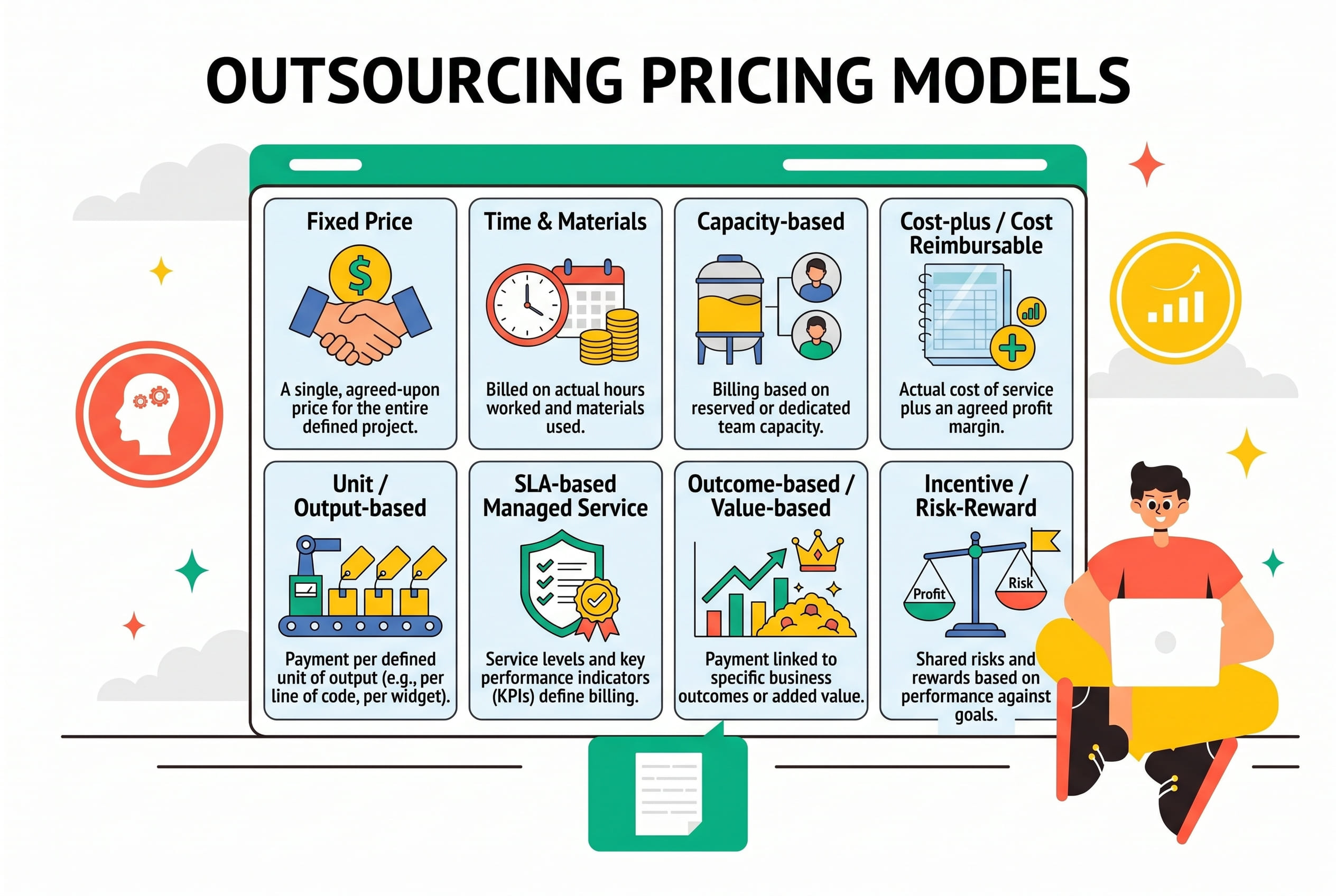
Use this matrix to compare the billing unit, commercial formula, matching outsourcing model, best-fit situation, and KPI/control layer for each pricing model.
| Pricing model | Billing unit | Common commercial formula | Matching outsourcing model | Best fit | KPI/control required |
|---|---|---|---|---|---|
| Fixed price | Project, milestone, deliverable, work package | Fixed fee per scope or milestone payment | Project-based outsourcing, turnkey delivery | Stable scope, clear output, clear acceptance criteria | Scope baseline, change request process, acceptance criteria, milestone sign-off |
| Time and materials | Hour, day, sprint, role-hour | Hourly or daily rate x actual time used | Staff augmentation, agile delivery, discovery project | Scope changes, backlog evolves, flexibility matters | Timesheet, sprint review, burn-rate tracking, budget cap |
| FTE-based / capacity-based | FTE/month, seat/month, role/month, pod/month | Monthly rate per FTE, role, seat, or team pod | Dedicated team, staff augmentation, retained BPO team | Stable capacity, knowledge retention, team continuity | Utilization, productivity, attendance, RACI, delivery KPI |
| Cost-plus / cost reimbursable | Actual labor, tool, infrastructure cost + margin | Actual cost + markup % or management fee | BOT, GCC support, transparent long-term operations | Cost drivers unclear, buyer wants transparency | Audit rights, cost benchmark, productivity target, margin rules |
| Transaction-based / unit-based / output-based | Ticket, invoice, call, case, transaction, page, report, task | Unit price x completed volume | BPO process outsourcing, shared service, managed operations | Repeatable work, variable volume, measurable output | Quality threshold, rework rule, exception handling, volume band |
| SLA-based managed service | Service package, SLA tier, coverage window, monthly service fee | Monthly fee tied to SLA scope or tier | Managed service, IT support, application maintenance, operations support | Recurring service with clear service levels | Response time, resolution time, uptime, accuracy, service credits |
| Outcome-based / value-based | Savings %, productivity gain, revenue lift, cycle-time reduction, quality improvement | Base fee + outcome fee or % value created | Transformation outsourcing, strategic BPO, performance partnership | Outcome measurable, provider can influence the result | Baseline, attribution model, data access, decision rights |
| Incentive / risk-reward / gainshare | Bonus, penalty, gainshare, risk pool | Base fee + bonus, penalty, or gainshare | Managed service, outcome-led outsourcing, complex ITO/BPO deal | Both parties influence performance | Bonus formula, penalty rule, dispute mechanism, independent verification |
| Hybrid / blended | Mix by phase, service, team, transaction, SLA, or outcome | T&M for discovery + fixed price build + SLA operations | Multi-phase outsourcing, long-term vendor partnership | Work has multiple phases or service lines | Pricing schedule, phase gate, model boundary, governance cadence |
1. Fixed price outsourcing
A fixed-price model charges a set amount for a defined scope, milestone, deliverable, or work package. IBM describes fixed-price contracts as arrangements where the provider is paid a fixed amount regardless of the time and resources used [1].
Fixed price is usually strongest when the buyer can define requirements, deliverables, dependencies, acceptance criteria, and change-control rules before work begins. It is often a fit for a defined migration, a short implementation, a small application, a standard workflow build, or a clearly scoped business process transition.
The trade-off is flexibility. If the scope changes, the provider must either absorb risk, negotiate a change request, reduce quality, or price the original proposal with a risk buffer. ISG notes that ambiguity across pricing models can create value leakage, disputes, and tension between buyer and provider [4].
Billing unit and formula: project, milestone, deliverable, or work package; usually a fixed fee per agreed scope or milestone payment.
KPI/control to include: scope baseline, milestone sign-off criteria, change request process, acceptance criteria by deliverable, assumption log, and exclusions.
Use fixed price when
- Scope and deliverables are stable.
- Acceptance criteria can be written clearly.
- The buyer wants budget predictability.
- The provider can estimate effort with confidence.
- Change requests can be managed without slowing the business.
Avoid fixed price when
- Requirements are still changing.
- The buyer expects agile discovery.
- Success depends on unknown dependencies.
- The provider is asked to commit to outcomes it cannot control.
2. Time and materials
A time and materials model charges based on actual hours and resources used. IBM describes this structure as a contract where the provider is paid based on the time and resources used during the work [1].
T&M works well when the buyer needs flexibility. It is common in software development, product discovery, system modernization, analytics, and situations where requirements evolve as the team learns.
The risk is budget drift. T&M is not automatically cheaper because the buyer pays for actual effort. It needs sprint-level governance, burn-rate tracking, scope prioritization, and frequent checkpoints.
Billing unit and formula: hour, day, sprint, or role-hour; usually hourly or daily rate multiplied by actual time used.
KPI/control to include: timesheet approval, sprint review, backlog review, monthly burn-rate threshold, budget cap, role-level rate card, and delivery review cadence.
Use time and materials when
- Requirements are evolving.
- The work is exploratory or agile.
- The buyer wants to prioritize and reprioritize frequently.
- The buyer has enough internal ownership to manage backlog, quality, and scope.
- Budget can be controlled through caps, milestones, or review cadence.
Avoid time and materials when
- The buyer needs a fixed commercial commitment.
- Internal stakeholders cannot manage scope.
- Procurement needs a defined cost before approval.
- The work is repeatable enough to price by output or SLA.
3. Dedicated team or capacity-based pricing
Dedicated team or capacity-based pricing charges for reserved team capacity, usually by FTE/month, seat/month, role/month, or team pod. It is often treated as a pricing model, but it also overlaps with the engagement model because the buyer is effectively buying stable people, not a finished outcome.
Wirtek describes dedicated teams as a model with transparency, reliable team efficiency over time, full control, and a fixed monthly rate per team member, while noting that management effort is still required [5]. The important distinction is that FTE is a billing unit, while dedicated team is an engagement model.
This model fits long-term product development, engineering extension, QA support, analytics operations, retained BPO teams, or recurring business-process support where continuity matters.
Billing unit and formula: FTE/month, seat/month, role/month, or pod/month; usually monthly rate per FTE, role, seat, or team pod.
KPI/control to include: utilization, productive hours, attendance, coverage, RACI, role ownership, delivery KPIs, output benchmarks, and ramp-up metrics.
Use dedicated team pricing when
- You need stable capacity over months or years.
- Knowledge retention matters.
- Internal leaders can manage priorities and backlog.
- Scope changes frequently, but the need for capacity is ongoing.
- You want more control than a managed service model provides.
Avoid dedicated team pricing when
- You want the provider to own end-to-end business outcomes.
- Work volume is too volatile to reserve capacity.
- You lack internal product, process, or technical ownership.
- You need clear unit economics by transaction, ticket, or output.
4. Cost-plus or cost reimbursable pricing
A cost-plus model reimburses the provider’s actual cost and adds an agreed margin or management fee. It can be useful when the buyer wants transparency into labor, infrastructure, tools, transition costs, or long-term operating costs.
This model can fit build-operate-transfer, global capability center support, complex transitions, or regulated operations where both parties need visibility into real cost drivers.
The weakness is incentive design. If the provider earns a margin on cost, there must be governance to prevent inefficiency. Cost-plus needs audit rights, margin rules, productivity targets, staffing controls, benchmarking, and periodic reviews.
Billing unit and formula: actual labor, tool, infrastructure, or pass-through cost plus margin; usually actual cost plus markup percentage or management fee.
KPI/control to include: audit rights, cost category definitions, markup rules, margin rules, cost benchmark review, staffing controls, and productivity targets.
Use cost-plus when
- Cost transparency is more important than fixed budget.
- The scope is complex and difficult to estimate upfront.
- The buyer wants visibility into staffing, tools, and transition costs.
- Both parties can agree on productivity targets and review cadence.
Avoid cost-plus when
- You need strong provider incentives to reduce effort.
- Cost data cannot be audited.
- Governance maturity is low.
- The business needs a simple, predictable commercial model.
5. Unit or output-based pricing
Unit or output-based pricing charges per measurable output, such as ticket resolved, invoice processed, case handled, report produced, call answered, document coded, transaction completed, or task delivered.
This model works best when the work is repeatable, measurable, and quality standards can be clearly defined. It can be a strong fit for BPO, customer support, claims processing, data operations, finance operations, shared services, managed operations, or other high-volume processes.
The trap is underdefining quality. A unit may be completed quickly but incorrectly. Output-based pricing should include exception handling, quality thresholds, rework rules, service-level targets, and volume bands. Infosys’ Philips case describes transaction-based pricing as a mechanism that supported variable cost and innovation incentives in a shared-service outsourcing relationship [6].
Billing unit and formula: ticket, invoice, call, case, transaction, page, report, or task; usually unit price multiplied by completed volume.
KPI/control to include: unit definition, included and excluded activities, quality threshold, rework rule, exception handling, volume bands, and renegotiation triggers.
Use unit or output-based pricing when
- Work units are repeatable and measurable.
- Volumes vary but can be tracked.
- Quality and rework rules can be defined.
- The buyer wants cost to move with demand.
- Process controls are mature enough to prevent gaming the metric.
Avoid unit pricing when
- Work units are highly variable or hard to classify.
- Quality is subjective.
- Exceptions are common.
- The provider cannot influence upstream inputs.
6. SLA-based managed service pricing
SLA-based pricing charges for an ongoing service governed by service levels, such as uptime, response time, resolution time, processing accuracy, or support coverage.
This model can work well for IT support, application maintenance, infrastructure operations, managed security, help desk, finance operations, or recurring business services.
The important point is that SLAs measure service performance, not necessarily business value. IBM notes that SLAs define the service, expected performance level, measurement and approval method, and what happens if performance levels are not met [7]. AWS also describes SLA metrics such as uptime, delivery time, response time, and resolution time, plus remedies such as pricing discounts when requirements are not met [8].
Billing unit and formula: service package, SLA tier, coverage window, or monthly service fee; usually monthly fee tied to SLA scope or tier.
KPI/control to include: response time by priority, resolution time, restoration target, uptime, availability, accuracy, quality threshold, service credits, escalation rules, and reporting cadence.
Use SLA-based pricing when
- The service is recurring.
- Performance expectations can be measured.
- The provider owns part of the service operation.
- There is a clear reporting cadence.
- Escalation rules and service credits are defined.
Avoid SLA-based pricing when
- The work is project-based.
- The buyer needs innovation, transformation, or business outcomes beyond service levels.
- SLA metrics are easy to meet but do not reflect business impact.
7. Outcome-based or value-based pricing
Outcome-based pricing links provider compensation to business results, such as cost savings, productivity gains, adoption, revenue lift, cycle-time reduction, defect reduction, or working-capital improvement.
This model is attractive because it aligns pricing with value. But it only works when outcomes are measurable and the provider has enough influence to affect them. EY argues that outcome-based outsourcing requires a different approach to supplier collaboration, because business outcomes usually require cross-functional and end-to-end coordination [2].
Deloitte reports that outsourcing delivery models are maturing, with more emphasis on value-based relationships and outcome-based delivery models [9]. KPMG also notes that many modern outsourcing deals include innovation clauses, value-sharing mechanisms, and outcome-based pricing aligned to commercial performance indicators [10].
Billing unit and formula: savings percentage, productivity gain, revenue lift, cycle-time reduction, or quality improvement; usually base fee plus outcome fee or percentage of value created.
KPI/control to include: baseline performance data, outcome definition, measurement method, attribution model, data access, auditability, decision rights, and provider influence over performance levers.
Use outcome-based pricing when
- The business outcome can be measured.
- Baseline performance data exists.
- The provider can influence the outcome.
- The buyer can give the provider enough decision rights, data access, and cross-functional cooperation.
- Governance can handle attribution, disputes, and changing business conditions.
Avoid outcome-based pricing when
- The metric is vague.
- Internal teams control most variables.
- Baseline data is missing.
- The buyer wants tight micromanagement while asking the provider to own results.
8. Incentive-based and risk-reward pricing
Incentive-based models add bonuses, penalties, gainshare, or risk-reward mechanisms on top of a base model. For example, a provider may receive a base retainer plus a bonus for exceeding service levels, sharing savings, reducing cycle time, or meeting adoption targets.
Accelerance describes incentive-based and shared risk-reward pricing as ways to align provider motivation with buyer goals, while warning that these models require detailed oversight and measurable benefits [11]. ISG also identifies risk/reward and gainshare as pricing models that can create ambiguity if not contractually defined with rigor [4].
Infosys lists transaction pricing, gain sharing, business outcome-focused pricing, fixed pricing, and FTE-based pricing as multiple commercial models in BPO contexts [12].
Billing unit and formula: bonus, penalty, gainshare, or risk pool; usually base fee plus bonus, penalty, or gainshare.
KPI/control to include: bonus formula, penalty rule, gainshare calculation method, independent verification, dispute mechanism, and rules for external factors outside provider control.
Use incentive or risk-reward pricing when
- A base model is already clear.
- Performance goals are measurable.
- Both parties can influence results.
- Upside and downside rules are explicit.
- The buyer can verify results independently.
Avoid it when
- Metrics are unclear.
- Attribution will be contested.
- The incentive is too small to change behavior.
- The model adds complexity without improving accountability.
How to choose the right outsourcing pricing model
Use this decision flow before you ask vendors for a proposal:
- Start with the billing unit. Are you buying an hour, an FTE/month, a deliverable, a transaction, a service level, or a business outcome?
- Start with scope clarity. If the scope is stable, fixed price can work. If the scope is evolving, T&M or dedicated capacity may fit better.
- Decide what you are buying. Are you buying a deliverable, a team, a transaction, a service level, or a business result?
- Check who controls the outcome. Do not use outcome-based pricing unless the provider can influence the result.
- Match pricing to governance maturity. More flexible models need stronger governance, reporting, and budget control.
- Define measurement before negotiation. Metrics, baselines, exclusions, rework, service credits, and change rules should be designed before final pricing.
- Use hybrid pricing when the work changes by phase. Discovery may be T&M, implementation may be fixed price, operations may become SLA-based or output-based.
- Define model boundaries. Hybrid pricing needs a pricing schedule, phase gates, and rules for when one model stops and another begins.
Scenario-fit matrix
| Buyer situation | Best-fit pricing model | Why it fits | Watch-out |
|---|---|---|---|
| Clear one-time project with stable requirements | Fixed price | Protects budget and timeline when scope is known | Change requests can become expensive |
| Agile product or software development | Time and materials or dedicated team | Supports evolving priorities and iterative delivery | Needs backlog, burn-rate, and sprint governance |
| Long-term engineering extension or retained operations support | FTE-based / capacity-based | Builds continuity, knowledge retention, and stable capacity | Buyer still owns management, utilization, and prioritization unless the contract says otherwise |
| High-volume repeatable process | Transaction-based / output-based | Cost moves with volume | Quality, exception, and rework rules must be precise |
| Recurring IT or business operations | SLA-based managed service | Aligns provider responsibility to service performance | SLA compliance may not equal business outcome |
| Transformation or process improvement | Outcome-based or gainshare | Links provider reward to measurable value | Requires baselines, attribution logic, data access, decision rights, and shared governance |
| Complex transition with unknown cost drivers | Cost-plus or hybrid | Gives transparency during uncertainty and can evolve by phase | Needs productivity controls, audit rights, phase gates, and model boundaries |
Pricing risk matrix
| Risk | Why it happens | Model most exposed | Control to add |
|---|---|---|---|
| Scope creep | Requirements change without repricing rules | Fixed price, T&M | Scope baseline, acceptance criteria, change-control process, approval thresholds |
| Budget drift | Actual effort grows faster than expected | T&M, dedicated team | Timesheet approval, budget cap, burn-rate review, sprint-level forecasting |
| Low provider accountability | Buyer pays for people but expects outcomes | FTE-based, dedicated team | RACI, ownership map, utilization review, productivity benchmark, delivery KPIs |
| Quality trade-off | Provider optimizes for unit volume or margin | Fixed price, transaction-based, unit pricing | Quality threshold, rework rule, exception handling, acceptance criteria |
| Metric gaming | Provider optimizes for what is measured, not what matters | SLA, output, outcome models | Balanced scorecard, audit rights, exception rules, independent verification |
| Attribution dispute | Outcome depends on many teams or market factors | Outcome-based, gainshare | Baseline data, attribution model, data access, exclusion rules, decision rights |
| Value leakage | Pricing language leaves room for interpretation | Hybrid, risk/reward, cost-plus, complex ITO/BPO deals | Pricing schedule, margin rules, model boundary, scenario testing, commercial assurance |
Common mistakes to avoid
| Mistake | What it usually means | Better approach |
|---|---|---|
| Choosing the cheapest hourly rate | Rate is compared without productivity, quality, billing unit, or management cost | Compare total cost by billing unit, control metric, and delivery accountability |
| Using fixed price for unclear scope | Buyer wants certainty before requirements are ready | Use discovery, phased fixed scope, or T&M with caps |
| Using T&M without governance | Flexibility turns into uncontrolled spend | Add timesheet approval, burn-rate tracking, sprint reviews, and approval thresholds |
| Treating FTE-based pricing as managed service | Buyer buys capacity but expects provider-owned outcomes | Choose managed service or define RACI, utilization, productivity, and delivery ownership clearly |
| Using transaction pricing without quality rules | Provider may optimize volume while exceptions and rework remain unclear | Define quality threshold, rework rules, exception handling, and volume bands |
| Asking for outcome pricing too early | Metrics, baselines, decision rights, and data access are not ready | Start with SLA/output model, then mature toward outcome model |
| Mixing pricing models without boundaries | Hybrid pricing becomes unclear across discovery, build, and operations phases | Use a pricing schedule, phase gate, model boundary, and governance cadence |
| Using cost-plus without audit rights | Buyer wants transparency but cannot verify actual cost, margin, or productivity | Define cost categories, markup rules, audit rights, benchmark reviews, and productivity targets |
FAQ
What are the main outsourcing pricing models?
The main outsourcing pricing models are fixed price, time and materials, FTE-based or capacity-based pricing, cost-plus or cost reimbursable pricing, transaction-based or unit-based pricing, SLA-based managed service pricing, outcome-based or value-based pricing, incentive-based or risk-reward pricing, gainshare pricing, and hybrid or blended pricing.
Which outsourcing pricing model is best?
There is no universal best model. Fixed price works for stable scope. Time and materials works for evolving scope. FTE-based pricing works for long-term capacity. Transaction-based pricing works for repeatable work. SLA-based pricing works for recurring service levels. Outcome-based pricing works when outcomes are measurable and the provider can influence results.
Is dedicated team a pricing model or engagement model?
It is both in practice, but the terms should not be treated as identical. FTE-based or capacity-based pricing is commercial because the buyer pays for reserved capacity. Dedicated team is an engagement model because it defines how the buyer and provider work together.
Is transaction-based pricing the same as outcome-based pricing?
No. Transaction-based pricing pays for completed units such as invoices, tickets, calls, cases, reports, or tasks. Outcome-based pricing pays for measurable business results such as savings, productivity gains, cycle-time reduction, or quality improvement.
Is outcome-based pricing always better?
No. Outcome-based pricing can create better alignment, but only when baselines, metrics, decision rights, data access, attribution logic, and governance are strong enough. Otherwise, it creates attribution disputes and disappointment [2].
Should outsourcing pricing include SLAs?
For recurring services, yes. SLAs help evaluate service quality, but they should not be the only measure of value. Business impact, quality, improvement, and governance should also be reviewed [1], [7].
When does hybrid pricing make sense?
Hybrid pricing makes sense when the engagement has different phases or service lines. For example, discovery may use time and materials, build may use fixed price, and operations may use SLA-based managed service or transaction-based pricing.
What to Keep in Mind
- Pricing is not just cost; it is a risk-sharing design.
- Start with the billing unit before comparing the pricing model.
- Fixed price buys predictability, but only when scope is stable.
- T&M buys flexibility, but only with budget governance.
- FTE-based pricing buys capacity, not automatic outcomes.
- Transaction-based pricing needs quality, rework, exception, and volume controls.
- SLA-based pricing needs service credits, escalation rules, and reporting cadence.
- Outcome-based pricing needs baseline data, attribution, data access, decision rights, and governance.
- Hybrid pricing is often realistic, but only if each phase has clear model boundaries.
References
[1] IBM, “What is business process outsourcing (BPO)?,” IBM Think. Accessed: Apr. 29, 2026. [Online]. Available: https://www.ibm.com/think/topics/business-process-outsourcing
[2] H. Rattenberger and M. Kuchler, “How outcome-based outsourcing can make BPO deals a win-win situation,” EY Switzerland, Feb. 20, 2024. Accessed: Apr. 29, 2026. [Online]. Available: https://www.ey.com/en_ch/insights/consulting/how-outcome-based-outsourcing-can-make-bpo-deals-a-win-win-situation
[3] International Organization for Standardization, “ISO 37500:2014 Guidance on outsourcing,” ISO, Nov. 2014. Accessed: Apr. 29, 2026. [Online]. Available: https://www.iso.org/standard/56269.html
[4] G. Leaderman, “Contractual pricing assurance: beyond benchmarking,” Information Services Group, 2016. Accessed: Apr. 29, 2026. [Online]. Available: https://isg-one.com/docs/default-source/default-document-library/contractual-pricing-assurance.pdf
[5] Wirtek, “Pricing models in IT outsourcing — which one is right for you?,” Wirtek, Jan. 13, 2021. Accessed: Apr. 29, 2026. [Online]. Available: https://www.wirtek.com/blog/pricing-models-in-it-outsourcing
[6] Infosys BPM, “Shared service centers case studies,” Infosys BPM. Accessed: Apr. 29, 2026. [Online]. Available: https://www.infosysbpm.com/offerings/industries/manufacturing/case-studies/Documents/shared-service-centers.pdf
[7] M. Goodwin, “What is an SLA (service level agreement)?,” IBM Think, May 30, 2024. Accessed: Apr. 29, 2026. [Online]. Available: https://www.ibm.com/think/topics/service-level-agreement
[8] Amazon Web Services, “What is SLA? Service level agreement explained,” AWS. Accessed: Apr. 29, 2026. [Online]. Available: https://aws.amazon.com/what-is/service-level-agreement/
[9] Deloitte, “Global outsourcing survey 2024,” Deloitte Global, 2024. Accessed: Apr. 29, 2026. [Online]. Available: https://www.deloitte.com/global/en/issues/work/global-outsourcing-survey.html
[10] KPMG, “The Future of Outsourcing: Rethink Everything,” KPMG LLP, 2025. Accessed: Apr. 29, 2026. [Online]. Available: https://kpmg.com/kpmg-us/content/dam/kpmg/pdf/2025/future-outsourcing-rethink-everything.pdf
[11] A. Hilliard, “Find the right pricing model to lower the cost of outsourcing,” Accelerance, Jul. 4, 2024. Accessed: Apr. 29, 2026. [Online]. Available: https://www.accelerance.com/blog/choosing-the-best-pricing-model-for-your-outsourcing-engagement
[12] Infosys, “Infosys BPO,” Infosys Analyst Meet, 2008. Accessed: Apr. 29, 2026. [Online]. Available: https://www.infosys.com/investors/news-events/analyst-meet/2008/india/documents/infosys-bpo.pdf