
Fixed Price vs. Time & Materials: Which Model Maximizes ROI? How to Choose The Right Contract

In the world of software development, choosing an Engagement Model is a strategic financial decision, not just an administrative box to check. A wrong choice at this stage won’t just delay your roadmap; it can erode your profit margins or burn through your startup’s runway before you even reach product-market fit.
The two heavyweights in IT Outsourcing (ITO) negotiations are always Fixed Price and Time & Materials (T&M).
If you are a CFO worrying about cash flow predictability, or a Founder seeking the agility to pivot, this guide places these two models on a financial and operational scale. We will dissect the hidden costs, analyze the ROI, and help you determine which model aligns with your business stage.
Direct Comparison Framework: The Mechanics of Money and Control
Before diving into the ROI analysis, let’s establish the core mechanics of how these models govern your relationship with a vendor like Bestarion.
Fixed Price: The “Safety” of a Closed Budget
Think of Fixed Price like buying a train ticket. You know the destination, the departure time, and the exact cost before you board.
-
Mechanism: The price is locked based on a detailed Statement of Work (SOW) and Software Requirement Specification (SRS).
-
Cash Flow: Payments are “lumpy,” tied to specific milestones (e.g., 30% Deposit, 30% Beta Release, 40% UAT Sign-off).
-
The Psychological Hook: Clients feel safe because the risk of “going over budget” is theoretically transferred to the vendor.
Time & Materials (T&M): The Agility of Speed
Think of T&M like using Uber. You have a general destination, but you can change the route mid-ride to avoid traffic. You pay for the actual time and distance traveled.
-
Mechanism: You pay based on the actual effort (Hours/Days) spent by the engineering team.
-
Cash Flow: Payments are smooth and predictable (OpEx), billed monthly based on approved timesheets.
-
The Psychological Hook: Clients retain full control over the roadmap and priorities but fear the risk of an uncapped total cost.
At a Glance: The Comparison Matrix
| Feature | Fixed Price | Time & Materials (T&M) |
| Scope Flexibility | Low (Rigid, requires Change Requests) | High (Adaptive, continuous iteration) |
| Budget Certainty | High (Known upfront) | Variable (Estimated) |
| Cash Flow Profile | Lumpy (Large milestone deposits) | Smooth (Monthly operational expense) |
| Primary Risk Owner | Vendor (If estimation is wrong) | Client (If management is poor) |
| Setup Time | Slow (Weeks of documentation) | Fast (Start immediately) |
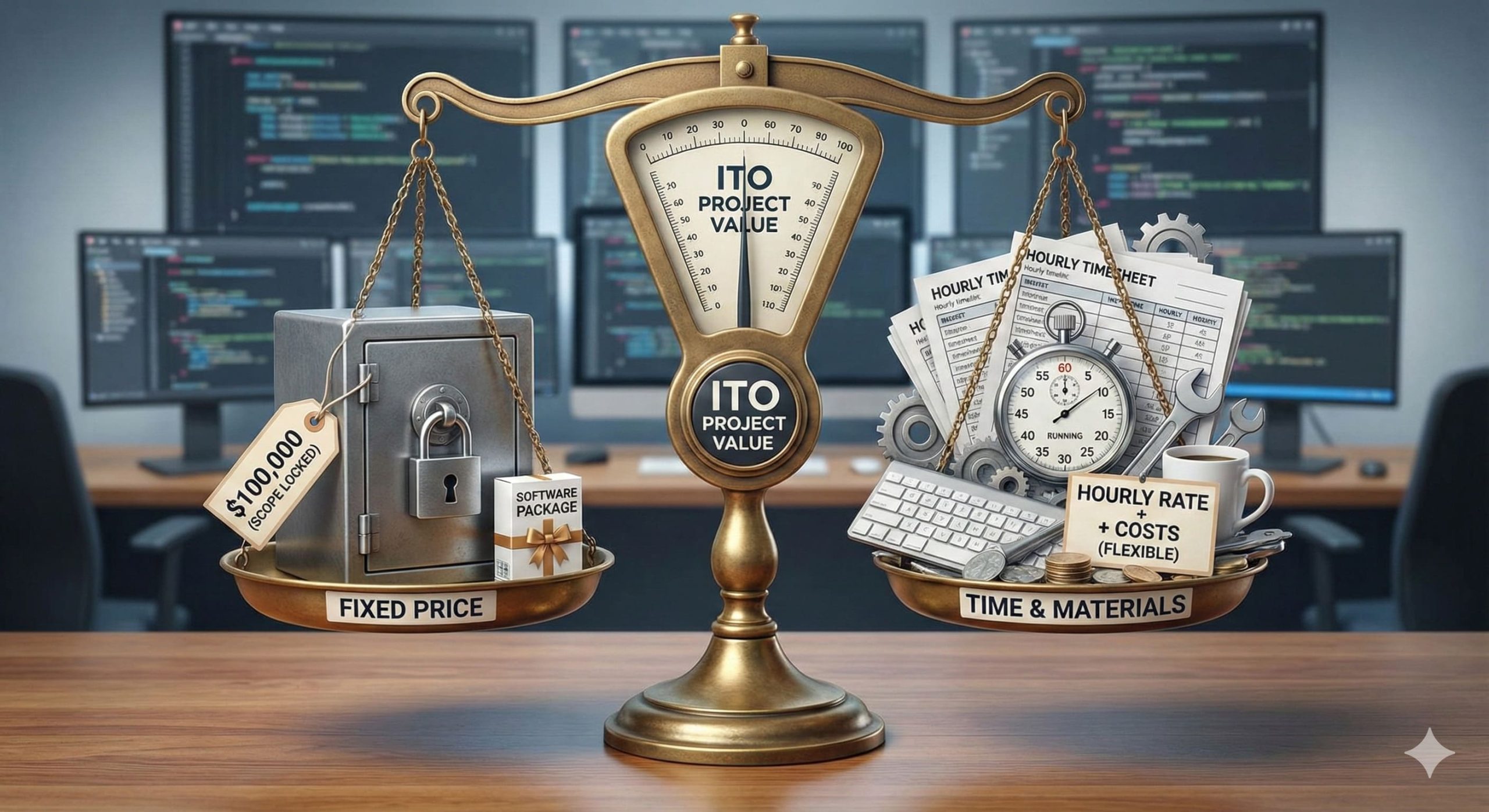
Financial Deep Dive: The “Hidden Taxes” You Must Know
This is the section most proposals won’t explicitly detail. Every model has a hidden cost structure that impacts your Total Cost of Ownership (TCO).
The Hidden Tax of Fixed Price: The “Risk Premium”
Do you believe Fixed Price is cheaper because the number doesn’t change? In reality, to guarantee a fixed price for an uncertain future, professional vendors always add a Risk Buffer.
-
The Reality: This buffer is typically 20% to 30% on top of the estimated effort.
-
Why? Vendors must insure themselves against ambiguous requirements, unforeseen technical debt, or delays.
-
The ROI Impact: If the project goes smoothly, you have effectively paid a 20% premium for safety. Furthermore, every minor change triggers a Change Request (CR) process, which often carries higher administrative fees and slows down time-to-market. You are essentially buying “Budget Insurance.”
The Hidden Tax of T&M: The “Management Overhead”
With T&M, you don’t pay the Risk Premium. You only pay for hours worked. Theoretically, T&M is 15-20% cheaper than Fixed Price. However, the hidden cost lies in Management Overhead.
-
The Reality: T&M requires an active Product Owner (PO) on your side. If your PO is slow to approve user stories, or if you pivot direction too frequently without strategy, the team may sit idle or build features that get scrapped.
-
The ROI Impact: You pay for the team’s time regardless of the output value if you fail to manage them. The “tax” here is your own internal capability to manage an agile process.
Decision Matrix: When to Choose Which?
There is no “best” model, only the right model for your specific stage. Use this matrix to decide.
Choose Fixed Price IF AND ONLY IF:
-
The Scope is Frozen: You have extremely detailed documentation (SRS, Wireframes, Figma) with zero ambiguity.
-
Short-Term Project: The project duration is under 3-4 months (e.g., a simple MVP, a Landing Page, or an internal tool).
-
Hard Budget Cap: You are a Seed-stage startup with exactly $50k to launch, and you cannot spend a penny more.
-
Hands-Off Management: You lack the internal technical resources to manage a daily Scrum process.
Choose Time & Materials IF:
-
Scope is Evolving: You have a vision, but the details will be defined based on user feedback and market testing.
-
Long-Term/Complex Project: You are building a Core Product, an AI/Data platform, or a project lasting > 6 months.
-
Speed is Priority: You need to start coding now rather than spending 4 weeks negotiating contract specs.
-
Transparency is Key: You want full visibility into what the team is doing daily and the ability to pivot priorities instantly.
Strategic Recommendations: The “Hybrid” & “Capped” Approaches
Smart US enterprises often move beyond the binary choice. Here are two advanced strategies we recommend at Bestarion:
Strategy A: The Hybrid Model (Best of Both Worlds)
This approach mitigates the risk of the unknown while preserving agility for execution.
-
Phase 1 (Discovery & Design): Sign a Fixed Price contract. The goal is to produce the UI/UX, Architecture, and Roadmap. This caps your initial spend.
-
Phase 2 (Development): Once the blueprint is clear, switch to Time & Materials for the actual coding. This removes the “Risk Premium” from the most expensive phase of the project.
Strategy B: Capped T&M (The “Not-To-Exceed” Clause)
You want the flexibility of T&M but your CFO screams “Budget Control”? Use a “Not-To-Exceed” (NTE) clause.
-
How it works: “We work on a T&M basis, but the monthly invoice shall not exceed $15,000 without prior written approval.”
-
The Benefit: This forces the vendor to communicate burn-rate risks early, giving you the safety of a ceiling with the agility of hourly billing.
The Investor’s Perspective (VC View)
-
Seed Stage: Investors prefer Fixed Price to ensure the startup doesn’t burn cash inefficiently before having a product.
-
Series A+: Investors prefer T&M. At this stage, Speed to Market and Growth are more valuable than saving a few thousand dollars on scope. T&M allows for rapid iteration, which drives valuation.
Conclusion: The Bestarion Verdict
The battle between Fixed Price and T&M has no absolute winner.
-
If you value Certainty and have a small, defined project: Fixed Price is King.
-
If you value Agility, speed, and long-term product evolution: T&M is Queen.
At Bestarion, we often see our most successful US clients start with a small Fixed Price engagement (to build trust and validate capabilities), and then transition to a Dedicated Team (ODC) or T&M model as they scale up.
Regardless of your choice, transparency is non-negotiable. Ensure your contract clearly defines how prices are calculated, how Change Requests are handled, and which KPIs will be used to measure success.
Expert FAQs (US Market Focus)
Q: Which model helps preserve cash flow better for a startup?
A: Time & Materials (T&M) is generally better for cash flow management. T&M allows you to pay smaller, predictable monthly invoices (OpEx), matching your burn rate. In contrast, Fixed Price often requires large upfront deposits (30-50%) or heavy milestone payments, which can cause significant dips in your working capital.
Q: Why do US Venture Capitalists (VCs) generally prefer T&M for growth-stage companies?
A: VCs prioritize Growth Speed and Adaptability. Fixed Price creates friction: every time you learn something new from the market, you have to stop and renegotiate the contract (Change Request), slowing down development. T&M allows startups to pivot instantly based on user feedback, which is critical for achieving product-market fit and driving valuation.
Q: Can I switch from T&M to Fixed Price in the middle of a project?
A: Yes, but timing is key. It is best to switch to Fixed Price only when the product reaches a “Maintenance Mode” or when requirements become static. Trying to switch to Fixed Price during active, chaotic development usually leads to conflict and reduced quality as the vendor tries to protect their margins against your changing needs.
Q: How do I control the budget in a T&M model if there is no cap?
A: You should insert a “Not-To-Exceed” (NTE) clause or a “Budget Alert” mechanism in the contract. For example, require the vendor to notify you in writing when 75% of the monthly budget is consumed. This gives you the financial safety net of a Fixed Price contract while retaining the operational flexibility of T&M.
Q: Which model has a lower Total Cost of Ownership (TCO)?
A: Over the long term, T&M typically delivers a TCO that is 15-20% lower. This is because in Fixed Price, you are paying a “Risk Premium” (insurance) to the vendor. In T&M, you accept the management risk, but you only pay for the actual hours used to create value, avoiding the buffer costs.
